
International patients please learn more here or call 1.713.441.2340.
Types of Radiation Therapy
Your radiation oncologist will recommend a treatment plan based on your cancer type, location and stage, plus your overall health. Most treatment plans fall into one of two categories: external radiation therapy or internal radiation therapy (brachytherapy).
Internal Radiation Therapy for Cancer
Internal radiation therapy, more commonly known as brachytherapy, places a radioactive source directly within or close to a tumor rather than aiming radiation at it from the outside. Houston Methodist offers advanced brachytherapy techniques that deliver a high dose of radiation to the tumor while limiting exposure to surrounding healthy tissue, often in fewer sessions than external radiation therapy.
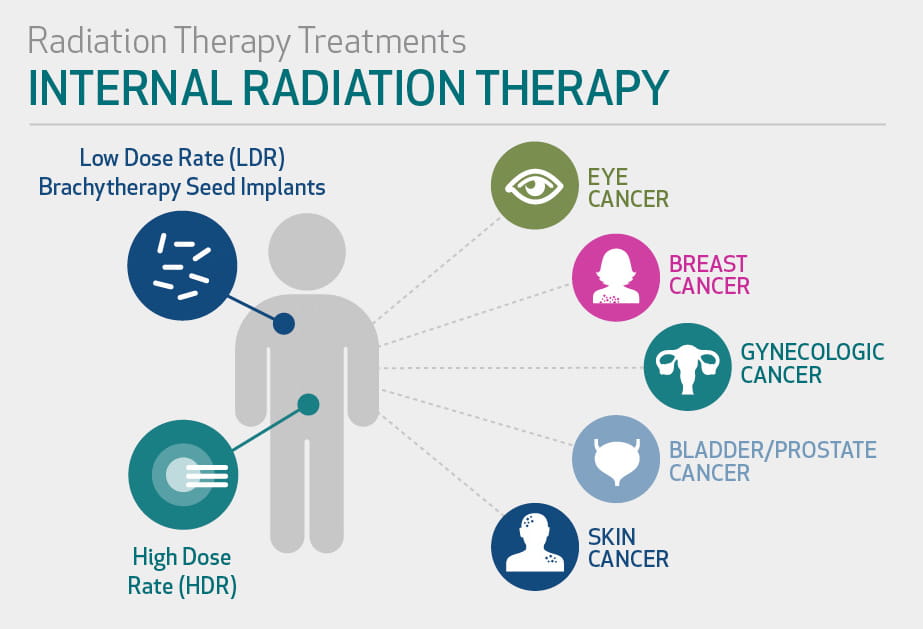
During brachytherapy, your radiation oncologist works with a medical physicist and dosimetrist to calculate the radiation dose and dose distribution, then places the radioactive material (frequently in the form of tiny seeds, pellets or wires) using a thin catheter.
Houston Methodist typically offers the two main types of brachytherapy:
- High-dose-rate (HDR) brachytherapy: High-dose-rate brachytherapy delivers a strong dose of radiation over a few minutes during each session. The applicator is removed afterwards, and treatment is repeated over several visits.
- Low-dose-rate (LDR) brachytherapy: Low-dose-rate brachytherapy places radioactive seed implants that stay in the body permanently, known as permanent brachytherapy, or for a set period of time, releasing a lower dose of radiation gradually as the source decays.
Other types of brachytherapy refer to where the radioactive source is placed:
- Intracavity brachytherapy: Intracavity (or intracavitary) brachytherapy places the source inside a body cavity, like the cervix, uterus or vagina, often to treat cervical cancer, uterine cancer (including endometrial cancer) or vaginal cancer, sometimes following a hysterectomy.
- Interstitial brachytherapy: Interstitial brachytherapy places the source directly into the affected tissue, such as the prostate gland or breast.
Different types of internal radiation therapy may be used to treat:
External Radiation Therapy for Cancer
External radiation therapy or external beam radiation therapy uses a machine called a linear accelerator to aim high-energy X-ray beams at a tumor from outside of the body. Before the treatment starts, your care team uses CT scans and other imaging to map the exact size, shape and location of your tumor so radiation can be precisely delivered. Most patients receive external radiation therapy in a series of short daily sessions, called fractions, usually over the course of several weeks.
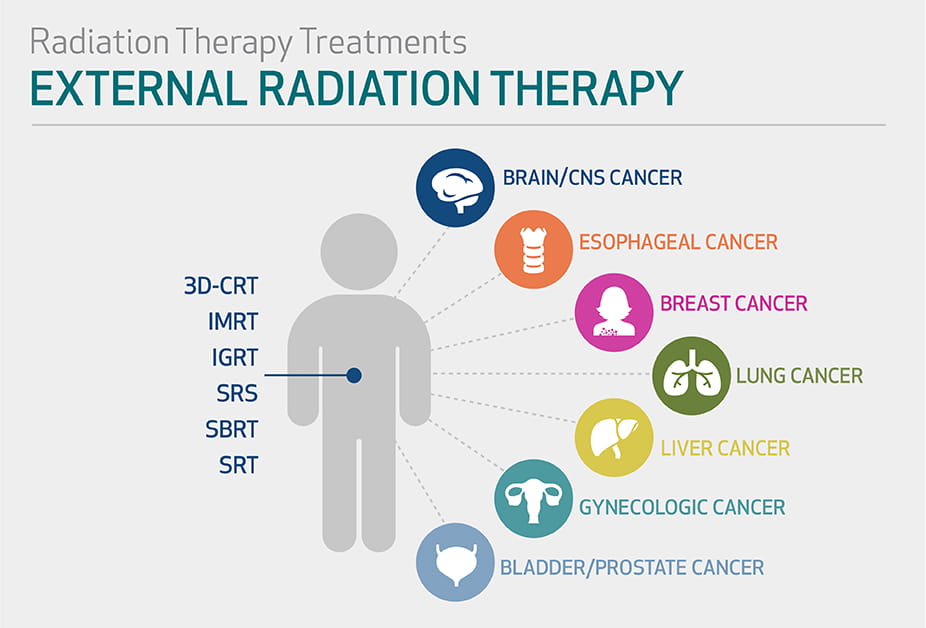
Houston Methodist offers several types of external radiation therapies, including:
- Three-dimensional conformal radiation therapy (3D-CRT): Three-dimensional conformal radiation therapy (3D-CRT) uses computer software and advanced machines to deliver radiation to precisely shaped targets in sites containing a tumor, including the brain, breast, gastrointestinal area, head and neck, liver, lung, and prostate and rectum.
- Intensity-modulated radiation therapy (IMRT): Intensity-modulated radiation therapy (IMRT) uses hundreds of radiation beam-shaping devices to deliver a single dose. The radiation beam intensity can change to allow different tumor areas or nearby tissues to receive varying radiation doses. A computer program calculates the number of beams and angles needed in sites, including the prostate, head and neck, central nervous system, breast, thyroid, lung and gastrointestinal area.
- Image-guided radiation therapy (IGRT): Image-guided radiation therapy (IGRT) uses repeated CT, MRI or PET scans that are performed during treatment to increase target accuracy and spare normal tissue. Learn more about image-guided radiation therapy >
- Stereotactic radiosurgery (SRS): Stereotactic radiosurgery (SRS) uses accurate image-guided tumor targeting and patient positioning to deliver high radiation doses to the brain and lungs to treat brain tumors and lung tumors while limiting damage to normal tissue.
- Stereotactic body radiation therapy (SBRT): Stereotactic body radiation therapy (SBRT) delivers radiation therapy to small, isolated tumors in fewer sessions than SRS using smaller radiation fields and higher doses at sites, including the lungs, liver, abdomen, spine, prostate, breast and head and neck.
- Stereotactic radiotherapy (SRT): Stereotactic radiotherapy (SRT) uses precise image guidance to target tumors over several smaller sessions rather than in one or a few high-dose treatments.
External radiation therapy may be used to treat:
- Brain cancer
- Esophageal cancer
- Breast cancer
- Head and neck cancers
- Lung cancer
- Liver cancer
- Gynecologic cancers
- Bladder cancer
- Prostate cancer
How Radiation Therapy Works
Before your first treatment, your radiation oncologist will create a treatment plan tailored to your cancer type, location and stage. For external radiation therapy, that process usually begins with a simulation appointment, where a CT scan maps the treatment area so your medical physicist and dosimetrist can calculate the dose and angles needed to target the tumor while saving healthy tissue. Treatment is then delivered in a series of fractions using a linear accelerator guided by IMRT or IGRT technology.
For brachytherapy, your radiation therapist places the radioactive source directly in or near the tumor using a catheter or applicator, often with imaging guidance to confirm proper placement. Depending on whether you’re receiving HDR or LDR brachytherapy, the source may be removed after each session or left in place to release small amounts of radiation over time.
Throughout treatment, your care team monitors your progress and adjusts your plan as needed, coordinating with any chemotherapy, immunotherapy or surgery that may also be a part of your ongoing treatment.
Houston Methodist’s Radiation Therapy Technologies
The exact treatment type you receive will depend on numerous different factors. There are great strides being made in radiation therapy for cancer, and our experts are on the leading edge of these technologies:
- TrueBeam: A linear accelerator that delivers powerful, accurate and fast image-guided treatments.
- Novalis: An image-guided radiosurgery system that precisely forms a radiation beam around a tumor while protecting the healthy tissue.
- TomoTherapy: A helical radiation therapy machine that confirms a patient's tumor before treatment and precisely delivers radiation therapy.
- Varian Clinac 21EX: A linear accelerator that provides accurate, full-dose ranges for intensity-modulated radiation therapy (IMRT) and image-guided radiation therapy (IGRT).
- Phillips CT simulator: A CT scanner that provides precise and flexible scanning and dosing delivery.
- Varian high dose rate (HDR) afterloader: A brachytherapy device that includes a computer-based management system allowing for proper placement, replacement and dosing.
Side Effects of Radiation Therapy
The side effects of radiation therapy vary broadly based on the type of radiation you receive, the treatment site and your overall health. Before you begin treatment, you and your radiation oncologist will discuss what you can expect based on your individual treatment plan. Common side effects of radiation therapy for cancer patients may include:
- Fatigue
- Skin changes like redness, tenderness and dryness localized to the treatment site
- Nausea
- Hair loss
- Headaches
- Blurry vision
- Sore throat or cough
- Dry mouth and changes in taste
- Diarrhea
Many side effects are specific to the area being treated with radiation therapy, and most subside or improve within a few weeks of finishing treatment. Your care team can recommend ways to manage symptoms during and after radiation therapy.
Who Is a Candidate for Radiation Therapy?