Spondylolisthesis (Slipped Vertebra)
Houston Methodist spine specialists diagnose and treat spondylolisthesis, also known as a slipped vertebra. This condition occurs when one vertebra shifts forward over the vertebra beneath it. In many cases, spondylolisthesis is mild and can be managed without surgery.
When symptoms occur, they may include lower back pain, stiffness or nerve‑related symptoms in the legs. Early evaluation helps your care team understand the cause of the slippage and determine whether monitoring, non-surgical care or surgery is appropriate. Spondylolisthesis can affect both younger people and adults, though the underlying cause often differs by age.
Our spine specialists work together to create a personalized care plan based on your symptoms, the degree of slippage and your overall health. When surgery is needed, we offer advanced options, including minimally invasive techniques.
What Is Spondylolisthesis?
Spondylolisthesis is a spinal condition that occurs when a vertebra shifts out of its normal position and slides forward onto the vertebra beneath it, potentially compressing nearby nerves and destabilizing the spine. While it can occur anywhere along the spine, it most commonly affects the lumbar region (lower back).
The degree of slippage is typically graded from mild to severe based on how far the vertebra has shifted. In many people, the degree of vertebral slippage remains stable over time and does not continue to worsen.

Ranked #13 in the Nation for Neurology & Neurosurgery
Houston Methodist Hospital is ranked Best in Texas and No. 13 in the nation by U.S. News & World Report for Neurology & Neurosurgery. U.S. News & World Report has also named Houston Methodist Hospital one of the nation's best as a nationally ranked Honor Roll hospital.
Learn More ➝

Ranked #21 in the Nation and Best in Texas for Orthopedics
Houston Methodist Hospital is ranked No. 21 in the nation by U.S. News & World Report for Orthopedics, receiving a high performing rating for back surgery. U.S. News & World Report has also named Houston Methodist Hospital one of the nation's best as a nationally ranked Honor Roll hospital.

Why Choose Houston Methodist for Spondylolisthesis Care?
If spondylolisthesis is affecting your daily life, you deserve clear answers and a path forward. Houston Methodist is home to one of Texas' top-ranked spine programs, where orthopedic spine specialists and neurosurgeons collaborate to deliver advanced, comprehensive care — tailored to your unique degree of spinal instability.
Using advanced imaging and evidence-based approaches, our team develops a personalized treatment plan that may include non-surgical care or surgery.
Common Causes of Spondylolisthesis
Spondylolisthesis can develop for several reasons, depending on age and underlying spine health. Common causes include:
- Herniated or bulging disk
- Bone spurs (osteophytes)
- Spinal stenosis
- Degenerative disk disease
- Spondylolisthesis or spondylosis
- Thickening of spinal ligaments
- Injury or trauma to the spine
Types of Spondylolisthesis
There are four primary types of spondylolisthesis. Each type is based on its cause.
Isthmic Spondylolisthesis
Degenerative Spondylolisthesis
Congenital Spondylolisthesis
Traumatic Spondylolisthesis
Signs & Symptoms of Spondylolisthesis
Symptoms vary widely. Some people have no symptoms, while others experience pain or nerve irritation. Getting evaluated helps determine whether symptoms are related to vertebral slippage and whether treatment is needed.
Lower Back Pain
Persistent lower back pain that may worsen with activity, prolonged standing or bending backward.
Radiating Leg Pain
If nearby nerve roots are compressed, pain, numbness or tingling may radiate into the buttocks or legs, similar to sciatica.
Muscle Tightness
Tight hamstrings can make standing upright or walking comfortably more difficult.
Muscle Weakness
In more advanced cases, nerve compression may cause weakness in the legs, which may affect balance and mobility.
How Spondylolisthesis Is Diagnosed
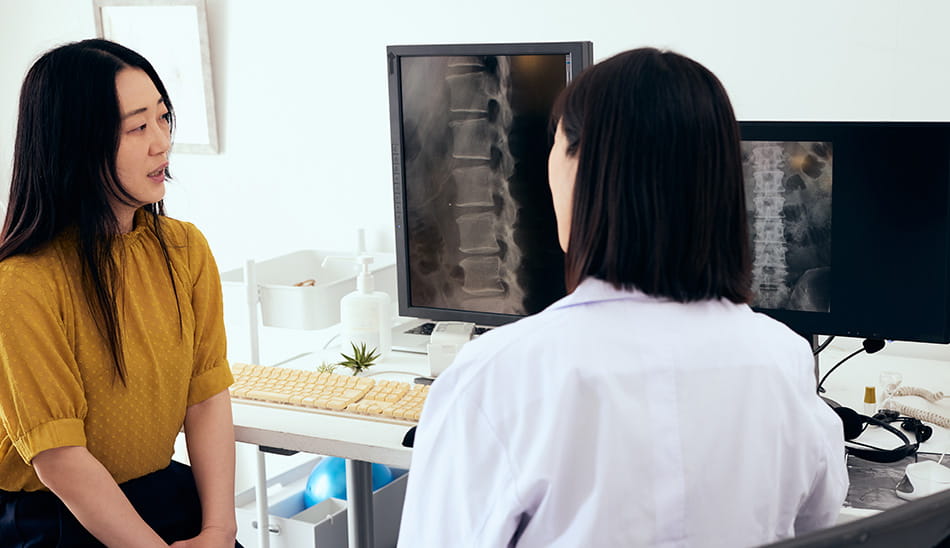
Diagnosis starts with a medical history and physical exam. Your doctor may recommend imaging tests to confirm vertebral slippage and evaluate spinal stability. Severity is typically assessed based on imaging findings, symptoms and whether the vertebra is stable or placing pressure on nearby nerves.
Diagnostic tests may include:
- X-rays – primary tool used for identifying vertebral slippage and grading its severity; flexion and extension views can also assess spinal instability
- Magnetic resonance imaging (MRI) – uses magnets and radio waves to evaluate soft tissue structures, identify nerve compression and assess disk and joint health
- Computed tomography (CT) scan or CT myelogram – creates detailed cross-sectional images of the vertebrae and can detect stress fractures not visible on X-ray
Convenient Spine Care Locations Across the Greater Houston Area
Across Houston, our patients have access to our expert neck, back and spine specialists so that you can get the best possible care personalized for your needs — without traveling far from home. Explore our footprint of locations in the Greater Houston area and suburbs below.