
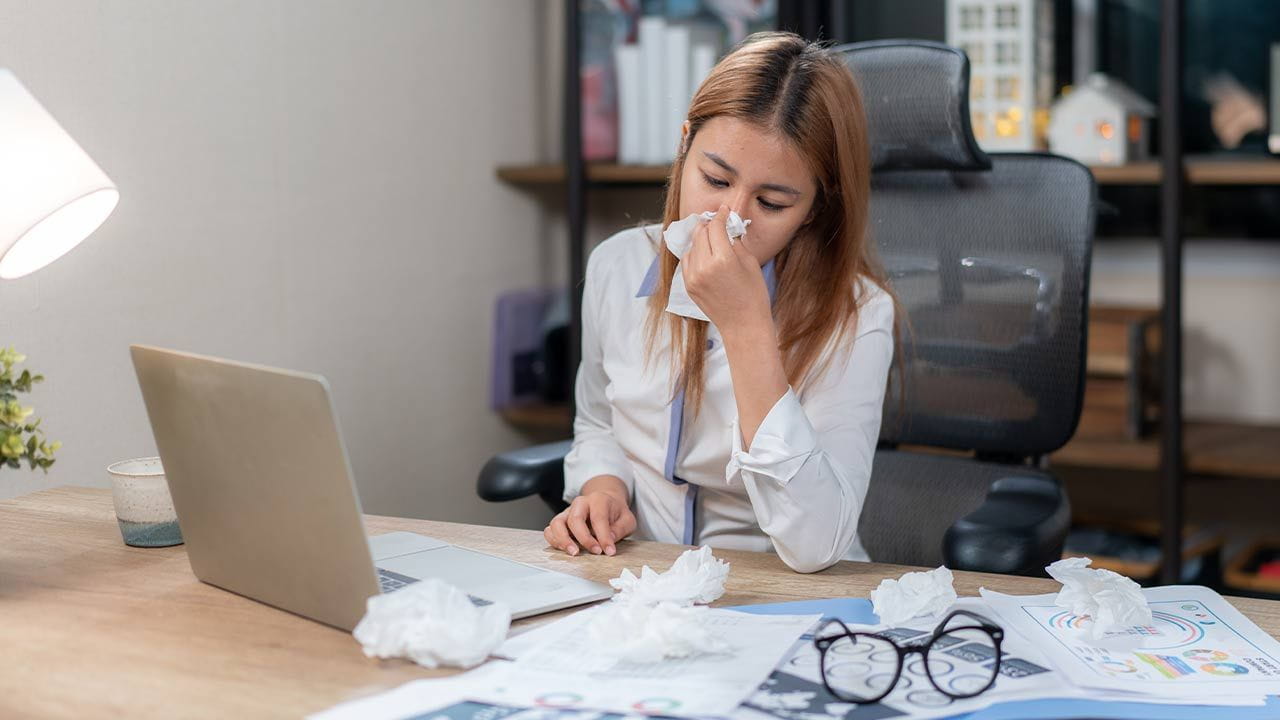

Working through an illness is common enough that most people don't think twice about it. Whether it's the right call depends on a few things worth knowing before you decide.
Adults in the U.S. average two to three colds a year, according to the Centers for Disease Control and Prevention (CDC). These illnesses often seem to crop up at inopportune times, with no consideration for the fact that we’re booked and busy.
Many of us may try to push through sickness anyway: take something for the congestion, drink an extra coffee for a jolt of energy and keep going about our days. But the simple truth is that sometimes our bodies are too taxed fighting an infection to work effectively, go to school or meet the demands of daily life.
So how do you know when you’re too sick for work, and when can you get away with grinding through an illness? We spoke with Dr. Michael Allen, a primary care physician with Houston Methodist, about how to make that call for yourself during cold and flu season, or any time the sniffles might strike.
Which symptoms signal you should take time and rest?
The clearest signal is how you feel overall, Dr. Allen notes. Mild congestion and a runny nose while you otherwise feel reasonably normal is a different situation than feeling lousy while experiencing multiple symptoms.
Certain symptoms should signal time for rest and recovery, not only for yourself but to help prevent others from potentially picking up the same bug.
Fever and body aches
When your body temperature is elevated, it’s a sign that your immune system is activated and fighting against an infection. Normal body temperature is considered 98.6 degrees, although it can vary based on age, time of day, whether you’re exercising or where you are in your menstrual cycle. That said, most healthcare clinicians would classify an elevated temperature as 99 to 100.3 degrees, and a fever as 100.4 degrees and above. Taking your temperature using a thermometer can verify a fever, but the telltale signs are often:
-
Chills, feeling cold
-
Faster heartbeat
-
Feeling tired
-
Experiencing headaches or body aches
-
Feeling flushed, where the skin looks red and may be hot to the touch
-
Sweating without exertion
Fever can be caused by many illnesses, including viral, bacterial or gastrointestinal (GI) infections, as well as a urinary tract infection (UTI). If you have a fever while experiencing multiple symptoms, it’s very likely you are contagious. Staying home and practicing good hygiene — washing your hands, covering your coughs, keeping shared spaces clean — is crucial to helping keep those around you healthy.
Diarrhea
“Was it something I ate?” is a common refrain after experiencing diarrhea, and it very well could be true that something you ate didn’t agree with you. However, if you’re experiencing stomach cramps, nausea, fever and/or vomiting along with watery diarrhea, it could signal stomach flu, also called viral gastroenteritis. The stomach flu is contagious from person to person, or through eating contaminated food or water. Diarrhea can also be caused by exposure to bacteria, such as Clostridioides difficile (C. diff), salmonella and Escherichia coli (E. coli), or a parasite like cyclospora or giardia.
If you’re having diarrhea and don’t know the cause, it’s likely safer to stay home until your symptoms have cleared. Having diarrhea doesn’t necessarily mean you’re contagious to others, but it’s better safe than sorry. Plus, being home, where you have more privacy and control over your environment, may feel better when experiencing GI distress.
Vomiting
Vomiting and diarrhea together can signal stomach flu but can also indicate a foodborne illness. Until you’re sure, it’s best to stay home for 24 hours after the last vomiting incident.
Shortness of breath
Difficulty catching your breath, breathing loudly or wheezing are all signs that could indicate a more serious respiratory infection than a cold. If you have serious trouble breathing, seek immediate care.
Significant fatigue, weakness or dizziness
If you’re feeling extreme fatigue and basic activities require major effort, your body is focusing its energy on healing the infection. This is where the rest component comes into play — sleep, stay hydrated, stay home and limit activities. Staying hydrated and eating can help ward off dizziness and weakness. If you’re feeling dizzy and it’s a new symptom for you, talk to your doctor.
Use your judgment when you start to feel sick
Resting doesn't necessarily require a dark room and a full day of sleep. Dr. Allen tells patients to do what they feel capable of doing, but above all, to pay attention to their bodies.
"If you have some congestion and a runny nose but otherwise feel OK, you do not need to spend three days lying in bed," says Dr. Allen. "On the other hand, if you have a fever, body aches, significant fatigue, dizziness, weakness, shortness of breath, vomiting, diarrhea, or normal activities are suddenly exhausting, your body is telling you something."
What pushing through does to your recovery
Mounting an immune response costs energy, fluids and sleep, and that debt must be paid whether or not your schedule accounts for it. Dr. Allen compares the situation to a computer with too many applications open at once.
"Your immune system is already running a pretty resource-intensive program in the background," he says. "You can keep opening more programs, but eventually everything starts running poorly."
The physical demands accumulate quickly when you’re sick. Fever increases your fluid needs while a reduced appetite means you're taking in less food and drink. Coughing and congestion interrupt sleep, which you need for recovery. Vomiting and diarrhea pull out both water and electrolytes. Add a full workday, a workout and errands on top of it, and the body is being asked to do more than it is capable of at the moment.
This bears out in performance data. Studies on presenteeism, aka working while sick, show that individuals who work while sick have productivity reduced by one-third or more and exhibit reduced focus, slower decision-making, and more mistakes. Plus, pushing through and working while sick can make someone more likely to miss work due to illness in the future.
According to Dr. Allen, people who try to push through often feel worse, dehydrate more easily and have less in reserve if the illness turns out to be more significant than when it first appeared.
“Your body can only do so much,” he says. “You cannot expect your body or mind to perform at 100% while also trying to fight an infection.”
What can help when you're recovering at home
Treating colds at home is about comfort while your immune system handles the virus, since there's no cure and these infections generally resolve on their own in under a week. Fluids, sleep and whatever food you can tolerate do most of the work. Beyond that, a few over-the-counter options can make the days more bearable:
-
Acetaminophen or ibuprofen for fever, headache and body aches, when those are safe for you
-
Saline sprays or rinses for congestion
-
Honey for cough in adults and children older than one year old
-
Decongestants, which help some people
Two cautions carry more weight than most people give them. The first is that just because a medicine is available without a prescription doesn't mean it’s safe for everyone. Some decongestants aren't appropriate for people with certain heart conditions or uncontrolled blood pressure, and anti-inflammatory medications may not be appropriate for individuals with kidney disease and other conditions.
"One thing I tell patients all the time is that over-the-counter does not mean harmless," Dr. Allen says. "There are directions and warnings on them for a reason."
The second is accidental double-dosing, which happens most often with combination cold products.
"Acetaminophen is hiding in everything," Dr. Allen says. "People can accidentally take Tylenol, then a cold medicine containing acetaminophen, then another nighttime product containing acetaminophen and have no idea they have taken the same medication three times."
Why antibiotics don't work on most illnesses
When you’re feeling miserable, you might wonder if taking a course of antibiotics might clear everything up. But the reality is that many common respiratory illnesses, including colds, influenza, COVID-19 and most cases of acute bronchitis, don’t respond to antibiotics.
The gap between how sick people feel and what will help them is a big part of why the CDC estimates that at least 28% of antibiotics prescribed in outpatient settings are unnecessary. Taking a course of antibiotics when it’s unneeded could leave you still feeling sick, with a potential added burden of side effects.
“If you have a virus, an antibiotic gives you all of the potential side effects without treating what actually made you sick,” Dr. Allen says. “You can get diarrhea, allergic reactions, yeast infections and contribute to antibiotic resistance. Meanwhile, the virus does not care that you took amoxicillin.”
Dr. Allen reminds us that more medication does not mean better treatment.
"I am not trying to just give you medication. I am trying to give you the right treatment," Dr. Allen says. "If you have bacterial pneumonia, strep throat, or another bacterial infection that requires an antibiotic, then absolutely, I want to treat it."
When can you go back to work or school after being sick?
For respiratory viruses, the CDC advises returning to normal activities once two things have been true for at least 24 hours: your symptoms are improving overall, and you haven't had a fever without using fever-reducing medication. Both conditions have to be met, and the 24-hour clock restarts if a fever returns after you've gone back. Dr. Allen applies the same standard with his patients.
Meeting that threshold typically means you're less contagious, not that the virus is gone. Your body may still be clearing it, which is why the CDC recommends five days of added precautions after you return — masking, distancing where practical and consistent hand hygiene. These precautions help protect everyone, but especially those at higher risk of severe illness.
Easing back into exercise and heavier activity
Being able to work doesn't necessarily mean you're cleared for everything on your calendar. Dr. Allen suggests rebuilding gradually rather than returning to full intensity the moment you're upright.
"You might be ready for a normal workday before you are ready for your hardest workout at the gym or weeding the garden," he says.
[Internal link: Working Out While Sick: Should You Push Through or Rest?]
What happens if you go back too soon?
Going back to your regular full schedule too early can set you up for a bad day. Dr. Allen says most people make it through half a day before realizing their body wasn't ready.
“Most of the time, nothing dramatic happens. You just feel terrible while doing those activities,” Dr. Allen says. “There is also the issue of everybody around you. If you are still contagious, pushing through does not just affect you. Now your coworkers, patients, classmates, or family members get invited to participate in your illness too.”
What to do if time off isn't an option
A fair number of people can't stop when they get sick, whether that's because of a job without paid leave, young children at home or a shift nobody else can cover. And let’s not pretend that “presenteeism pressure,” the implied pressure to work when sick, isn’t a very real experience in many workplaces, even when paid sick leave is available.
Dr. Allen is direct about the limits of the standard advice in these situations.
"Telling a parent with young children to 'just stay in bed and rest' may be completely useless advice," he says. "Same thing for someone who does not have paid sick leave. If you have to keep going, prioritize."
Dr. Allen suggests treating your energy as a limited budget while you're sick. Spend your energy on the tasks that must get done no matter what and skip all optional errands and activities (including exercise). Use the time you might get back (even if in short spurts) for things that support your recovery: sitting and resting when you can, drinking water, eating, taking breaks and going to bed earlier than usual.
If you’re caring for kids or other loved ones, Dr. Allen also recommends habits that can help you avoid sharing the sickness with everyone in the household.
For a respiratory illness, masking, hand hygiene, ventilation and some physical distance all help. With vomiting and diarrhea, wash with soap and water specifically because many stomach viruses are extremely contagious, and alcohol-based sanitizer is less reliable against norovirus in particular.
[Engagement Card]
Take recovery seriously as complications can develop
Most viral illnesses run their course without incident, though there are exceptions worth recognizing. A respiratory infection can develop into pneumonia or set off an asthma flare. Influenza and COVID-19 can cause complications in the lungs or place real strain on the heart. Vomiting and diarrhea can dehydrate someone severely enough to affect kidney function.
The risk of complications with respiratory infections can increase with age and certain conditions. But Dr. Allen is quick to mention that some risk of complication exists, no matter our age or current health status.
"Being young and healthy gives you better odds, but that is what they are: odds," Dr. Allen says. "They may not always be in your favor."
Pay attention if you improve and then get worse again
One pattern deserves particular attention: an illness that appears to be resolving and then reverses course. Dr. Allen calls this double sickening, and it can indicate a secondary infection on top of the original one. A change in direction carries diagnostic information that a steady decline doesn't, which is why he asks patients to call when it happens rather than wait it out.
"I warn patients about what I call 'double sickening': you start getting better, then turn around and get worse again," he says. "That change in direction is useful information and sometimes means we need to take another look."
When to see a doctor about a cold, flu or stomach bug
No universal checklist exists, since the right threshold depends on the person and the illness. Dr. Allen wants to hear from patients when an illness is unusually severe, isn't improving on the timeline he'd expect or changes direction.
“'I was getting better, and now I'm getting worse,’ always gets my attention,” Dr. Allen says.
Symptoms worth an evaluation include:
-
Persistent fever
-
Significant dehydration, repeated vomiting or an inability to keep fluids down
-
Worsening shortness of breath
-
Significant sinus, throat or ear pain
-
Worsening of an underlying condition such as asthma or COPD
-
Symptoms lasting around 10 days without improvement
Difficulty breathing, significant chest pain or pressure, confusion, an inability to stay awake, severe weakness or an inability to stay hydrated requires urgent or emergency care.
Timing carries its own consequences. Someone with influenza or COVID-19 who is at increased risk of complications can access antiviral medications that work best when started early. Waiting a week to talk to a doctor can mean the useful treatment window has closed.
"Trust your gut and listen to your body," Dr. Allen says. "If something just does not feel right, then see the doctor."
When a video visit isn't enough
Telemedicine handles a wide range of questions well and can be a great way to be seen by a clinician easily without a commute or serious schedule disruption. When you’re sick and want answers, it may be frustrating to be told you need to go into the office to be seen. But there’s a reason for it — clinicians don’t want to upend your day — they want to make sure you get the right treatment.
"I cannot properly listen to your lungs through an iPhone," Dr. Allen says. "I cannot get an accurate oxygen level unless you have the equipment. I cannot examine your throat particularly well, feel your lymph nodes, assess certain signs of dehydration, or get a chest X-ray or testing if I think you need it."
A request to come in after a video visit reflects information a clinician can't safely gather through a screen. Following through on it is what turns the visit into a diagnosis. This can be especially important when you’ve been battling an illness on your own for some time, or symptoms suddenly worsen in the “double-sickening” scenario.
Rest is an essential part of treating a respiratory illness
The reality is, there are no blue ribbons or trophies awarded for white-knuckling your way through illness. If anything, it can extend how long you stay sick, reduce your productivity and make everyday activities harder.
“I want people to understand that resting when you are sick is not being lazy; it’s part of the treatment,” Dr. Allen says.
At the same time, Dr. Allen acknowledges that most people do not need to (or simply cannot) shut their entire lives down when they’re sick.
“If you are steadily improving, great. Keep doing the basics and ease back into normal life,” he says. “If you are getting worse, not improving when you should be, becoming dehydrated, having trouble breathing, or the illness takes a turn after you thought you were getting better, that is when I want you to stop trying to ‘push through’ and get evaluated.
“The body is usually pretty good at telling us when something is wrong,” Dr. Allen says. “The trick is actually listening to it.”