

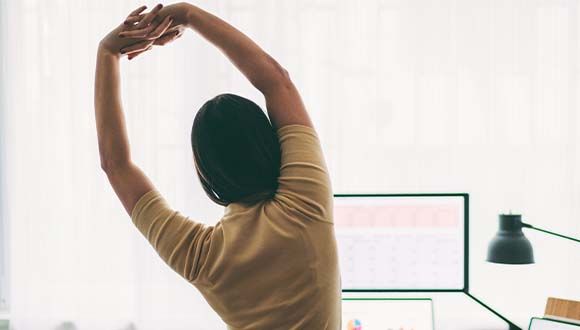
Do you work at a desk, have a long commute or enjoy a good rot on the couch after a busy day? If so, you’re like most Americans, who clock an average of 9.5 hours per day sitting (sedentary), according to the American College of Sports Medicine. The body keeps the score, as the saying goes, so if you ever notice hip stiffness, lower back tightness, neck pain or just feel sluggish, there’s a good chance your body is telling you it needs to move more often.
Getting more movement throughout the day doesn’t necessarily mean signing up for a gym membership or a brand-new workout routine. To help clarify how we can sit less and move more, we spoke with Dr. Armida Celeste Gavino, a primary care physician at Houston Methodist, about sedentary behavior, how prolonged sitting affects the body and the simple ways movement can fit into our busy days.
Why sitting less matters (even if you work out)
Research shows that a sedentary lifestyle increases the risk for many conditions, including obesity, heart disease and cancer. When we sit for long stretches, the body conserves its energy by burning fewer calories because it doesn’t need to provide us with energy. Over time, this can lead to slower metabolism, weight gain and increased fat storage.
“Moving often and being more active helps with our metabolism, and it also decreases the risk for development of chronic diseases,” Dr. Gavino says.
Being inactive for just over 10 hours per day showed an increased risk of heart failure, heart disease, stroke and dementia. It’s also been shown to increase the chances of developing heart disease risk factors such as hypertension. Plus, other research shows that being inactive for long stretches also increases the risk of certain cancer types, including colorectal cancer, uterine or endometrial cancer, lung cancer and prostate cancer.
Dr. Gavino also says that inactivity can be especially relevant for people with certain health conditions.
“Being inactive can decrease insulin sensitivity, which can be especially worse for patients with known prediabetes, diabetes and heart disease,” Dr. Gavino says. “For patients with arthritis, if they are inactive, they can feel more pain and stiffness in their joints.”
If you’re reading this thinking, “I don’t have to worry, I work out!” there is bad news coming. Unfortunately, a workout first thing or later in the day doesn’t automatically undo a full day of sitting with minimal breaks.
“If you sit for eight hours straight with very minimal breaks and then go to the gym after, even if you were to exercise for two or three hours, it does not negate the fact that you were sitting your entire workday,” Dr. Gavino says.
The research bears this out, even if you meet the recommendations outlined in the Physical Activity Guidelines for Americans: 150 minutes of moderate-intensity aerobic activity or 75 minutes of vigorous activity plus two days of strength training. So even if you are working out every day, you still need to move regularly during the day.
What counts as a ‘sedentary lifestyle,’ exactly?
“The definition of sedentary would just be a period of inactivity,” Dr. Gavino says. “For example, sitting for prolonged periods of time while working, watching TV, playing video games, scrolling on the phone, or even sitting in transportation in a bus or car during your commute.”
Sedentary behavior is less about whether you ever exercise and more about how long you go without moving. Your lifestyle can be considered sedentary if you have an inactive period as short as four to six hours — shorter than a full workday. Also, these hours don’t need to be consecutive to work against your active lifestyle goals. Getting fewer than 5,000 steps in a day can also signal that you’ve been sedentary.
Signs you might be sitting too much
You might not always recognize the subtle signs or associate it with your workday or commute, but eventually, these day-to-day aches and annoyances can slowly become your “normal.”
Posture suffers, causing aches and pains to develop
“Posture can suffer if you’re not paying close attention to it because when you’re sitting for a long time, you really just end up slouching without being aware of it,” Dr. Gavino says. “This can lead to your hips feeling tight, lower back pain and feeling like you don’t have control of your core.”
Dr. Gavino says posture problems can further lead to pain and stiffness in the back and neck, as well as lower leg swelling and sluggishness. Bad posture is a habit that’s easy to fall into, but it is possible to fix.
RELATED: QUIZ: Are You Making These Bad Posture Mistakes?
Your mood may feel off
If you’ve ever noticed that you feel more tired, anxious, low or foggy after a day you barely moved, you’re not imagining things. Dr. Gavino shares that a sedentary lifestyle can contribute to mood issues.
“Having a sedentary lifestyle absolutely can lead to mood issues like depression and anxiety. Regular movement can really combat this by raising your endorphins and increasing neurotransmitters like serotonin and dopamine, which can definitely improve the mood," she says.
Want an even bigger mood boost from movement? Go outside. The physical and mental health benefits of spending time in nature are well-documented, and even 10 minutes per day can add up.
Strategies to move more during the day
Breaking up the day with bursts of movement is the best way to combat sedentary stretches. Taking more steps during your day helps, too. The oft-cited 10,000 steps is a good overall goal, but the true sweet spot is 7,000-8,000 steps. A 2025 study published in Lancet Public Health found that people who take at least 7,000 steps a day had a 25% lower risk of heart disease. Another study showed that people who took 7,000 steps regularly had between 50-70% less chance of dying than those who took fewer steps in their day.
Dr. Gavino points to what she calls “quietly effective” habits that add steps and movement to our days without requiring movie-montage-level motivation: parking farther from our destination, taking the stairs and a practical sit-break routine. All of these can help get you to 7,000 steps.
Park as far away from your destination as possible
In a perfect world, we could all safely walk or bike to run errands as people often do in Blue Zones. But most Americans rely on cars, so parking as far away from a building entrance can give you the opportunity to get some extra steps in. And, if you can, try to carry your groceries to your car without using a cart for a brief boost of strength training.
Start a sit-break routine (a minute of movement is enough!)
“My usual recommendation for a simple sit-break routine is for every 30 minutes of sitting, take five minutes to do some kind of movement,” Dr. Gavino says. “Get up, stretch your legs, take a walk, climb some stairs, do stretches, squats or other exercises you can easily do in place.”
And if five minutes feels unrealistic at first? Dr. Gavino says one minute still counts.
“A five-minute break is great, but one is good enough to start,” she says. “One minute has 60 seconds, right? If you can do 10, 15, 30 squats during those 60 seconds, it can still have an impact.”
If you’re thinking, “OK, but what do I do for that minute?” Dr. Gavino lists several simple options that don’t require equipment and can be completed in an office setting, even if it may feel a little awkward.
“Jumping jacks can be done quietly. Running in place, arm circles, leg lifts and squats can all be done standing in place,” Dr. Gavino says. “You can get up and walk to the bathroom; you could walk to the nearest stairwell and walk up and down a flight of stairs.”
Take the stairs, even if you don’t need to
She also suggests simple “challenge” ideas like adding extra stair trips if you live in an apartment or using office stairwells during a break to get your heart rate up.
“A way to challenge yourself would be to, instead of taking just one flight of stairs, see if you can do it two more times so you’ll climb three flights,” Dr. Gavino says. “For example, we have a stairwell where I work. During my lunch break, I’ll go up and down, up and down the stairs, because that’s the only time I can actually get my heart racing during my workday.”
Use a standing desk or under-desk bike
Using a standing desk while working (if your job allows) can be an effective way to sit less. But, even if you use a standing desk, you’ll want to make sure you’re still moving around every hour. Using a standing desk alone may not lower the risk of heart risk factors, according to a 2024 study from the British Medical Association.
To get further health benefits from a standing desk, Dr. Gavino suggests adding a walking pad under it.
“I often recommend a standing desk and a walking pad to patients,” Dr. Gavino says. “Walking pads can be an affordable option to get steps in while you work.”
She acknowledges there can be a learning curve (especially if you’re typing), but adds there are other under-desk options that may feel more manageable for some people.
“There are also under-desk bicycles that allow you to move your legs and pedal as you would seated on a stationary bike,” Dr. Gavino says. “These can be a great option to get movement in without a dramatic alteration of your workspace.”
How to get movement on your lunch break (without extra time)
If your day is packed with back-to-back meetings, lunch can be one of the easiest places to “find” time for movement without changing your schedule. Dr. Gavino suggests splitting a 30-minute lunch into movement and eating.
“Another tip that I can give is if you have a 30-minute lunch break, take 15 minutes of the break for eating your lunch, and the next 15 minutes would be for a walk.”
Dr. Gavino’s tip offers dual benefits. Not only will you get more steps, but post-meal walks, a practice popular with the fibermaxxing crowd, can help kickstart your digestion and protect against blood sugar spikes.
“It may seem like a sacrifice, right?” Dr. Gavino says. “But you will be surprised that 15 minutes of walking can give you 1,000 or 2,000 steps that you wouldn’t get just sitting, eating lunch.”
Plus, taking a lunch break walk outside can help you take a mental break before diving back into the workday.
“If I have extra time, I walk outside, and it helps me like check out a little bit,” Dr. Gavino says. “Then, I come back refreshed and ready to start again.”
How to get started & when to talk to your doctor
Much like restarting exercise after a break, start small and build from there. Schedules will vary Monday through Friday, and that’s OK. Add movement where it fits into your day planner — stairs, parking farther away, a short lunch walk or a few squats beside your desk.
“Any type of movement that we can incorporate during everyday life will pay off in the long run,” Dr. Gavino says. “Standing more, walking more, all movement is medicine.”
Dr. Gavino advises talking with your doctor about increasing your activity if you notice certain symptoms.
“If someone experiences shortness of breath, any wheezing, chest discomfort, weakness or dizziness, I suggest they talk to their doctor before starting a new routine,” Dr. Gavino says. “It’s important to rule out certain medical conditions with those symptoms.”


