

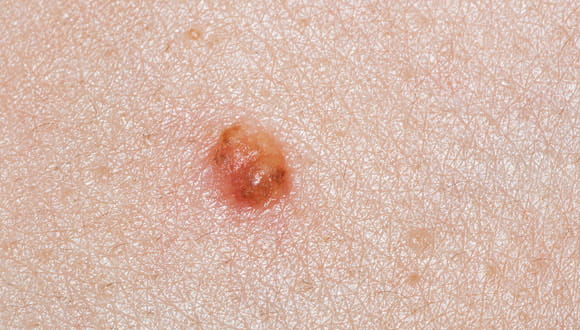
What Skin Cancer Looks Like & When to See a Doctor
Jan. 28, 2026 - Katie McCallumMost people notice small changes in their skin — a new freckle, a dry patch, a mole that looks a little different. But when should you be concerned that a spot might be a sign of something more serious?
Skin cancer is the most common form of cancer in the U.S., affecting as many as 1 in 5 Americans in their lifetime. It can start subtly, often without highly noticeable signs.
“Most skin cancers don’t hurt, and they don’t usually cause dramatic symptoms,” says Dr. Kelvin Allenson, an oncologist at Houston Methodist. "That’s why awareness and regular self-checks are so important. Knowing what’s normal for your skin is the best way to catch potential problems early.”
What are the most common signs of skin cancer?
The clearest warning sign of skin cancer is a change on your skin, especially a new growth or a sore that doesn't heal. Though it can appear in many different forms, there are some common skin cancer signs to watch for:
A new growth or mole, or a change in appearance of an old mole
A sore that doesn’t heal after a few weeks, or one that seems to heal and then returns. It may bleed, ooze or crust over.
A patch of skin that's a different color and becomes darker or changes color
A flat pink/red or brown-colored patch or bump that may look like a scar
Skin cancer can affect people of all skin tones. On darker skin, skin cancer often appears in areas that are not regularly exposed to the sun and may present as dark, glossy bumps or patches or as a dark band under a fingernail or toenail.
“Changes can occur anywhere, such as between your toes, on your genitals and even inside your mouth,” Dr. Allenson says. “If something on your skin just looks or feels off — even if it’s not painful — get it checked.”
(Related: Is Itchy Skin Related to Skin Cancer?)
What are the different types of skin cancer?
There are three main types of skin cancer, and they look and grow differently:
Basal cell carcinoma (BCC) is the most common type of skin cancer. It often looks like a small, shiny, dome-shaped bump that is pearly, waxy, or clear.
Squamous cell carcinoma (SCC) is the second most common type. You might notice a firm red lump, a raised, dull-red lesion or a scaly patch that may bleed, itch or become crusty.
Melanoma is less common but is the most serious form of skin cancer because it is more likely to spread beyond the skin. It can look like an irregular, multicolored mole or a new dark spot.
Skin cancers are strongly linked to cumulative, lifetime UV exposure, including sunlight and artificial sources like tanning beds.
A rare type of skin cancer called acral lentiginous melanoma occurs only on the palms of the hands, soles of the feet or under the nails. This type is not typically linked to UV exposure and is the most common form of melanoma in people with dark skin.
(Related: 8 Ways to Reduce Your Cancer Risk)
When should I see a doctor about skin changes?
Schedule a skin exam if you notice any of the following:
Any spot that changes, itches or bleeds
The appearance of any new growth
Any patch or sore that heals and then comes back
“Don’t discount even minor symptoms,” says Dr. Allenson. “A lesion that bleeds on its own or a patch that becomes itchy deserves attention.”
Some areas, such as your scalp or the backs of your legs, can be hard to monitor. Ask a partner or family member to help check those spots. Talk with a doctor about annual full-body exams if you have 50 or more moles, a weakened immune system or a history of skin cancer.
(Related: Skin Tag vs. Mole: How Can You Tell the Difference?)
How will I know if an existing mole or spot is cancer?
“Most moles stay stable over time,” Dr. Allenson explains. “If something starts to change, whether it’s growing, itching or changing color, that’s a red flag.”
To monitor for melanoma, follow the ABCDE rule:
A = Asymmetry: One half of the spot does not match the other half
B = Border: The edges are irregular, blurry or ragged
C = Color: The color is uneven, and shades of black, brown, tan, white, red or blue may be present
D = Diameter: The spot is typically larger than 6 millimeters (about a quarter of an inch, or the size of a pencil eraser)
E = Evolving: The most important sign, this is when the mole is changing in size, shape, color or texture.
"The ABCDE test should be used for screening purposes," says Dr. Allenson. "If you or your primary care doctor is looking at a mole and can answer yes to any of these questions, this should prompt an evaluation by a dermatologist."
(Related: When Should I Worry About a Mole?)
How is skin cancer diagnosed?
Diagnosis starts with a thorough skin exam. Your provider may use a magnifying tool called a dermatoscope to help identify suspicious features.
If a spot looks concerning, the next step is a biopsy to confirm whether cancer cells are present. Your provider will take a small sample of tissue and send it to a lab for testing.
“It might be a shave biopsy using a tool similar to a razor blade, or a punch biopsy using a small hollow tool to extract a small core of tissue,” Dr. Allenson says. “Both are quick, in-office procedures, performed with local anesthetic, that allow your doctors to make a definitive diagnosis.”
(Related: How Often Should You Reapply Sunscreen?)
What are the treatment options for skin cancer?
Treatment for skin cancer is customized and depends heavily on the type of cancer, its stage and its location. In many cases, if the cancer is small and caught early, surgical excision will be the primary treatment.
Common treatment options include:
Surgery: Methods like Mohs surgery (removing thin layers until all cancer is gone) or excisional surgery (removing the tumor and a margin of healthy tissue). Early-stage basal and squamous cell cancers and melanoma can often be cured with minor surgery.
Local treatments: Cryotherapy (freezing with liquid nitrogen), curettage and electrodesiccation (scraping and burning remaining cells) and topical chemotherapy.
Advanced treatments: For more advanced or aggressive skin cancers, options may include immunotherapy, systemic chemotherapy and sometimes radiation therapy.
“Most skin cancers including basal and squamous cell cancers and melanoma are cured with surgery,” says Dr. Allenson. “Melanoma is the most serious of the skin cancers and requires more rigorous staging evaluation and post-operative surveillance. Some patients with melanoma, including those with thicker tumors and those with spread of the tumor to lymph nodes, will receive immunotherapy, which has dramatically improved survival in patients with more advanced disease.”
(Related: Skin Cancer Treatments & Removal Procedures)
Get to know your skin
Examine your skin regularly, know the ABCDEs of melanoma and don’t ignore changes, even small ones. And remember that most skin cancers are highly treatable when found early.
“Don’t panic about every mole or freckle,” Dr. Allenson says. "Just stay familiar with your skin, use sun protection and get checked when something doesn’t look right. Regular screening visits with a dermatologist should be a part of your health maintenance and primary care.”


