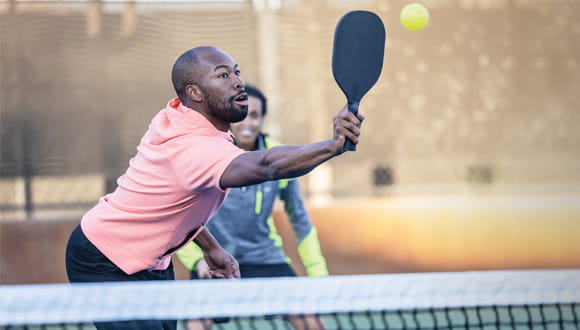


Most pickleball injuries don't start with the swing. They happen during the first explosive step toward the ball.
Pickleball is a great low-impact game that almost everyone can play. But once you step on the court, the game can get dynamic in a hurry. The ball skips, angles change and your lower body has to react even faster.
The key is proper footwork. Not only is it crucial to win games but it also prevents injuries that can keep you off the pickleball court.
We talked with Dr. Haris Vakil, a sports medicine doctor at Houston Methodist, about pickleball footwork, including the specific movements that can lead to injury and how to build fundamentally safe habits to withstand the lightning fast activity.
Move first, hit second: the foundation of safe pickleball footwork & play
Controlling your lower body movements, especially footwork, is key to playing pickleball well and avoiding injury. Casual players don’t need to practice fancy footwork, though. Rather, it’s about small strides, finding your balance and shot position before you swing.
“Good footwork in pickleball means small, quick strides, aiming to get your body behind the ball rather than reaching or lunging,” Dr. Vakil says. “In general, moving first, hitting second.”
This means as soon as you see or hear the opponent strike the ball, your feet should already be on the move, with the goal of squaring your body so you can swing the paddle from a stable base. Ideally, your feet are planted and you're all but stationary, when your paddle makes contact with the ball.
“It’s all about balance. If you find yourself reaching, or having to lean for a swing, you haven’t positioned well enough.”
Dr. Harris Vakil
Sports medicine doctor at Houston Methodist
Moving to the ball, getting in position, then hitting solves two problems at once, according to Dr. Vakil. It sharpens shot quality and reduces off-balance, last‑second leans and twists that overload the body’s soft tissue.
“Your legs have to get there first,” Dr. Vakil says. “Reaching from a poor position mixes rotation with a sudden burst of movement, and that is exactly how calves, Achilles tendons, hamstrings and knees get stressed.”
Use diagonal movement to safely set up your best shot
In addition, thinking about the direction you move to set up your shot is important.
“The game isn’t so linear where you move north to south or east and west," Dr. Vakil says. "It’s almost like you move in diagonals: northeast, northwest, southwest, southeast. Take a scenario where a ball gets hit to you and you judge it’s going behind you and to the left. You’re not going to take steps to the left and then step backward. You’re going to do a diagonal back‑into‑the‑left motion.”
On most volleys, your best route to the ball is to cut the diagonal (the “hypotenuse” of the triangle), according to Dr. Vakil. That way, you can arrive beside the bounce, not behind it. Even when the ball seems to be coming straight at your body, drifting straight back will jam your swing. For increased power and comfort at contact, you still want a small angle to the side.
So how can we cut the diagonal safely? Lateral movement is a trained skill, Dr. Vakil says. If you notice you tend to turn and chase while playing, make time for drills that teach your feet — not your spine — to do the repositioning.
“Lateral shuffles and side-to-side lunges are some of the best dynamic exercises that emphasize hip stability and lower extremity strength,” Dr. Vakil says. “Most traditionally athletic individuals would rather turn their full body to chase rather than move side to side because that is more difficult and requires more training.”
(Related: Signs of Weak Glutes & How to Strengthen Them)
Common pickleball injuries (and what you can do to try to prevent them)
Most pickleball injuries aren’t about tripping or awkward landings. They often happen at the start of the movement, the very first push when you realize the ball isn’t coming to you and you have to move quickly.
“If I see that the ball is going to be very far to my right, I’m pushing off very hard on my left side to generate the force to go to my right," Dr. Dakil says. "People have had bad Achilles and calf issues with that drop step, or negative step, where they use that step to generate the force of moving their body. Since your legs have to get there first, you can’t reach for it. Twisting along with the burst, depending on how much you’re leaning, sends the force to the calf, Achilles area or the knee or hamstring area. Those are by far the most common injuries.”
Dr. Vakil breaks down what you can do to try to avoid the most common pickleball injuries.
- Drop step → calf/Achilles strain – That quick “negative” step to generate force can overload the calf-Achilles complex. Replace panicked drop‑steps with an early first step toward the diagonal and shorter, choppier strides that keep you centered.
- Backpedaling or sudden bursts → hamstring strain – If you are late to the ball and try to salvage with a sprint or backpedal, the hamstring takes the hit. Read the ball as it leaves the opponent’s paddle, turn the hips and run the diagonal rather than straight back.
- Sudden stops or sharp cuts → knee ligament stress – Arriving late forces a hard brake and twist. Start moving earlier, plant under your center of mass and use shuffles to control speed into the shot.
Upper‑body injuries can also happen when the lower body does not arrive in time to your shot.
“Upper extremity injuries can happen too,” Dr. Vakil says. “Erroneous reaching, swings or poor body control can force the back or shoulder to jerk, twist or rotate. Ultimately, this is a consequence of limited footwork and body positioning.”
[Related Content]
Wear pickleball-appropriate shoes for better stability
You can’t wear just any shoes to hit the pickleball court. Pickleball requires lateral and diagonal movement, so you want to wear shoes that can support your feet, reduce ankle instability and keep the rest of the kinetic chain in line. Think of the kinetic chain as your body’s interstate highway system of joints, muscles and tendons that work together to produce motion.
“Shoe choice that has lateral stability and non‑slip support can greatly assist in preventing ankle instability, which can influence the rest of the leg,” Dr. Vakil says. “Running shoes or sneakers are not the best because they are streamlined for forward, linear, repetitive motions rather than true court shoes that allow for lateral and dynamic stability.”
The best shoes for pickleball are court shoes that offer high traction, stability and feel comfortable on your feet.
Build single-leg strength and balance for better footwork
Dr. Vakil says that everyone has a “strong leg” and a “weak leg,” and the stronger leg often makes up for the weak leg’s challenges.
“In clinic, we have patients do a double‑leg squat and they do that no problem,” Dr. Vakil says. “As soon as you isolate them to a single‑leg activity, you see the deficit pretty clearly.”
Pickleball demands that both legs carry their share of movement. If your weak leg can’t brake, stabilize or push off independently, it puts you more at-risk for injury.
“Single‑leg workouts are essential,” Dr. Vakil says. “Single‑leg work exposes what’s really happening, especially at the knee and hip.”
Dr. Vakil recommends trying a routine of single-leg exercises, two to three days per week, focusing on slow control and full balance:
- Single‑leg mini squats to a chair or box – Control your body to press down and stand up while keeping the knee tracking over the toes.
- Single‑leg step‑backs or reverse lunges – These exercises help build deceleration and hip control for safe stops. These exercises help build deceleration and hip control for safe stops.
- Single‑leg calf raises and ankle push‑offs – These exercises teach the lower leg to absorb and produce force, rep after rep.
(Related: 27 Effective Bodyweight Exercises to Add to Your Workout Routine)
[Engagement Card]
When to seek care for a potential pickleball injury
Dr. Vakil’s red flags are plain: any sudden pop, click, tear or significant swelling in a joint or limb should end your session and prompt medical evaluation.
“More often than not, due to the bodyweight nature of the sport, a soft tissue or ligamentous injury is far more likely than a fracture,” Dr. Vakil says. “But these injuries are all the more frustrating to recover from.”
Pickleball curious? What to know before you go
Pickleball is a low-impact sport that almost everyone can play. You can encounter different paces of play depending on the venue, court and partner's playing level. Some facilities even segment courts by level, color‑coding them for beginner, intermediate and advanced play.
If you are newer to playing pickleball or getting back into exercise, choose the level that matches your current conditioning and pace. Be honest with yourself: choosing a more advanced level than you’re ready for can escalate the demands on your body and injury risk quickly. If you’re playing for social reasons vs. the sheer love of the game, know that alcohol consumption before playing can compound injury risk by affecting your reaction time, balance and depth perception.