

Explore how spinal neuromodulation research is helping clinicians better understand and support functional recovery after paralysis, spinal cord injury and neurologic loss.
Article Highlights
- Houston Methodist’s Neuromodulation and Recovery Lab is investigating epidural, transcutaneous, transcranial magnetic and peripheral nerve stimulation to improve sensorimotor recovery after spinal cord injury and stroke.
- NIH-funded research is focused on identifying the mechanisms of spinal neuromodulation, including optimal stimulation targets, parameters and functional outcomes.
- Investigators are combining spinal neuromodulation with robotic exoskeleton training to support ambulation while exploring potential effects on spinal cord regeneration and repair.
- The lab is using advanced neuroimaging, electromyography and custom-built technologies to refine stimulation approaches and personalize treatment strategies.
- Future research aims to integrate spinal and brain stimulation and develop brain-spinal cord interfaces to further enhance recovery in patients with severe neurologic injury.
Researchers at Houston Methodist Hospital are making significant strides in the field of spinal neuromodulation, aiming to enhance functional recovery and mobility for patients suffering from neuromuscular disorders and injuries, including stroke and spinal cord injuries.
The Neuromodulation and Recovery Lab, led by Dr. Dimitry Sayenko, is part of the hospital's Center for Neuroregeneration, which brings together experts in neural stem cell biology, neural activity and stimulation, robotics, cell growth, myelin and plasticity to bioengineer solutions for chronic paralysis and neurologic loss.
"There is a huge interest in the field of spinal neuromodulation," said Dr. Sayenko, a neurosurgeon. "Although there are many ongoing projects applying this technology, there is still a lack of understanding of the mechanisms behind it. Our research aims to determine what to stimulate, how to stimulate, and which specific functions can be promoted."
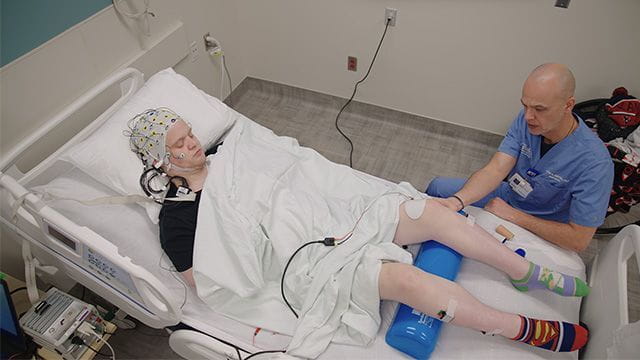
Dr. Sayenko's cutting-edge research uses epidural and transcutaneous spinal stimulation, transcranial magnetic stimulation, peripheral nerve stimulation, electromyography and neuroimaging to help patients with spinal cord injuries recover sensorimotor functions.
"There is a huge interest in the field of spinal neuromodulation," Dr. Sayenko said. "Although there are many ongoing projects applying this technology, there is still a lack of understanding of the mechanisms behind it. Our research aims to determine what to stimulate, how to stimulate, and which specific functions can be promoted."
The lab's research includes trials with robotic exoskeletons combined with spinal neuromodulation. These trials aim not only to facilitate ambulation in individuals with spinal cord injuries but also to promote spinal cord regeneration and repair.
“We are just scratching the surface. The knowledge gained from this project and others will help us build future projects, such as combining spinal stimulation with brain stimulation and creating interfaces between the brain and spinal cord. This is achievable within the next few years.”
Dr. Dimitri Sayenko
"Recently, we were awarded NIH funding to advance our project on invasive and noninvasive spinal neuromodulation for people with spinal cord injuries," Dr. Sayenko said. "This project is exciting because it allows us to delve into the mechanisms behind these technologies in promoting neuromuscular and sensorimotor function."
Alexander Steele, PhD, a post-doctoral fellow in the lab, emphasized the complexity of spinal cord functions, explaining that it transforms signals in a nonlinear way to translate brain signals to muscle actions. "Our goal is to understand how this function happens, so we can better interact with the spinal cord," Dr. Steele said.
Catherine Martin, a senior physical therapist at Houston Methodist, highlighted the lab's individualized approach. "We look at each participant's function over time with stimulation, whether transcutaneous or epidural," Martin said. "We believe in creating an individualized approach rather than a one-size-fits-all method."
The lab features custom-built equipment to help the researchers fine-tune stimulation parameters.
"There are nearly infinite combinations of stimulation parameters to adjust," Dr. Steele said. "Our equipment helps narrow down the search to better target what we need for each person."
As the research progresses, the team at Houston Methodist is optimistic about the potential outcomes.
Meanwhile, the Neuromodulation & Recovery Lab will continue to push the boundaries of spinal neuromodulation research, aiming to translate their findings into effective treatments that enhance the quality of life for those affected by severe neurological disorders and injuries.