
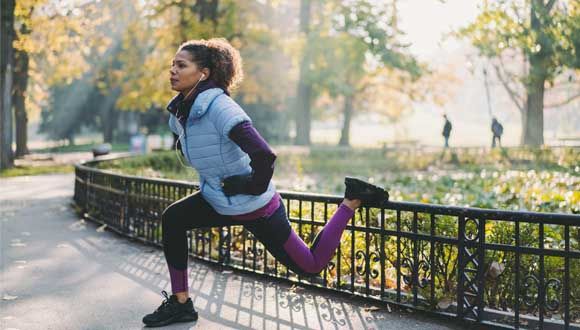

Weak hips don't always hurt at the hip; knee pain, back trouble and poor balance can all be clues.
When you go to the gym, you probably know arm day. Leg day. Maybe even back day. But hips? They’re rarely anyone’s headliner — even though they largely run the show. Your hips create the power that drives movement and the stability that keeps you upright while you do it.
“It really all starts at the hips,” says Dr. Robert Flannery, a primary care sports medicine doctor at Houston Methodist. “They’re central not just for athletic performance, but for staying balanced as we age.”
Here, Dr. Flannery reveals why hips are so important, the surprising places along the body that weak hips can affect and exercises you can do to strengthen them.
“Small improvements in hip strength and mobility can go a long way. A little consistency makes a big difference.”
Dr. Robert Flannery
Primary care sports medicine doctor at Houston Methodist
Why your hips matter more than you think
The hips are the engine behind most of your body’s movement. For example, the simple act of walking puts you on one leg much of the time, meaning your hips (among other muscle groups like your core) are constantly adjusting to keep you centered and stable. When those muscles work well, your stride feels smooth, and your balance feels natural.
If they aren’t strong or mobile enough to do that job, your body starts compensating in ways you may not notice at first.
The surprising problems weak hips can cause
Weak hips rarely stay contained to the hips, according to Dr. Flannery.
“Everything is connected,” says Dr. Flannery. “If your hips aren’t supporting you well, the rest of your body has to make up the difference, and you begin to see breakdowns throughout the kinetic chain — from the foot all the way to the core.”
The kinetic chain refers to how the body’s joints and muscles operate as a linked system; movement in one area affects what happens above and below it.
For instance, when the hips aren’t keeping the pelvis level, the knees often pick up extra load, which can affect the kneecap and daily movement. Dr. Flannery notes this imbalance can also contribute to more serious issues, including a higher risk of ACL tears, especially in female athletes who rely heavily on hip control to manage landing forces and prevent their knees from collapsing inward.
(Related: PODCAST: ACL Tears: As the Women's World Cup Begins, What's With All the Injuries?)
The lower back can also tighten or ache when the hips don’t rotate or absorb force properly, especially during activities that require repetitive bending, walking or twisting.
Weak hips can also affect the upper extremities, especially in athletes involved in throwing sports like baseball, says Dr. Flannery. The idea is that weak hip muscles force the shoulders and elbows in these athletes to overcompensate, increasing the risk of overuse and injury in those areas.
They can also contribute to falls, notes Dr. Flannery.
“If your hips aren’t strong, keeping your balance becomes harder. That’s how falls happen,” he says. “Stronger hips lower your risk of falls, which become a bigger concern as we get older.”
(Related: When to See a Doctor About Balance Problems)
What weak hips look like
So, how do you know if you have weak hips? According to Dr. Flannery, one of the biggest indicators is when someone shifts their weight dramatically over each planted foot. That kind of weight shift is a classic sign that the stabilizing muscles around the hip aren’t doing their job.
When the stabilizer muscles are weak, the pelvis has trouble staying level during walking. The body compensates by leaning toward the standing leg — a pattern known as a Trendelenburg gait.
Even people who look strong and fit can show this. Someone may have well developed quads or impressive lower body strength, but if the deeper stabilizers aren’t firing, their hips won’t stay steady when they take a step, stand on one leg or shift direction.
“A single-leg squat is one of the best assessments of hip strength also,” Dr. Flannery says. “If you can’t control the movement the whole way down and back up, your hips aren’t doing their job.”
What strong hips look like
In contrast, strong hips aren’t something you can see like your biceps or quads; rather, what you’re working on strengthening are the deeper stabilizer muscles. These include the gluteus medius, gluteus minimus and several other smaller muscle groups below the larger gluteus maximus muscles.
(Related: Signs of Weak Glutes & How to Strengthen Them)
“We don’t focus enough on the hip’s endurance muscles, the slow-twitch stabilizers buried underneath the big, showy muscles,” says Dr. Flannery. “These stabilizing muscles are the ones responsible for keeping you upright.”
He likens the difference to the “white meat” and “dark meat” of a turkey. The white meat provides quick bursts of power, he explains, while the dark meat is built for endurance and stability. Our hips rely on that darker, stabilizing muscle group — the ones most people unintentionally overlook.
Mobility also plays a factor in hip strength, says Dr. Flannery.
“Strength is the ability to control force; mobility is the usable motion — you need both,” he says. “Too much of one without the other increases the risk of injury. Weak but highly mobile hips can lead to overuse injuries. Strong but stiff hips tend to cause compensatory injuries elsewhere.”
When these muscles fire consistently and the joint can move freely, the hips can do their job, creating power, absorbing load and supporting the rest of the kinetic chain.
[Related Content]
Why hips become weak in the first place
Hip weakness doesn’t develop overnight. It often shows up slowly, shaped by the way you move, train and recover (or don’t recover).
“Overuse is a big one,” he says. “We focus so much on the big, fast-twitch muscles that we forget the stabilizers underneath. They fatigue early during heavy training, and when they do, the body starts finding ways around them.”
When one part of the body hurts, other muscles jump in to compensate. Over time, those workarounds can become your default movement patterns, even after the original issue has healed.
The way your hips are shaped and how you naturally walk can also play a role, according to Dr. Flannery. Some people tend to turn their feet inward or outward or have structural differences in how the ball and socket joint aligns. Those variations don’t always cause problems on their own, but they can influence which muscles fire and which ones get overlooked.
Modern habits contribute as well. Long hours of sitting can shorten the hip flexors and reduce how often the stabilizers need to work. When you get up and move — especially if you jump straight into exercise — the hips may not respond the way you expect.
How to build strong, stable, mobile hips
Hip strengthening doesn’t require a complicated routine. According to Dr. Flannery, most people benefit from two to three focused sessions per week — enough to build consistency without overwhelming the smaller stabilizing muscles.
1. Start with single-leg balance work
“Even something as simple as going for a long walk improves hip endurance, because walking puts you on one leg most of the time,” Dr. Flannery says. “Single-leg movements are essential because so much of daily life and sport happens on one leg.”
Exercises that build on this idea — from single‑leg reaches to hip hinges to lateral steps — retrain the stabilizers to fire on cue. Once that feels steady, Dr. Flannery recommends introducing instability with tools like a foam pad or Bosu ball, or simple coordination work like catching a tennis ball. These progressions increase the challenge without adding weight.
Pairing regular walking with targeted single‑leg drills creates a simple routine that supports long‑term hip strength.
(Related: 27 Bodyweight Exercises You Can Do at Home or Anywhere)
2. Focus on slow, controlled movements
Once balance improves, more dynamic exercises can help strengthen the hips through a fuller range of motion. Single leg bridges, step downs, lateral band walks and controlled squats reinforce stability and alignment without relying on momentum.
Dr. Flannery recommends focusing less on heavy weight and more on technique. Slow, intentional reps ensure the stabilizing muscles do their job instead of letting larger muscle groups take over.
3. Stretch the deep hip rotator muscles
“A flexible, mobile hip is just as important as a strong one,” he says. “Stretching the piriformis and other deep hip muscles helps prevent low back and knee issues.”
The deep hip rotators — a group of small muscles that sit beneath the gluteus maximus, including the piriformis, gemelli, obturators and quadratus femoris — help keep the hip joint stable and aligned. Tightness in these muscles can restrict how well the hip moves, making the stabilizers work harder than they should.
A few simple stretches can help target these deeper muscles:
- Figure‑four stretch – Lying on your back, cross one ankle over the opposite knee and gently pull the lower leg toward your chest. You’ll feel the stretch deep in the glutes and outer hip — exactly where the piriformis sits.
- Seated hip rotator stretch – Sitting tall, cross one ankle over the opposite knee and hinge forward slightly until you feel the stretch along the back and side of the hip.
- Knee‑to‑opposite‑shoulder stretch – Lying on your back, pull one knee across your body toward the opposite shoulder. This helps lengthen the piriformis and nearby rotators without stressing the low back.
Hip flexor stretches can also make a big difference — a half‑kneeling lunge or gentle forward hip shift helps lengthen the front of the hip, which often tightens after long periods of sitting.
(Related: Foam Rolling & Resistance Band Exercises)
[Engagement Card]
When to see a doctor for sore or painful hips
Some soreness is expected when you challenge muscles that haven’t been used in a while. Discomfort that shows up after new activity and fades within a day or two is usually normal, says Dr. Flannery. But pain that sticks around for more than a few days, interrupts your sleep or limits your ability to move comfortably may prompt a doctor’s visit.
Difficulty with everyday tasks should also require attention, notes Dr. Flannery. If pain keeps you from doing the things you need to do — like getting out of bed comfortably, walking normally or taking the stairs — it’s worth getting checked out. And even pain that limits the activities you want to do, such as exercise or sports, may be worth addressing before it becomes a larger issue.
Dr. Flannery also stresses that early evaluation makes a difference. When hip related pain is caught early, strength, mobility and stability are often quicker to restore — before the body starts developing new compensations that can create their own problems.

