

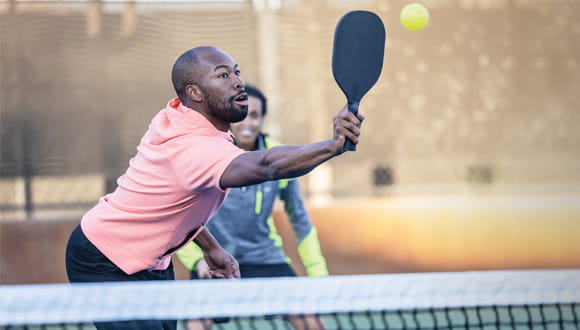
How to Prevent Tennis Elbow When You Play Pickleball: Expert Advice from an Orthopedic Surgeon
March 9, 2026Pickleball may be the fastest-growing sport in America, but with its rise has come a wave of unexpected injuries — especially among adults who jump in without much preparation. One of the most common? Tennis elbow.
To understand why pickleball players are so prone to this painful overuse injury — and what you can do to avoid it — we spoke with Dr. Chia Wu, an orthopedic surgeon at Houston Methodist. His message is clear: pickleball is fun and accessible, but your body still needs proper prep and technique to stay healthy.
Why tennis elbow happens — even if you’ve never picked up a tennis racquet
Despite the name, most people who develop the condition don’t play tennis at all.
Tennis elbow, or lateral epicondylitis, is caused by irritation and degeneration of the tendons that straighten your wrist and fingers. All those tendons attach to one small bony point on the outside of your elbow, which means a lot of force gets concentrated in a tiny area.
“All the tendons on the back of the finger that allow you to straighten your finger and wrist attach to the outside of your elbow," says Dr. Wu. "This bone-tendon interface can be prone to degeneration, especially from overuse.”
Pickleball players often overload these tendons without realizing it — especially beginners who rely too much on arm strength instead of generating power from their legs and core.
Why pickleball players are at risk
Pickleball feels approachable. The court is small, the paddle is light and the game moves quickly. That combination leads many players to skip warmups or technique work.
Dr. Wu sees this firsthand. “People tend to take pickleball less seriously. They sometimes are willing to skip warmup for pickleball,” he says.
He also notes that many new players try to “muscle” the ball with their arm alone, which puts even more strain on the elbow.
Unlike tennis, where players naturally use their legs, hips and core to generate power, pickleball’s lighter paddle and slower ball can trick players into thinking they don’t need full body mechanics. But the tendons don’t care how light the paddle is — they still absorb the force of every swing.
The No. 1 prevention strategy: warm up
If you do nothing else, warm up before you play.
Dr. Wu emphasizes that inadequate warm-up is a major contributor to pickleball injuries. Even though the sport feels casual, your tendons still need to be pliable and ready for quick movements.
A proper warmup should include:
-
Light cardio (2–3 minutes of brisk walking or jogging)
-
Gentle wrist and forearm stretches
-
Shoulder mobility exercises
-
A few practice swings with increasing intensity
It doesn’t need to be complicated. You just need to do it.
Use proper technique
Technique matters in pickleball just as much as it does in tennis. Dr. Wu recommends working with a coach or an experienced player to ensure you’re generating power correctly.
“Pickleball is easier to pick up, so a lot of times people don’t take it very seriously, but technique matters a lot.”
Key technique reminders:
-
Use your legs and core to drive the shot
-
Rotate through your torso instead of swinging only with your arm
-
Keep your wrist stable — avoid excessive flicking
-
Position your body early so you’re not reaching awkwardly
Good footwork also reduces strain. If you’re constantly lunging or reaching because you’re late to the ball, your elbow absorbs more stress.
Strengthen the muscles that support your swing
Tennis elbow isn’t just an elbow problem — it’s often a whole-body strength problem.
Dr. Wu notes that inadequate core strength is a major issue in racquet sports. When your legs and trunk aren’t contributing, your arm overcompensates.
A balanced strengthening routine should include:
-
Forearm extensor exercises (gentle wrist lifts, eccentric lowering)
-
Grip strengthening
-
Shoulder stabilizers (rotator cuff and scapular muscles)
-
Core work (planks, antirotation exercises)
-
Leg strength (squats, lunges)
Even two short sessions a week can make a noticeable difference.
Consider a counterforce brace
For players who are prone to elbow pain — or who are recovering from a mild flare-up — a counterforce brace can help reduce strain on the tendon.
Dr. Wu says these braces can be useful and are commonly recommended.
What to do if you already have tennis elbow
The good news: most people recover without surgery.
Dr. Wu outlines the typical treatment path:
-
Stretching exercises (the cornerstone of recovery)
-
Anti-inflammatory medications (oral or topical)
-
Bracing
-
Activity modification (avoiding painful grips or motions)
-
Physical therapy
He also cautions against relying too heavily on injections:
“Injections don’t provide longer-term relief. Once the injection wears off, it can come back quite hard.”
Surgery is reserved for stubborn cases where the tendon simply won’t heal. Even then, outcomes are generally good.
Small adjustments that make a big difference
A few simple habits can help prevent flare-ups:
-
Use an underhand grip when lifting heavy objects (like grocery bags) to avoid stressing the irritated tendon
-
Stop playing if you feel sharp pain — pushing through often makes it worse
-
Ease back into play gradually after a break
As Dr. Wu notes, recovery takes effort and consistency, but most players can get back to the court pain-free.
The bottom line
Pickleball is fun, social and accessible — but your body still needs preparation and good mechanics to stay injury-free. Tennis elbow is common, but it’s also highly preventable with the right warmup, technique, and strengthening routine.
With proper foresight, you can keep your elbow healthy and stay in the game for the long run.


