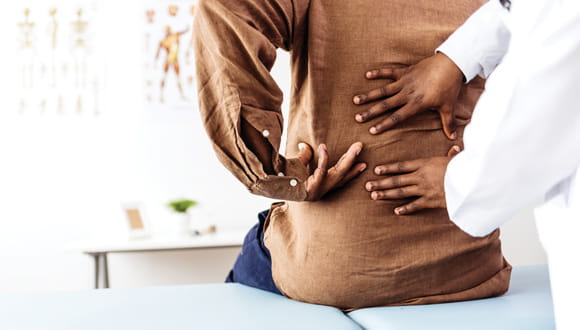


Identifying the underlying issue causing symptoms is key since it shapes treatment options and decisions.
If your doctor used the word "radiculopathy" to describe the shooting pain, numbness or tingling running down your arm or leg, you're probably wondering what comes next: physical therapy, injections, long-term symptom management … surgery?
"There are a number of non-surgical options that can benefit the majority of people experiencing radiculopathy," says Dr. Jeffrey Ratusznik, a spine surgeon at Houston Methodist.
The first step in determining which treatment path is right for you is understanding what's causing your symptoms in the first place.
What is radiculopathy?
Radiculopathy arises when a nerve root is irritated, typically near the point where it exits the spine. It describes a set of symptoms — meaning, by itself, it’s not a complete diagnosis.
These symptoms follow a predictable pattern: A stripe of numbness, tingling and/or pain that travels down the arm or leg, depending on where the problem is. Some people also experience weakness in the specific muscle groups supplied by the affected nerve root.
Finding the underlying cause of radiculopathy is important because treatment depends on what's irritating the nerve.
What are the most common causes of radiculopathy?
The most frequent culprits include:
Arthritic changes: Wear and tear can narrow the bony tunnel where nerve roots exit the spine, shrinking the space where nerves travel.
Disc herniation: The cushiony material of a spinal disc can push outward and into the space where the nerve root lives, causing sudden compression.
Fractures, infections or tumors: Much less common, but all capable of producing similar compressive or inflammatory effects on the nerve root.
Each of these can happen anywhere along the spine, and where the affected nerve is located determines how symptoms show up.
[Engagement Card]
Cervical vs. lumbar radiculopathy: What's the difference?
The spine is divided into regions. The two most common areas affected by radiculopathy are the cervical spine (neck) and lumbar spine (lower back).
"The cervical spine is the portion between the base of your skull and the top of your rib cage," Dr. Ratusznik explains. "The lumbar spine is the portion from the bottom of your rib cage to the top of your pelvis."
Cervical radiculopathy causes numbness, tingling or pain that radiates down the arm, along with potential weakness in the arm. That’s because the nerve roots in the cervical spine supply strength and sensation to the arms.
Lumbar radiculopathy produces the same type of stripe — but down the leg, because the nerve roots that supply strength and sensation to the legs exit the lumbar spine.
You can have cervical radiculopathy and lumbar radiculopathy at the same time
Dr. Ratusznik describes it plainly: "Just like you can break your arm and leg at the same time, you can have both types of radiculopathy at the same time, too.”
Because radiculopathy often traces back to arthritic changes, having both cervical and lumbar radiculopathy isn’t unusual.
"If you've accumulated enough wear and tear to develop a problem in one spot, chances are you may be close to developing problems in another spot.”
Dr. Jeffrey Ratusznik, spine surgeon
But while cervical and lumbar radiculopathy can happen in the same spine, they're separate issues — treating one won't resolve the other. When both are present, the approach is to identify which is causing the most difficulty and address that one first.
Fortunately, most people improve without surgery. Treatment typically starts with conservative options aimed at reducing pain and building up the structures that support and stabilize your spine to help you return to normal activities.
Non-surgical options for relieving radiculopathy include physical therapy and anti-inflammatory medications
Physical therapy is often an important first step for most patients. The reason is simple: once you learn the exercises, you can keep doing them on your own indefinitely.
The goal of physical therapy is strengthening the muscles that support the spine, so they can help offload pressure on the joints and nerve roots. This is often one of the most effective ways to make meaningful and lasting improvement in symptoms without changing the underlying anatomy through surgery.
Anti-inflammatory medications can also help reduce pain and make it easier to stay active. They don’t cause drowsiness and aren’t habit-forming. That said, they're not appropriate for everyone. Dr. Ratusznik advises that people on blood thinners or with less-than-optimal kidney function should avoid them.
Epidural steroid injections can be both therapeutic and diagnostic
When symptoms are more severe or not responding to physical therapy and medication, epidural steroid injections are a useful next step. During the procedure, which happens in an operating room, a physician places a needle near the affected nerve root and injects a local anesthetic and steroid medication.
The effects are temporary since the underlying anatomy isn’t changed, but Dr. Ratusznik points to two important benefits:
Therapeutic: If the injection substantially improves symptoms for several weeks or several months, it creates a window to pursue physical therapy more effectively. "It's hard to do exercises when you're really hurting a lot," he notes.
Diagnostic: If even a short period of relief follows the injection, it tells the care team how much of the pain is coming from that specific nerve root.
"If we put a little bit of numbing medicine and steroid around the nerve root where we think the problem is, and it makes the symptoms better — even if only for a few hours or days — that's not a useful treatment, but it does give us a sense of how much of what you're feeling is coming from that spot," Dr. Ratusznik explains.
This can help make future treatment plans more tailored and precise.
Surgery becomes an option when specific criteria are met
Most people don't need surgery for radiculopathy, but it can be the best option in certain situations.
Dr. Ratusznik notes that three criteria must first be met, including having:
An anatomic problem visible on imaging that clearly matches the patient's symptoms. "If you've got an MRI that shows it's really tight around the left-sided nerve root, but all your symptoms are in your right leg, making the left side different probably isn't going to help the right-sided symptoms," he says.
An anatomic problem that is surgically correctable.
Persistent symptoms that haven't improved despite an appropriate course of non-surgical management. "If you're doing everything you can to get better and things are staying the same or getting worse, you may need to correct the underlying anatomy to get where you want to be."
[Related Content]
Surgical procedures range from small decompressions to complex fusions
The size and scope of surgery depend on the underlying problem. For many patients, a relatively small operation may be all that's needed.
This typically involves making a small incision, trimming ligament between the vertebrae and sometimes a small amount of bone to create more room around the nerve root.
When a disc herniation is involved, the portion of disc that has pushed into the spinal canal is also removed. "As far as spine surgeries go, those are relatively small operations, and most people bounce back from them pretty quickly," Dr. Ratusznik says — while adding an important qualifier: "A small operation for me is not necessarily a small operation for the patient that's having it."
Larger operations become necessary when the problem involves significant spinal deformity or instability, not just narrowing around a nerve.
In these cases, simply creating more space around the nerves could leave the spine unstable. The solution involves instrumentation to hold the spine in the correct position, combined with a spinal fusion — a process of encouraging the bones to heal together into a solid structure.
The threshold for pursuing a larger surgery is higher, Dr. Ratusznik notes, precisely because it is a more significant undertaking.
You have more options than you may realize
A radiculopathy diagnosis doesn't automatically mean surgery. Most people improve with a combination of physical therapy, anti-inflammatory medications and sometimes even epidural steroid injections.
Surgery becomes a real and effective option when non-surgical approaches haven't worked and when a clear, correctable anatomic problem is present — but it's a decision made carefully, with your specific symptoms, imaging and goals at the center of the discussion.
If your symptoms are severe, getting worse or significantly limiting your daily life, that's the right time to sit down with a spine specialist and map out a plan that's built around your anatomy and your life.
Frequently asked questions about radiculopathy
What is radiculopathy and how is it different from general back pain?
Radiculopathy specifically describes symptoms caused by irritation of a nerve root where it exits the spine. Unlike general back pain, radiculopathy follows a predictable stripe — down the arm if the problem is in the cervical spine, down the leg if it's in the lumbar spine. It can include numbness, tingling, pain or weakness in specific muscle groups, and it points to an underlying anatomic cause rather than general muscle soreness.
Does radiculopathy always require surgery?
No. The majority of radiculopathy patients improve with non-surgical treatment. Physical therapy, anti-inflammatory medications and epidural steroid injections help most people avoid surgery altogether. Surgery is considered when symptoms persist despite appropriate non-surgical care and when there is a clearly identifiable, surgically correctable anatomic problem.
What is the most effective non-surgical treatment for radiculopathy?
Physical therapy is the number one non-surgical treatment because the exercises can be continued indefinitely after just a few supervised sessions. Strengthening the muscles that support the spine reduces load on the joints and decreases pressure on the affected nerve roots. Anti-inflammatory medications and epidural steroid injections are additional tools that work well for many patients.
What do epidural steroid injections actually do for radiculopathy?
Epidural steroid injections deliver local anesthetic and steroid directly into the space around the irritated nerve root. They serve two purposes: providing temporary pain relief that creates a window for more effective physical therapy, and confirming the diagnosis by revealing how much of the patient's symptoms are coming from that specific nerve root. The effects are always temporary — no permanent anatomic change is made.
When does radiculopathy surgery involve a spinal fusion?
Spinal fusion is necessary when the underlying problem involves significant deformity or instability, not just nerve compression. When so much bone and ligament would need to be removed to adequately decompress the nerve that the spine would be left unstable, instrumentation and fusion are added to restore stability. Fusion means encouraging the bones to heal together into a solid structure, holding the spine in the correct position.
Can you have cervical and lumbar radiculopathy at the same time?
Yes, and it's not uncommon. Because most radiculopathy stems from arthritic wear and tear, patients who have developed problems in one spinal segment are often close to developing problems at another. Cervical and lumbar radiculopathy are treated as separate problems — resolving one will not improve the other — so treatment is typically prioritized based on which problem is causing greater limitation.
What causes radiculopathy in otherwise healthy, active people?
Even healthy, active people can develop radiculopathy. Disc herniations can occur suddenly, while arthritic changes build up gradually over time. Fitness can help support spinal health, but it doesn't eliminate the risk of developing conditions that irritate a nerve root.