
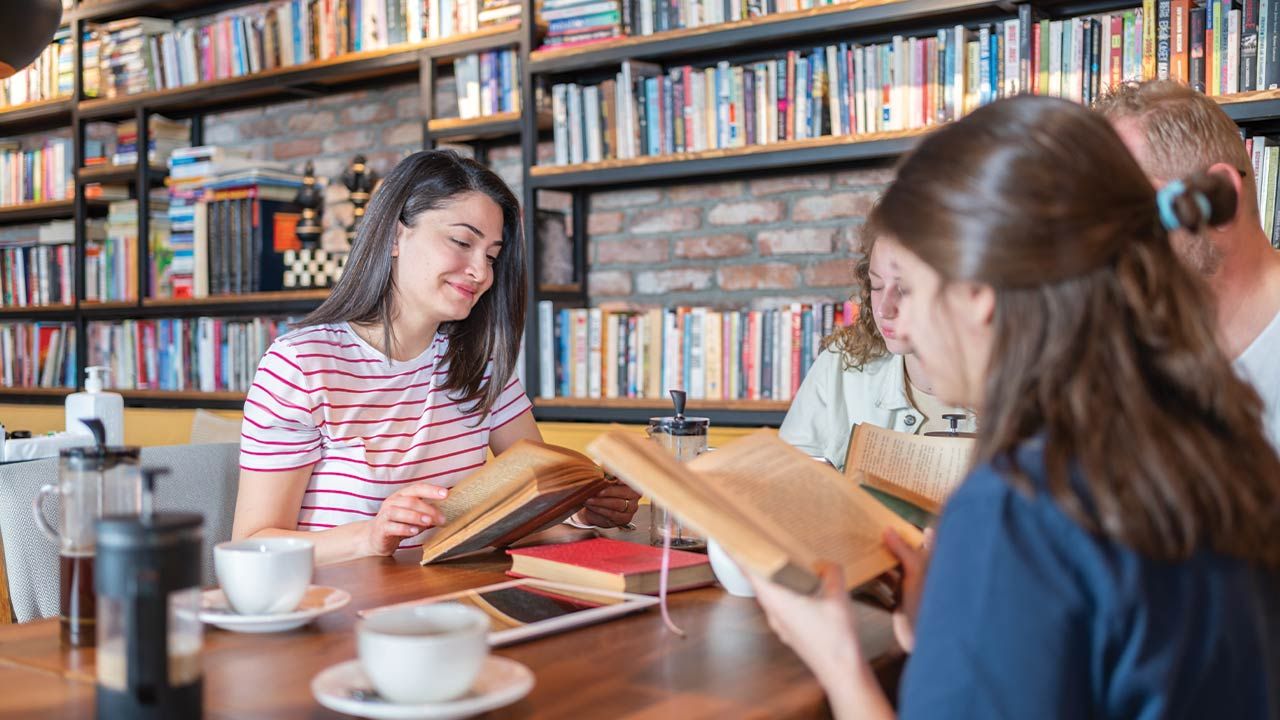

Coffee shops, parks, libraries — the spaces beyond home and work do more for your health than you might think. A psychologist explains what makes a third place worth finding.
It's easy to feel like a leisurely morning in a coffee shop, getting lost in the stacks at the library or a walk in the park are luxuries rather than self-care. But the spaces beyond home and work — what sociologists call third places — do real work for our social health, the pillar that's easiest to let slide when we’re busy. And many of us do skip these spaces: half of Americans say they seldom or haven’t visited a park in the past year, and 63% say the same about libraries, according to the 2024 American Social Capital Survey. If these spaces are available, why aren’t we going?
In this episode, we explore third places: why they matter for your mental and physical health, and how you can find one that’s meaningful for you with little or no pressure.
Expert: Dr. Namrata Vasquez, psychologist at Houston Methodist
Notable topics covered:
Definitions of first, second and third places
The four traits of a true third place
Why Americans engage less in third places
Do online communities count as third places?
Why work-life balance is crucial for well-being
Self-care and hobbies: how they relate to third places
How arts and sporting events keep us connected
Using self-exploration and trial-and-error to find meaningful third places
[Engagement Card]

Article Transcript
ZACH MOORE: Welcome to On Health with Houston Methodist. I'm Zach Moore. I'm a photographer and editor here, and I'm also a longtime podcaster.
KIM RIVERA HUSTON-WEBER: I'm Kim Rivera Huston-Weber, and I'm a copywriter here at Houston Methodist. Zach, when was the last time you were in a third place?
ZACH: Third place. Well, first of all, "third places" is a terminology that I was unfamiliar with until I started seeing articles about how we're losing our third places. And I'm like, "What are we losing? Where are they going? What are they?" That sort of thing. And I really had to stop and think about the last time I was in a third place because I don't think in those terms. I don't think we as a society think in those terms. But when you think of a third place, what's the first thing that comes to mind for you?
KIM: For me, it's probably always been the library. I'm actually a librarian by my education, and, you know, I kind of grew up volunteering in libraries. I was a library page. All of my jobs until, you know, I started the transition into content, were all in libraries. And so, it's still one of my absolute favorite places to just go get lost in.
ZACH: I enjoy going to them when I can, but it's very rare these days. I used to go a lot when I was a kid, but to me, it's more like a nostalgia thing now to go to the library. Like, "Oh, wow. I remember being in this library, this monument to a lost civilization of books and physical media." But to me, I guess my favorite go-to would be like a baseball game, you know, a sporting event. Now, to me, I would count that as a third place. But see, these are the things we're going to unpack in our conversation today. What is a third place? Do they count?
KIM: Yeah. Yeah. Does baseball count?
ZACH: Yeah, I hope so. Well, we'll find out. But who did we talk to today about third places, Kim?
KIM: Yeah, we spoke with Dr. Namrata Vasquez. She's a psychologist here at Houston Methodist. There are many trend pieces online right now talking about how many of us are craving in-person social experiences, probably to combat loneliness and isolation. But the reality is that I think we've lost a lot of the spaces that we can get together and build community and have different experiences together. So, to start our conversation today, I'd really like to know, what is the definition of a third place?
DR. NAMRATA VASQUEZ: Yeah, that's a great question. So, a third place was first conceptualized, I guess, by a sociologist many, many years ago named Ray Oldenburg. And it's the idea that there's a place beyond our home, which is our first place, our work or our school, which is often the second place if applicable, but where we can engage with others. And really it's about social support. You know, we use the term "social support" very often in psychology to describe all of the different forms of meeting our social needs. And a third place is one way to do that. So there's some key characteristics of a third place that I think are important to mention. And this is also kind of going back to the way it's been defined historically, but it's usually a neutral ground. So, it's important that it's public, you know, it's accessible to many people. It's not very high maintenance, like it's easy to be there, right? There's not a lot required of you. There's no tasks you have to be completing like there are at work and home a lot of the time, right? And there's some playfulness. That's a big component that I think is important to talk about as adults, like, just places to be playful and not working, right?
KIM: Yeah. Just thinking about it from your definition, it does seem like to meet all of those characteristics, I'm having a hard time listing those kind of places for myself. You know, I'm curious to know, so, why are these spaces important for us, and do they benefit our health in any way, whether it's physical or even our mental health?
DR. VASQUEZ: Yeah, absolutely. And the types of places that can be third places can be of physical nature, like it could be gyms or walking clubs or run clubs, which have been on the rise in the last few years, especially after COVID. Or it can be more chill, you know, like a cafe or coffee shop or a restaurant. So, there can definitely be benefits to your physical health, depending on the type of third place that you're attending. But certainly for our mental health, it's a really crucial way of meeting social needs that are hard to meet otherwise. You know, we all have needs socially, whether we need a lot of people in our lives or even just a few. We need folks that we can engage in small talk with, like acquaintances and just pleasant people, right? Just exposure to the world, right? That's really important. All the way to another end of the spectrum where we have close friends and intimate partners and people that we rely on more emotionally. So the third place, thinking about that spectrum of social support, can be really important in terms of how we meet those needs.
KIM: Yeah. You've talked about what a third place is. Would you describe what a third place isn't?
DR. VASQUEZ: Yeah. Yeah, another question that comes up often is like, "Does online community count?" And so I think that's a tough one. You know, are you thinking about just being online? You're not really connecting with people necessarily, right? I think if thoughtfully done, there's been some conversation and almost no research, so that needs to happen, right? But there's been some thoughts about how like a thoughtful community online can maybe resemble a third place. So, that could be like a support group, a passion project you're working on with people online. Thinking about like that laughter, playfulness, you know, is there some kind of topic you're bonding over? An actual group, right? Potentially that could have some of the benefits of a third place. But things like social media on their own, you're not really connecting with people. It feels like we are sometimes, right? Like we're seeing the content that they're creating. But is that real social connection? I think it definitely doesn't have the same benefits.
KIM: Yeah, you bring up a -- because so much of, especially with social media, it's passive, right? So, you're seeing the updates of friends or that coworker from like three jobs ago. "Oh, that's what they're up to now." Which kind of leads me to this question, which is, you know, I saw that -- or rather I read that someone said that social media or digital connection is kind of like a snack, but in-person conversation or community is like a nutritious meal. How true or not true is that statement?
DR. VASQUEZ: That's a fun one. I mean, like any metaphor, it probably has its limitations. I would think about the quality of the snack, too, right? Like, yeah, you might be getting some social interaction there, but is it a good snack, a satisfying snack? Does it meet your needs nutritionally?
KIM: Are you getting the fat, fiber, and protein?
DR. VASQUEZ: Or is it a feel-good snack? So, yeah, I mean, it definitely lacks like the components that would feel like all of my social needs are being met and I'm having like a great contribution to my mental health, right? Digital interactions do have those limitations. That being said, are they better than nothing? Some would argue that there is some kind of interconnectedness that has been beneficial, right, from being able to connect with people all around the world. I think, again, like that thoughtfulness piece is really important. Are you connecting with your family members across the world or a friend group, a meaningful, quote-unquote "place" to gather that is going to feel very different than, like you said, passively engaging with strangers or people that you don't know. Not to say there's no benefits to that, but that doesn't really meet our social needs a lot of the time.
KIM: What I was surprised to learn is that even when we have access to things like libraries and parks, Americans aren't necessarily utilizing them. I saw that half of Americans say that they seldom or never visited a park in the past year. And with libraries, it was even more stark. 63% said they seldom or never visited a library, and less than 20% said that they visited more than twice a month. So, you know, if we know that social interaction and spending time in these third places give us benefits to our physical and mental health, why aren't we going?
DR. VASQUEZ: Yeah. Yeah, that's such a good question. I mean, I think there's a lot of different reasons. My first thought kind of comes to the anxiety that people feel after COVID to some degree. But maybe also in general, like that this was an issue before that as well, with engaging with people. In a community where we have grown up so much online, at least like, you know, newer generations are connecting online more than ever before. And so, I think it can be very anxiety-provoking to enter a space or a group or a community that you don't know, to know if you're going to like the people, what they're going to think about you, right, or "Is this going to be my kind of people?" Right? We have all these fears and anxieties. And I think definitely after the pandemic, we definitely saw a unique type of anxiety with people trying to come back to public life, like we lost our abilities a little bit. You know, there were conversations about folks feeling more awkward or socially anxious than ever before. And so I think that's definitely played a role as well. Is that something that can be worked on? Of course, right? But I think that can be a big barrier. And then kind of growing up in a more individualistic society, I think, is another barrier. You know, there's this idea of the third place across the world, and so there are communities where you see less stark metrics than those that you've described, you know, in communities where people live closer to each other and there are more quote-unquote "public" third places. But the way that we're kind of structured here often can be very spread apart, right? Suburbs are very far from one another. Even in Houston, being such a big city in terms of population, it's fairly spread apart, you know, it takes a long time to get from one area to another. And so I think that that makes it harder. We have to be more intentional, and sometimes it's just easier to not, right?
KIM: Yeah. You know, one of the things that Americans love to do is we love to work.
DR. VASQUEZ: Absolutely.
KIM: And so it makes sense to me, at least, that many of us might default to the second place, work, to find like friendship, to find community. And, you know, we've also built this kind of hustle culture where you should have like a side gig or something going on in your evening hours that I think to me kind of blurs the lines between labor and leisure. So I think folks might feel like they need to monetize something that is just a hobby for joy --
DR. VASQUEZ: Yeah, absolutely.
KIM: Or take on extra work. So, could you talk about the importance of a healthy balance between both work and our personal lives?
DR. VASQUEZ: Yeah, yeah. And I think the way you described it is so correct. That balance, sometimes it's like a false dichotomy if we're at work all the time and we're eating dinner and lunch at work, right? There's this idea of a balance that sounds really nice, but it's just not the reality for a lot of people. And sometimes that's due to financial limitations, and sometimes it is more of a cultural thing, right? Like, "Let's do the hustle culture," like you said, or monetize my hobby and not just have that as an enjoyment, but "I can make something of this." So that's such a tempting, I think, tendency for folks. And that balance is really important.
KIM: Yeah.
DR. VASQUEZ: Can a second place be a third place? I think that's a really important question. You know, after COVID, there was this rise of co-working places, and also the rise of remote work, which we haven't talked about yet, but I think that was another response to maybe the isolation that comes with working remotely, right? We're actually physically far away from people when we used to actually work physically together, and there's benefits to that, too, so I'm not saying it's necessarily bad, but the co-working I think is a way to bridge that a little bit, and a lot of people do describe co-working places as like a third place, even though it is technically a second place.
KIM: Right.
DR. VASQUEZ: But I think what's neat about some of these places is that there is like a recreational component, right? Like the pickleball court or like a break room or whatever. Would it be nice if there was a true physical separation? You know, sure. But if you're actually engaging with people that you think are enjoyable, bring out that playfulness, you feel kind of like an equal there, you feel safe, I mean, arguably, you are meeting some of those needs that a third place would meet.
KIM: Yeah, and to the point about the co-working spaces, if you're just physically going to be in a separate place than your home and you're keeping your earbuds in and you're not interacting with anybody, is that co-working space a third place?
DR. VASQUEZ: Yeah, I would say no, right? You're not getting to engage in that shared humanity piece and that conversation and chatter that again is like not task-oriented. That's another big piece of it, right? We're not working together to meet a work goal. That can be enjoyable, great, if you like your team, you know, that's a good thing but part of that nature of a third place is supposed to be kind of recreational in nature. Like you're not pressured to do anything. And what you described about monetizing hobbies can also be where that shifts, you know? Like are you part of a pottery club for fun or other types of hobbies for fun, where it feels playful, creative, mindful, right?
KIM: Mm-hmm.
DR. VASQUEZ: Versus the pressure of having to produce and monetize and meet orders and take that on. Of course, if you want to do that, that's fine, but it is a completely different experience for a lot of people.
KIM: Yeah, you're kind of breaking my brain a little bit with the task element of it, since I have so many hobbies that have tasks. I mean, gardening...
DR. VASQUEZ: Sure.
KIM: But I'm just out there in my garden alone weeding, but, you know, I have my tasks. But if they're pleasurable tasks...
DR. VASQUEZ: Yeah.
KIM: ...is that okay?
DR. VASQUEZ: Yeah, yeah, absolutely. I think that's the piece. Does it feel playful? Is it fun? Could you do that with other people in a way that doesn't feel pressuring? Those pieces are so important. If you're gardening and telling yourself, "I have to do this and I hate it" the whole time, right, then no. Then we're not really getting that mental health benefit. And some people do engage in a lot of tasks that way, even at home, right? So I think that's where the mindfulness piece comes in, like, "Is this important to me? Do I want to spend time doing it? Why do I want to spend time doing it? How could I make this enjoyable for myself? Do I want to meet other people who enjoy this," right? That's a very different experience than feeling that pressure like, "I have to do this."
KIM: Yeah, and kind of to the point about pressure and many folks feeling that even with our private time, we still need to be working toward our life goals, whatever those may be, if all of our third places are tied, or groups as well, if they're all somehow tied to our profession, is that okay?
DR. VASQUEZ: Yeah, that's a tough question. I mean, I think it sort of reminds me of like the conversation of self-care, you know, like we've kind of lost the ability to do things, or I don't know if we had it to begin with, but it's hard to have the space and time created to just do things that are just for health, you know, for feeling connected to your body, to feeling connected to your mind in a way that isn't urgent, right? And so that piece I think is sometimes lost when work becomes like your entire identity or anything becomes your entire identity. That part of nurturing ourselves, if your work feels that way, like that can be true, right? Feels really nurturing, fulfilling. And there is room for that kind of self-care, pouring into your own cup, whatever you want to call it, right? Perhaps that would be fine. Is that the case for most people? I don't think so. You know, I think a lot of us have fulfilling jobs, which is wonderful. But after that, we need to kind of take care of ourselves to be able to do the job again the next day, right? And meet the demands of the other roles that we find important, whether that be family member or community member or part of an organization. That piece is really important.
KIM: Yeah, taking the time to really make sure that you're taking care of yourself, I think is something that we kind of might lose in the forest for the trees, as it were.
DR. VASQUEZ: And the third place can be a means of doing that, you know? Other spaces that we haven't mentioned are like beauty parlors, barbershops, nail salons. A lot of third places historically have been places where you do take care of yourself a little bit, right? And self-care doesn't always have to be that way, doesn't always have to be expensive, but do those places count if you do them regularly? Yeah, I mean, I think a lot of people do get that community element, feel connected to people they wouldn't otherwise see. Same with like the fitness or the running clubs or the walking clubs. We get to meet our own physical needs, take care of ourselves, and have that social component, so it's nice when you can kind of find a two-for-one, right?
KIM: Yeah, no, it makes total sense that, you know, going and getting your nails done and maybe enjoying some light to moderate chisme, gossip with your nail technician, I mean, that sounds like a fun afternoon to me, you know?
DR. VASQUEZ: Yeah, bringing in that playfulness, that connectedness, yeah.
KIM: Yeah. And kind of to that point, when we're seeking out third places and groups, how important is it that we're seeking belonging in groups and organizations that are tied to our beliefs, whether our identity, wellness, or leisure? How important is it?
DR. VASQUEZ: Yeah, that's a great question. I think it's always important to have a space, right, where we feel connected to those that maybe identify or believe the way that we believe or identify. Does that have to be all of your spaces? No, right? And so, I think it might differ based on the person. If you feel like you have that community outside of your third place, maybe within your family or at work, you work in a place that's related to your identity, right, you might have those needs met, and it might be nice to feel that connectedness with a diversity of humans that are different than you. That piece I think is still really important for us to feel safe and connected to the world. But if you don't have that, then of course, yeah, having a third place that brings people into your life that believe or identify the way that you do or have some kind of commonality, right, can feel really important. And that is also where you find a lot of third places, organizations, support groups like we've talked about, even things just like hobbies, like ultimate frisbee groups, things like that, you know, pickleball leagues and whatever else is going on these days. So, I think that can be a really nice way to come together. And when people do have anxiety about going into building their social support system, that can be a really nice way to combat some of that, like having something in common with the people that you're engaging with can be a nice way to have those initial conversations when you're feeling anxious.
KIM: I saw an article that suggested a third place resolution. And it was simply, "I will leave my house and be with other people in person on purpose in the place where I live."
DR. VASQUEZ: Oh, that's nice.
KIM: The author suggested spending at least an hour a week going to a local third place, local to your own community and just trying to interact with folks there. They recommended strategies like taking a book or just simply saying hello to the staff or learning their names, etc., etc. If someone wanted to adopt a practice like this where we're trying to meaningfully engage with others at a third place, how should we approach it?
DR. VASQUEZ: Yeah, that's lovely. I think it's important to consider like, one, what your options are first, and then two, what are you comfortable with. If there's a really high level of anxiety, you know, or discomfort or fear of safety, like a lot of these things that come up, right, starting really small is a great way to start, you know? It doesn't have to be that you rip the Band-Aid and go to a concert or something like that. And there's also this idea of direct and indirect contact socially, indirect meaning like you're around a lot of people, but you're not necessarily having to interact a ton, going to the mall, going to the grocery store, going to the park, but walking alone, you know, like those are still means of social support or social engagement that can be really helpful as a starting place. And then maybe you work yourself up to having a conversation if that's something that's important to you. So yeah, I think start by figuring out what all the options are. Sometimes I'll tell folks to make just a really long list of possibilities, right? Just all the things available to you, whether or not you would really want to do them, but like what's feasible, you know? What can you afford? What's available? What's free in your community? Do some sleuthing on the internet, you know, try to find all the options. And then from there, we can think about what's appealing, what would meet a need for you, what even feels possible. And then even from there, you can break it down much smaller, you know? Let's say you want to go to a book club, maybe you just start following their page first, you figure out where the cafe is, you go to the cafe on a non-book club day. You know, like you can work yourself up to a lot of these things. It doesn't have to be like you immerse yourself, because then it starts to feel like a task, right, if it's too big. And so starting kind of small is usually my recommendation if you're starting something that feels overwhelming for whatever reason.
KIM: You know, you had just said a concert. So I'm curious to know, like if we're thinking about venues like that where you might go see a music concert or, I love baseball, so is going to a baseball game, am I going to a third place when I do that?
DR. VASQUEZ: Yeah, I think there's that conversation on like indirect engagement in third places that would maybe suggest yes, like are you around people that you wouldn't normally interact with? Are you having that playful experience? You know, like you're all laughing or cheering or booing the other team, whatever it might be, right? Are you singing together? I think a lot of people do report connectedness at concerts, for example, just from sharing the music and singing with one another. Same with sporting events. And so yeah, if that feels like it's boosting you in a social way, then that's totally fine. For some people that might be enough, and for others they might want more direct contact with people. Part of it is personal exploration, and so learning what is important to me, if I've picked something, is that because it's important or because it sounds nice, or I feel some pressure, or that's what my friend would do, right? And if we can find what's important to us, then usually that offers a little bit of motivation. That's what motivates us a lot more effectively than just pressure or trying to fit in, for example. And so that self-exploration, obviously therapy can help with that, and just spending some time learning like what actually matters to me in my downtime, not what will make money, not what will look impressive, if those things happen as side effects, great, but what actually matters to me? Maybe it's feeling kind of free or just engaging with music or being outside, right? Like what matters to me, and then can that be the motivation that I think about? And if it's still feeling overwhelming, I would say kind of break it in half, you know? Like the step is still too big. You can always keep breaking it in half, even if that means just driving to the park the first day, right, and walking around for a few minutes and then try again the next day.
KIM: Yeah, it seems that this concept of the third place, while it is a place that is not your home...
DR. VASQUEZ: Yeah.
KIM: ...or not work, it's still really kind of tied into us as individuals, right? So, like, finding what places bring us out and kind of fill our cup, there needs to be a little bit of self-exploration to do that, it seems.
DR. VASQUEZ: Yeah, yeah, absolutely. And then going back to like the big list of possibilities, there's nothing wrong with trial and error, right? And so maybe you try something and you're like, "You know, I put myself out there, but that wasn't really for me," or, "I don't like that activity, I don't like pickleball," for example, if that's what you tried. I do like pickleball, but, you know, you don't have to stick to the first thing that you try. And so I think allowing yourself that like, "I'm just going to trial and error, have some grace with myself and see what it is that feels meaningful to me at the end of the day," and letting it come to you, right? You can't really know unless you start trying. But making it about your internal needs, your unique needs, rather than what other people are doing is really important.
KIM: Do you have a favorite third place?
DR. VASQUEZ: Oh, that's a great question. I love coffee shops. I like reading at coffee shops, working, which is not really a third place, at coffee shops, talking to people. I go to the library quite a bit. There's a lot of neat programming at our local libraries here. And then I think nature is big. You know, Houston does have quite a few parks. Depending on where you've lived otherwise, I know people have lots to say about Houston's nature opportunities, but...
KIM: No mountains, I've heard.
DR. VASQUEZ: Not a lot of elevation, but there are a lot of parks, and there's often events going on at a lot of the parks. And I'm aware that they're trying to expand the green spaces pretty frequently around here to meet some of those civic deserts or green space deserts that you were alluding to earlier. So, that's kind of what I like to do.
KIM: Yeah. Is there anything that we haven't talked about that you think our viewers should know?
DR. VASQUEZ: Yeah. I mean, I think if you're struggling generally to figure out how to spend "downtime," quote-unquote, even if it feels like you don't have it, you know, finding a third place can be a great option. Obviously, working with a therapist can also be something that's really helpful to try to figure out where to start. Biased because that's what I do. But it doesn't have to, I guess what we've been saying this whole time, just like it just has to be yours. It doesn't have to look like anyone else's third place or form or method of filling your own cup up, you know? It just has to be what works for you.
KIM: Thank you. This has been such a great conversation.
DR. VASQUEZ: Thank you.
ZACH: So Kim, listening back to your conversation with Dr. Vasquez, you know, I've had the good fortune of being able to do a lot of international travel in recent years, and I gotta say, I think other countries, they integrate third places into their everyday lives a lot better than we do here in America.
KIM: Yes, I agree. I've also been blessed enough to go abroad and...
ZACH: Couple international travelers here.
KIM: I know, like, world travelers! But I think it is just a little bit more hardwired into the culture. Like you think about going to a restaurant here in the States and it's just you go in, you eat your meal, and then you need to leave, you know? Sometimes you're kind of being scooted out a little bit to turn a table. In other countries, you're expected to linger and you're going to have your coffee and your cake at the end of a meal and you're going to have to flag down that waiter to be able to leave.
ZACH: There's definitely a different mindset. The European mindset is more suited to the third place.
KIM: Yeah, and, you know, I think it's very interesting that you bring that up because, you know, when I asked her if work could be a second place or a third place, potentially.
ZACH: Yeah.
KIM: I think we do culturally have a much different relationship to work than in other cultures. And so, you know, I think a lot of when we try to get involved with things, a lot of it might be career adjacent. And so that was something for me that I took away that helped me is that, you know, if something starts to feel like work or starts to feel like a task, you know, maybe that isn't your third place.
ZACH: Yeah, you guys talked about hobbies, right? And having a, like something to show for it, you're working towards something. And look, I mean, we all have the things that we want to feel accomplished. Like if I'm going to spend a lot of my free time on something, on the other end of it I want to say, "Hey look, I accomplished this!" But even that is not, you know, necessary for relaxation. It can be healthy just to really unplug and have no objective, right? And that's why I'm glad you guys brought up sports and how going to a baseball game, for example, is a nice relaxing thing. I know we're both big baseball fans, and it's just something about going to the stadium with your friends and you sit there and it's just part of -- you talk, and it's a whole experience, really.
KIM: It's very communal.
ZACH: Yes, yeah.
KIM: Because, especially if you are in your team's home stadium, like you might not necessarily know the person next to you, but you still might chat them up when, you know, a play happens and then you're like, "Oh..."
ZACH: Here we go again.
KIM: Yeah, here we go again. "He hasn't been playing well."
ZACH: Yeah.
KIM: And it's those kind of interactions that, you know, can fill your cup. And, you know, we also talked about concerts, and, you know, that's definitely been something that I've experienced in my life where, you know, I used to go to concerts by myself all the time, and I just loved being amongst the vibe of the crowd and people being just in the music. Now, I mean, of course now everybody's got their cell phone up, and that's like a whole other conversation.
ZACH: You guys mentioned the internet, which I appreciated you guys talking about that and the question of, "Is the internet a third place?" And yes and no. If you're engaged with and talking to people and there's a back and forth and a true interaction and investment with, you know, people or a group or whatever that may be, then yes.
KIM: Yeah.
ZACH: But if you're just kind of scrolling, which we all do, we've all done it, we'll all continue to do it, but that's not engagement. That's just passive, you know, intake and not really being an active participant. And that's an important component of going to the third places and taking advantage of what they are, is being an active participant in them.
KIM: Yeah, being an active participant and perhaps getting out of our comfort zone a little bit. I loved what Dr. Vasquez said about how you can kind of gently introduce yourself in these spaces or trying to just find out what's for you and really getting that sense of play when you're trying to figure out what your third place is. It shouldn't feel like a burden. It shouldn't feel like, "Ugh, I should do this."
ZACH: See, kids understand this. That's why kids go to the park with their kite and their ball, and they're like, "You know what? I'm here to have a fun time today." And as adults, we feel guilty, right? Because we feel like we should be doing something more productive, when this is an important part of our health, right? Because our social health, it's an offshoot of emotional health, but it is probably the most neglected pillar of health these days, right? I mean, physical health speaks for itself. We've come a long way, fortunately, about mental health, that had been ignored for far too long, and I feel like finally, as a society, we're giving it the proper attention and respect it deserves. And then, you know, emotional health is up there, too, with the mental health. And then the social health, right? And it's probably the one that's easiest to overlook.
KIM: Yeah, you know, because I think we all are very busy, and we have things on our proverbial to-do list, but we're social animals. I think as one of our experts in an episode last season mentioned, the kind of small talk that you get into at the grocery store or at a coffee shop, it lights a different part of your brain than when you're speaking with someone you know.
ZACH: Yeah.
KIM: So, all of this is really important for our health, like both our physical and mental health.
ZACH: Yeah, I mean I was wearing an Astros hat when I was in Greece recently. Again, world traveler Zach Moore here, but we were just on a hike and some guy saw my hat, he's like, "Oh, you're from Houston?" We started talking about, you know, random stuff, and so those sorts of things can kind of trigger fun interactions that are totally unexpected. Those dopamine lights went off in my head like you guys talked about, that sort of connection, right?
KIM: Oh yeah. One of my favorite things, cause, you know, I follow all of the Cleveland sports teams, so Ohio people always find each other. So like you'll see somebody wearing the hat, and you just kind of do the subtle "O-H" and wait to hear the "I-O." We're hardwired to, you know, make these connections, and so it's important for us.
ZACH: Yeah, so take that pro tip from us, Wear some paraphernalia of your city, your teams of choice if you're a sports fan. And really though, because we're on the lookout for that. That's an easy way to be like, "Hey, hey, go Astros."
KIM: Go 'stros.
ZACH: All right, well that's going to do it for us this time on On Health with Houston Methodist. Be sure to share, like, and subscribe wherever you get your podcasts. We drop episodes Tuesday mornings, so until next time, stay tuned and stay healthy. ♪ ♪