

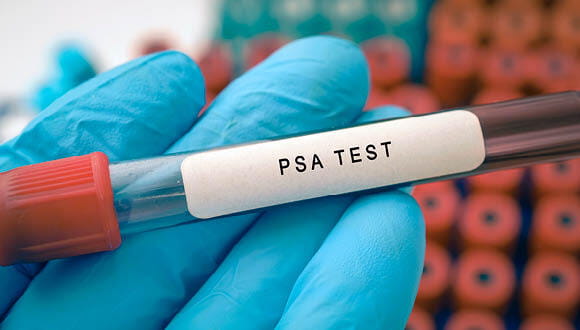
Checking a man's prostate-specific antigen (PSA) level is a key part of prostate cancer screening. It's done through a simple blood draw, but the results can sometimes be confusing to the layman — perhaps even alarming if your levels are elevated.
"A higher level of PSA is not a diagnosis of cancer," says Dr. Brian Miles, a urologic oncologist at the Houston Methodist Neal Cancer Center. "It's one several screening tools we use to see if you might need further testing."
Here's how Dr. Miles explains the basics of PSA screening and what to expect if your doctor recommends more tests.
What is a PSA test?
A PSA test requires just a simple blood draw. It measures the amount of prostate-specific antigen in the blood. PSA is a protein that is made in the prostate gland.
It's normal to have a small amount of PSA in a blood sample, and levels can vary depending on factors like your age, the size of your prostate or if inflammation or infection are present.
A PSA screening is not a routine test for men who are at average risk of prostate cancer. Your doctor may suggest adding a PSA test when you reach age 50. You might also need to start testing at a younger age if you have a family history or other risk factors. (Related: Prostate Cancer Screening: When to Start & What to Expect)
A higher-than-normal PSA level isn't solely associated with prostate cancer. This can also happen with a common condition called benign prostatic hyperplasia (BPH).
What is considered an elevated level of PSA?
Measured in nanograms per milliliter (ng/mL), PSA lab tests are highly sensitive.
Because of all the factors that can affect PSA levels, there is no specific threshold that defines an "elevated" PSA. Instead, your doctor will use the results of your first test as a baseline:
- If your PSA level is 2.5 ng/mL or less, you will likely be retested every two years.
- If your PSA level is higher than 2.5 ng/ML, you may need a test each year.
It's important to note that these are guidelines. Shared decision-making between you and your doctor is used to individualize the right screening interval for you, based on age, risk factors and PSA trends.
"We consider all your health factors to determine what 'normal' means for you," Dr. Miles says. "For example, you might have a PSA that started out around 2 and has slowly gone up to over 5. That's when a primary care doctor should refer you to a urologic oncologist."
(Related: Prostate Cancer Screening: 5 Things Every Guy Needs to Know)
What is the next step with an elevated PSA?
A urologist specializing in oncology will do one or more additional blood tests to screen for the possibility of cancer. Dr. Miles uses a test called a 4Kscore that looks at all the variations within the PSA proteins. It also checks for a related protein called human kallikrein 2 (hK2). Importantly, the 4K test helps us avoid a biopsy of the prostate in up to 40% of men with elevated PSA if the 4K result is low.
"We put all this data into an equation that shows the likelihood of cancer," Dr. Miles explains. "A high 4K score doesn't mean that you have cancer, but it does mean that we need to consider a prostate biopsy."
Before suggesting this procedure, the following will likely be performed:
- A digital rectum exam (DRE) to feel for changes in the prostate
- Magnetic resonance imaging (MRI) to look for areas suspicious for cancer
Your oncologist may recommend a biopsy regardless of blood tests or MRI results if you:
- Have a strong family history of prostate cancer
- Are African American, since this increases your risk of prostate cancer
- Have firm bumps, called nodules, that are felt in your prostate
What happens during a prostate cancer biopsy?
A prostate biopsy is a 10-minute outpatient procedure in a doctor's office. Your provider will insert a small ultrasound probe into the rectum to visualize your prostate on a screen. They then inject a local anesthetic to numb the area. (Related: Before, During & After a Prostate Biopsy)
"The biopsy instrument is a spring-loaded device that inserts and removes a hollow needle in just a fraction of a second," Dr. Miles says. "The probe feels uncomfortable, but the procedure is actually painless."
After the biopsy, most men will have a bit of blood in the urine or stool. There is a slight risk of infection, so you will take an antibiotic before and for three days after the biopsy.
Talk with a doctor about your risk for prostate cancer
A PSA screening is not a routine test for men who are at average risk of prostate cancer. Your doctor may suggest adding a PSA test when you reach age 50. You might also need to start testing at a younger age if you have a family history or other risk factors.
"The PSA is an important test, but high levels don't automatically mean you have cancer," Dr. Miles emphasizes. "It's important to get the 4K done, the MRI and, if need be, schedule your biopsy."


