

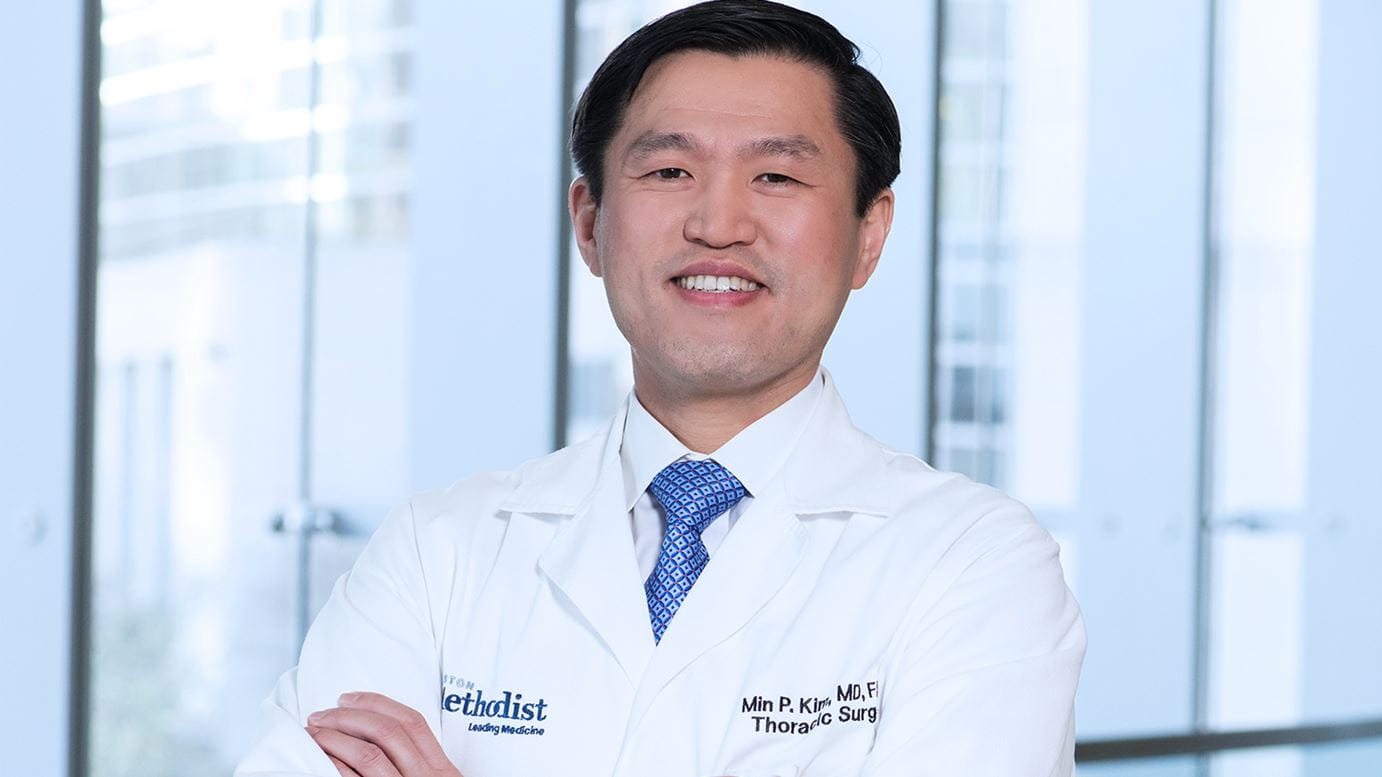
Inside the Evolution of a Thoracic Surgery Program
Jan. 28, 2026 - Erin GrahamWhen Dr. Min Kim arrived at Houston Methodist in 2010, he imagined a career split evenly between the operating room and the research lab. Fresh from a fellowship at MD Anderson Cancer Center, he had a clear plan: half his time would be spent modeling lung cancer and metastasis, the other half caring for patients.
But four years into practice, that plan changed.
Leadership approached him with a question that would reshape his career: Do you want to do the job of division chief with the title, or without it?
He chose the title — and the responsibility — despite being told by many that taking on such a role so early would be “miserable” and likely end in failure. His response was simple: If failure was the expectation, then the experience could only be valuable.
That mindset became the foundation for what would evolve into one of the most innovative thoracic surgery programs in the country.
Building a modern thoracic surgery program
Dr. Kim trained broadly — five years of general surgery followed by cardiothoracic specialization — but ultimately chose to focus on general thoracic surgery with a strong emphasis on foregut disease. At Houston Methodist, he found himself in a unique environment: an open-model hospital where any credentialed surgeon could perform a procedure. Unlike systems where lung cancer cases automatically route to thoracic surgeons, Houston Methodist’s culture meant cardiac surgeons, general surgeons and thoracic surgeons often shared the same case types.
“In this model, expertise becomes your currency,” he explains. “If you become truly excellent at something, the cases naturally come to you.”
To build a program that stood out, he focused on two emerging pillars: robotic surgery and enhanced recovery after surgery (ERAS). A decade ago, neither was widely adopted in thoracic care. Today, they define the division’s identity.
The robotic evolution
When Dr. Kim performed his first robotic cases in 2011, the technology wasn’t yet designed for most thoracic surgery. Only a few operations — thymoma resections and Heller myotomies — were feasible. Everything else still required traditional approaches.
That changed in 2016 with the introduction of the Xi platform. Now, the precision, visualization and dexterity of robotic surgery surpassed what could be achieved laparoscopically. Dr. Kim and his team tracked outcomes meticulously and published their data, demonstrating clear advantages for foregut and thoracic procedures.
Today, the division has performed nearly 3,500 robotic cases, including 2,000 by Dr. Kim (among the most in the country by a robotic thoracic surgeon). The impact on patient care has been dramatic: shorter hospital stays, fewer complications and near zero mortality for routine thoracic procedures.
Procedures that once required large thoracotomies and week-long hospitalizations are now done through small incisions, with many patients going home the next day.
Expanding expertise: lung cancer, esophageal disease and complex foregut surgery
The division’s clinical scope is broad, but lung cancer remains its core. Using advanced diagnostic tools like the ion robotic navigation platform, the team achieves 93% diagnostic accuracy for small or difficult-to-reach nodules — a significant improvement over prior technologies. They manage the full continuum of care, from diagnosis and staging to minimally invasive resection.
Esophageal cancer, one of the most complex operations in thoracic surgery, has also become a program strength. Robotic esophagectomy — once associated with 7-10 day hospital stays — now routinely results in discharge by the fourth postoperative day.
Foregut surgery is another area where the division has become a regional referral center. Large type III and IV hiatal hernias, which many surgeons feel uncomfortable tackling, are routine for Dr. Kim’s team. With robotic techniques, even octogenarians experience outcomes comparable to much younger patients, often going home after just one day.
Technologies such as EndoFLIP have further refined their approach, allowing surgeons to calibrate repairs and myotomies with precision and ensure long- term symptom relief.
Transforming culture through data and collaboration
As vice chair of quality for the Department of Surgery, Dr. Kim applied the same principles that shaped his division: transparency, accuracy and shared ownership.
Early quality reports lumped together outcomes from unrelated services, making the data unusable. Dr. Kim worked with analytics teams to build surgeon-specific, procedure-specific reporting that's accurate, validated and actionable. Surgeons now know their outcomes, better understand what led to them.
The result was a cultural shift. Surgeons began adopting ERAS pathways, robotic techniques and standardized practices because the data showed such clear benefits.
Within two years, mortality indices dropped dramatically, length of stay improved and ERAS participation more than doubled. Robotic adoption rose from 40% to over 75%.
“It wasn’t about telling people what to do,” Dr. Kim says. “It was about giving them information they could trust — and letting them drive their own improvement.”
A program built on innovation, safety and shared purpose
Fifteen years after joining Houston Methodist, Dr. Kim leads a thoracic surgery division known for its technical excellence, data-driven culture and patient-centered outcomes. With partners who contribute expertise in lung transplantation, foregut surgery and complex thoracic disease, the division continues to grow. It added a fourth surgeon in 2025.
What began as a young surgeon taking an unexpected leadership role has evolved into a program that sets national benchmarks for safety, recovery and innovation. At the center is a simple philosophy: Do what's safest. Do what's best. And use data, technology and teamwork to make tomorrow’s outcomes better than today’s.