

New Research Illuminates How Spinal Stimulation Amplifies Residual Motor Signals
Dec. 17, 2025 - Eden McCleskeyRecent advances in spinal stimulation research are reshaping how clinicians and scientists understand recovery potential after spinal cord injury, thanks in part to a series of breakthrough studies led by Houston Methodist Hospital's Dimitry Sayenko, Ph.D.
Dr. Sayenko, a neuroscientist in the Department of Neurosurgery and a member of the Center for Neural Systems Restoration, is helping move spinal cord stimulation from an empiric therapy toward a mechanistically informed intervention.
His recent work spans preclinical large-animal models, noninvasive human studies and early clinical translation, all aimed at clarifying how spinal and supraspinal circuits interact to restore voluntary motor output.
In a study published in Experimental Neurology, Dr. Sayenko and co-authors Philip Horner, Ph.D., and Dr. Amir Faraji of Houston Methodist and Giuliano Taccola, Ph.D., of Scuola Internazionale Superiore di Studi Avanzati (SISSA) examined how descending cortical signals interact with spinal stimulation in animal models using clinically relevant neuromodulation hardware.
The work addressed a longstanding gap in the field: while spinal stimulation is known to improve motor function after spinal cord injury, the neural mechanisms underlying those gains have remained poorly defined.
By pairing motor cortex stimulation with epidural or transcutaneous spinal stimulation, the researchers demonstrated that spinal stimulation, when titrated to an intensity near the motor threshold, can amplify weak descending motor commands, producing increases in motor evoked potentials of up to 400%–500%.
Crucially, the magnitude of facilitation depended on both stimulation intensity and timing. Facilitation was greatest when the stimulation was delivered at a latency matching the central conduction time of cortical input, while higher-intensity stimulation was found to suppress cortically driven responses.
"This work shows that spinal stimulation does not simply increase the excitability of motor pools," said Dr. Sayenko. "It reshapes how properly activated spinal networks process and relay brain signals, engaging multiple descending and intersegmental pathways instead of simply boosting one reflex connection."
That mechanistic framework informed Dr. Sayenko's parallel human work using noninvasive cervical transcutaneous spinal cord stimulation (tSCS).
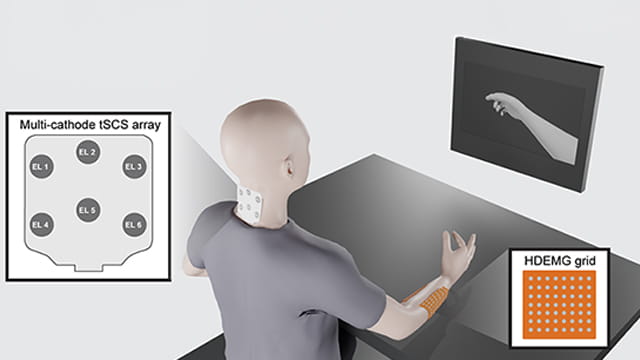
In a recent Journal of Neurophysiology study, Dr. Sayenko and researchers from Houston Methodist, Carnegie Mellon and the University of Pittsburgh combined multi-cathode tSCS with high-density electromyography to examine how stimulation modulates motor unit firing in people with and without spinal cord injury.
The study showed that tonic, sub-threshold cervical tSCS facilitated motoneuron firing via synergistic activation of transsynaptic and descending pathways, enhancing voluntary hand muscle activity by up to 21% and grip strength by as much as 55% in participants with tetraplegia.
High-density EMG allowed investigators to demonstrate, at the single motor unit level, that stimulation increased the probability of motor unit discharge immediately following each stimulus pulse — direct evidence that properly delivered tSCS can enhance integration of descending input within spinal circuits.
For clinicians, the critical implication is that stimulation parameters — location, intensity and timing — are not interchangeable variables but critical determinants of outcome.
"These studies help define a rational basis for parameter selection," Dr. Sayenko emphasized. "Understanding how different spinal cord stimulation configurations interact with descending drive is what allows us to move from anecdotal improvement to reproducible, scalable therapies."
Together, the animal and human studies form a translational pipeline that distinguishes Houston Methodist's recent contributions from earlier efforts in the field.
By using clinical-grade devices in large animals, applying advanced electrophysiological tools in humans and anchoring both in shared neurophysiological principles, the research provides a blueprint for next-generation neuromodulation trials in spinal cord injury, and potentially in stroke and other neurological disorders as well.