

AI-Enabled Virtual Care Platforms: Making Hospital Rooms Self Aware
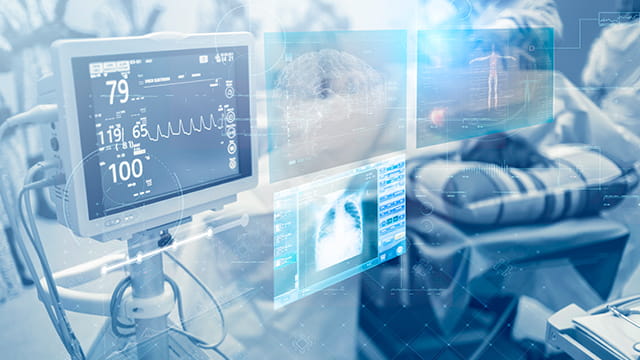
Dec. 10, 2025Houston Methodist is using artificial intelligence-enabled virtual care platforms and embedded sensors to make its hospital rooms self-aware care spaces.
The cutting-edge technology platform integrates two-way audio and video to monitor the hospital's clinical and operational workflows, helping to virtualize administrative tasks and empowering remote physicians, nurses and staff to identify potential risks.
"It's wonderful technology that allows us to monitor patients in real time in almost every single patient room in the system," says Michael Garcia, CEO of Houston Methodist Sugar Land and a leading architect of the effort. "Virtual nurses can complete admissions and help discharge patients remotely. It can be used for telesitters, and physicians can track and evaluate patients throughout their stay."
Key monitoring benefits include patient fall prevention, clinical care documentation and hand hygiene compliance. Pixelation is offered for patient privacy when appropriate.
As part of the program, Houston Methodist has established a "care traffic control center," which alerts clinicians when the platform determines patients require a higher level of care. The platform collects surrounding data from the patient's room and translates it into real-time alerts. The result is streamlined care delivery and improved patient flow.
Remote clinician-patient interactions work like this: When a virtual nurse needs to talk to a patient, a "virtual knock" alerts the patient they will be joining via a camera and audio that sit on top of or below the room's television. Beyond that, no additional technology is required.
Previously, virtual care relied on portable devices — such as computers on wheels and iPads mounted on IV poles that were wheeled into rooms. That approach worked but was cumbersome and slow.
"This allows us a lot more rapid response time," says Garcia. "We can log into any room, almost any specialty, and properly evaluate and assess the patient."
That includes managing the risk of falls, a common but significant problem, given an estimated 700,000 to 1 million occur annually in hospitals. The platform uses sensors and algorithms to look for patterns, such as gait irregularities and unusual movements that indicate an increased risk, in addition to a patient's medical history, including diagnoses, medications, procedures and previous falls. If a risk is determined, caregivers receive an alert to trigger personalized interventions before a fall occurs.
Houston Methodist launched the program, in partnership with Florida-based health care technology company care.ai, beginning in fall 2022 at its flagship Houston Methodist Hospital in the Texas Medical Center, then gradually expanded systemwide.
Two programs showcase the program's transformative potential: stroke care and psych.
Houston Methodist operates several designated stroke centers, but not all of its hospitals have on-site neurologists available all times. The platform bridges that gap. If a patient arrives at a network hospital with seeming stroke symptoms, a neurologist at a stroke center can log in, evaluate the patient and make critical decisions — such as whether to transfer the patient to another Houston Methodist facility.
"The program allows us to evaluate the patient virtually to determine whether they're suffering a stroke and then make a clinical decision, all very rapidly," Garcia explains. "For conditions like stroke, that's a game-changer."
Psychiatric care faces a different challenge: a shortage of specialists. Houston Methodist uses contracted providers for telepsych services, and the platform makes those interactions seamless. Instead of juggling equipment or scheduling delays, providers can connect directly through the in-room system.
"Because we don't always have enough psychiatrists, telepsych is incredibly valuable," Garcia says. "This technology makes it easier for contracted providers to assess and talk to our patients quickly."
Houston Methodist data already demonstrates the platform's value. In a 2024 study published in the Journal of Medical Internet Research, hospital officials reported the following benefits from the Acute Care Telenurse (ACTN) program:
- Improved patient experience — Patients reported better communication with doctors and were more likely to recommend the hospital
- Satisfied nurses — 95.3% of nurses said the program was helpful or somewhat helpful
- Saved time — ACTN calls averaged 13 minutes compared to the traditional 45-minute bedside process
- Earlier discharges — More patients were discharged before 2 PM, improving throughput
Implementing the platform wasn't without hurdles. Installing cameras required taking nursing units offline temporarily, reducing bed availability. In addition, Houston Methodist had to redesign workflows to ensure technology supported care rather than complicating it.
The effort paid off. Today, virtual nursing for admissions and discharges is standard across Houston Methodist hospitals. It also provides a new model of efficient care and helps shift care from reactive to proactive.
"The great thing is that the technology is uniform for all our programs, which allows our nurses to create standard work to remotely care for patients, whether they need assessment and care for stroke, psych or anything else," says Garcia.