
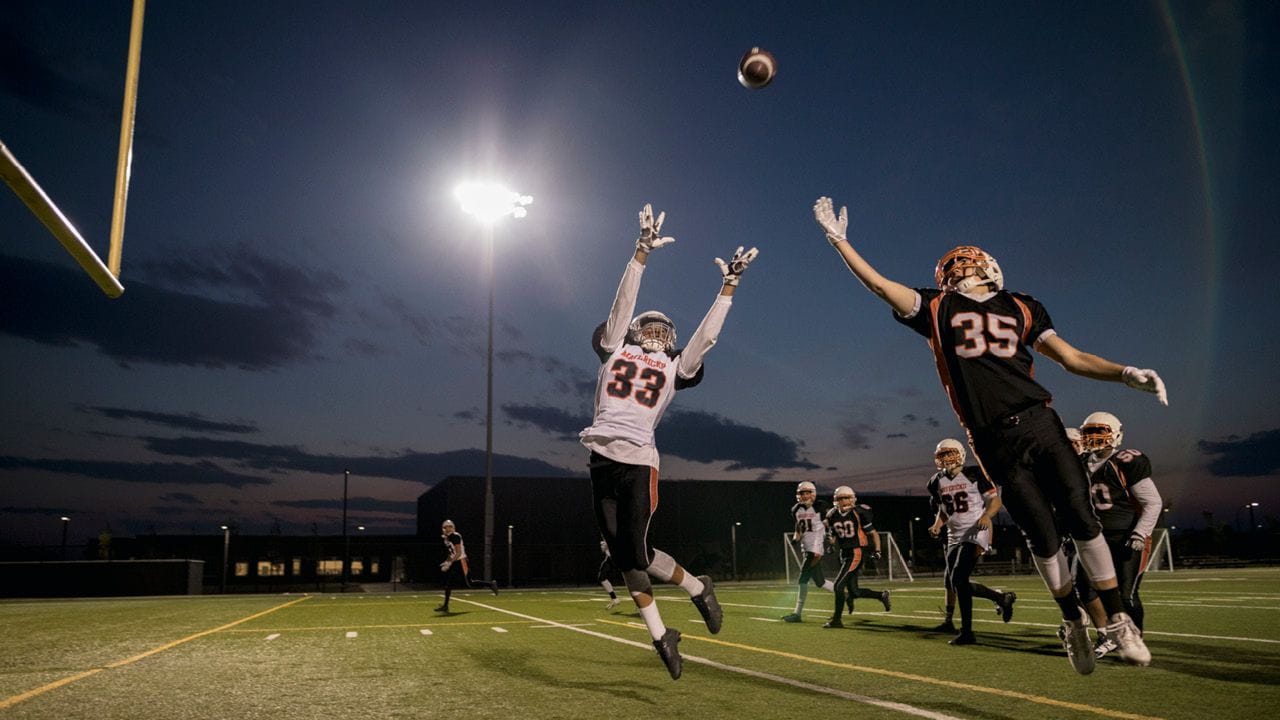

While some sports come with inherent risks, experts say there are practical ways parents can help make the games their children love safer without taking away the fun.
In an age of seemingly endless screen time, youth sports offer kids a chance to get outside, stay active and spend time with teammates and friends. But like any physical activity, sports carry some degree of physical risk, including the potential for concussions.
While most concussions resolve without lasting complications, they're more than just a bump on the head. Understanding how they happen, what may help reduce the risk and why early recognition and treatment matter can help young athletes stay healthy and safe.
The good news? Parents don't have to choose between sports and safety. The goal is to understand and minimize the risks while still recognizing everything young athletes can gain from participating.
“There are a lot of great benefits that come from football and all other team sports,” says Dr. Kenneth Podell, a neuropsychologist and the director of the Concussion Center at Houston Methodist. “You have to work as a team player, there’s camaraderie and physical exercise, problem solving and learning perseverance. There’s a lot of good that comes from that.”
While there's no surefire way to prevent every concussion, there are meaningful steps parents can take to help young athletes play safer. Here's what every sports parent should know.
Why concussions are still a concern in youth sports
Despite advancements in sports safety equipment, training techniques and injury awareness, concussions remain a risk in many youth sports. According to the CDC, about 7 in 10 emergency department visits for sports- and recreation-related traumatic brain injuries and concussions involve children ages 17 and younger. Contact sports, including football, basketball and soccer, account for 45% of these visits among children.
It also helps to understand what defines a concussion in the first place, beyond a good “ring to your bell.” A concussion is a type of mild traumatic brain injury, or TBI, and you don’t have to be knocked unconscious to have one.
“A concussion is a metabolic disturbance in brain function that is caused by trauma to the brain. It can be caused by a hit to the head or body," explains Dr. Podell. “The concussion changes how the brain functions and causes a decrease in blood flow and energy to the brain. There's no fuel or energy when the brain is trying to restore chemical balance, which leads to many of the symptoms of a concussion."
Some young athletes also face a greater risk than parents might expect. Boys make about twice as many emergency department visits for sports- and recreation-related TBIs and concussions overall. However, when girls and boys play sports with similar rules, such as soccer and basketball, girls often have twice the rate of sustaining a concussion, per the CDC. Girls are also more likely to report severe and longer-lasting symptoms.
“We know that in the same sport, women have a higher rate of reported concussions,” Dr. Podell says. “They also tend to take longer to recover and experience more symptoms.”
How concussions happen depends on the sport, but collisions between athletes are the biggest contributor overall. More than 2 out of 3 concussions in high school sports result from athletes colliding with one another. Tackle football has the highest concussion rate among youth sports, followed by girls' soccer, according to the CDC. Girls' basketball and softball also rank among the top 10.
Ultimately, an athlete’s risk for concussion is influenced by several factors — the sport itself, yes, but also the rules and type of contact that’s involved. A history of prior concussions or psychiatric disorders can increase the risk of sustaining a concussion. Understanding those differences can help parents ask better questions about coaching, equipment and safe play before their child steps onto the field, court or pitch.
[Related Content]
5 ways parents can help reduce concussion risk in youth sports
From starting conversations at home to asking questions of coaches, parents can help shape a safer sports experience.
1. Help create a culture of safe play
If possible, talk with your child before their first practice about playing safely and speaking up if they or their teammate experience possible concussion symptoms.
According to the CDC, athletes are more comfortable reporting symptoms when parents discuss concussions with them, coaches positively reinforce speaking up and teammates support players who need to sit out. Young athletes shouldn’t have to weigh how they feel against the fear of letting their team down or not playing.
“The common phrase is, ‘When in doubt, sit them out.’ If you continue to play with a concussion, you’re possibly going to take two to four times longer to recover than if you come out immediately.”
Dr. Kenneth Podell, a neuropsychologist and the director of the Concussion Center at Houston Methodist
Parents can ask leagues and coaches how they handle possible head injuries before signing up. Texas law requires public schools to have written concussion protocols overseen by concussion specialists. Schools must follow strict protocols that trained professionals oversee before students return to competition. Don't hesitate to ask to see these written protocols and which healthcare professionals helped design them for your child’s school or organization.
2. Ask how the program limits unnecessary contact
Some hits and collisions can be avoided. The CDC reports that head impacts during a high school football season fell by 42% after one school reduced contact practices from three or more days a week to two or fewer.
Parents can ask how frequently a program uses full-contact drills, whether contact is introduced gradually and how coaches enforce rules against head-first contact. Across sports, practices should reflect the athletes’ age and development, with dangerous play corrected when it occurs.
Parents can also ask how coaches teach tackling techniques. Proper tackling techniques not only reduce concussion rates, but they also reduce neck and shoulder injuries. USA Football developed Heads Up Football, designed for middle and high school football programs, to teach proper tackling techniques and make football safer and more enjoyable.
3. Choose equipment carefully and prioritize proper fit
Helmets remain essential equipment in sports such as football, baseball, softball and lacrosse. First and foremost, they help protect against skull fractures and other serious head and neck injuries, though no helmet can completely prevent a concussion.
However, when it comes to choosing a helmet for your child, the price tag shouldn’t be the deciding factor, per Dr. Podell.
“The most expensive helmet is not always the most protective helmet,” he says. “What’s important in selecting a football helmet, particularly for a younger child, is fit. It has to fit perfectly.”
The helmet should feel snug and move with the child’s head rather than shifting independently. Parents should also inspect its padding for cracks, deterioration or missing pieces and follow the manufacturer’s guidance for maintenance, reconditioning and replacement.
If your child uses a school issued helmet, ask when it was last reconditioned and the helmet’s age. Virginia Tech has independently rated various sports helmets for their ability to reduce concussion risk. Its ratings are independent and not influenced by advertisement or support from commercial helmet manufacturers.
4. Know what Guardian Caps and soccer headgear can and can’t do
Football helmet technology has advanced considerably in recent years, according to Dr. Podell. Guardian Caps, soft coverings worn over football helmets, represent another effort to reduce the force generated during contact, and their growing use among professional players has fueled interest at the youth level.
“The NFL has shown a significant reduction in the number of concussions during the preseason since Guardian Caps became mandatory,” Dr. Podell says. “What happens is the cap slips against the helmet and redirects the energy in a different direction.”
Laboratory data suggests upwards of 40-50% reduction in the force of a helmet-to-helmet hit when both players are wearing a Guardian Cap.
“The problem is that the caps designed for high school and younger athletes use different materials, and it’s not clear if they work as effectively as they do at the professional level,” he adds.
Soccer headbands and padded headgear raise similar questions. Although these products may offer protection against cuts, bruises or certain types of contact, parents shouldn’t assume they make heading or collisions concussion-proof.
“The data consistently and clearly show that soccer headgear does not reduce the rate of concussions,” Dr. Podell says.
Before buying supplemental gear, check whether it meets applicable safety standards and is allowed by your child’s league. No helmet, cap or headband can promise to prevent concussions altogether.
5. Prepare athletes with proper technique and conditioning
Equipment is but one part of safer play. Athletes also need coaching that teaches them how to tackle, block, fall, absorb contact and move through the game without unnecessarily leading with their head.
Strength and conditioning may offer another layer of preparation. Dr. Podell encourages young athletes to work on the muscles of the neck and upper back, particularly in sports that involve regular contact or require heavier protective equipment.
“If you have a stronger neck and stronger upper back, you reduce the amount of head movement,” Dr. Podell says. “Football helmets are the heaviest protective headgear, so you really need the neck and upper-back strength to control that.”
This is especially true for younger female athletes, he says. Their training often does not emphasize enough neck and upper back strength and conditioning.
Neck strengthening shouldn’t be presented as a shield against concussion, and exercises should be appropriate for the child’s age, sport and physical development. A qualified coach, athletic trainer or physical therapist can help families identify exercises that build strength without adding unnecessary strain.
[Engagement Card]
Concussion signs and symptoms every parent should know
Even with the right precautions, concussions can still happen. Knowing the signs symptoms ahead of time can help parents recognize when a young athlete should leave play and be evaluated.
“Headache is the most common symptom, but dizziness, nausea, sensitivity to light or sound and balance problems are also common,” Dr. Podell says. “Athletes may also feel mentally slow, a little confused or foggy in the head.”
Other possible symptoms include:
Neck pain
Vomiting
Difficulty concentrating or remembering
Blurry or double vision
Fatigue or drowsiness
Changes in mood or behavior, especially irritability
Trouble sleeping
(Related: How Long Does a Concussion Last?)
Symptoms may not appear immediately, and a child doesn’t have to lose consciousness to have a concussion. If something seems off following a hit to the head or body, Dr. Podell recommends having the athlete evaluated rather than waiting to see whether it passes.
“It’s very important to have a concussion checked out,” Dr. Podell says. “Typically, the people who are still symptomatic three months later are the ones who never followed up and received care. Concussions are treatable, and the sooner you have one checked out, the sooner we can start treatments or exercises that can help you recover faster.”