
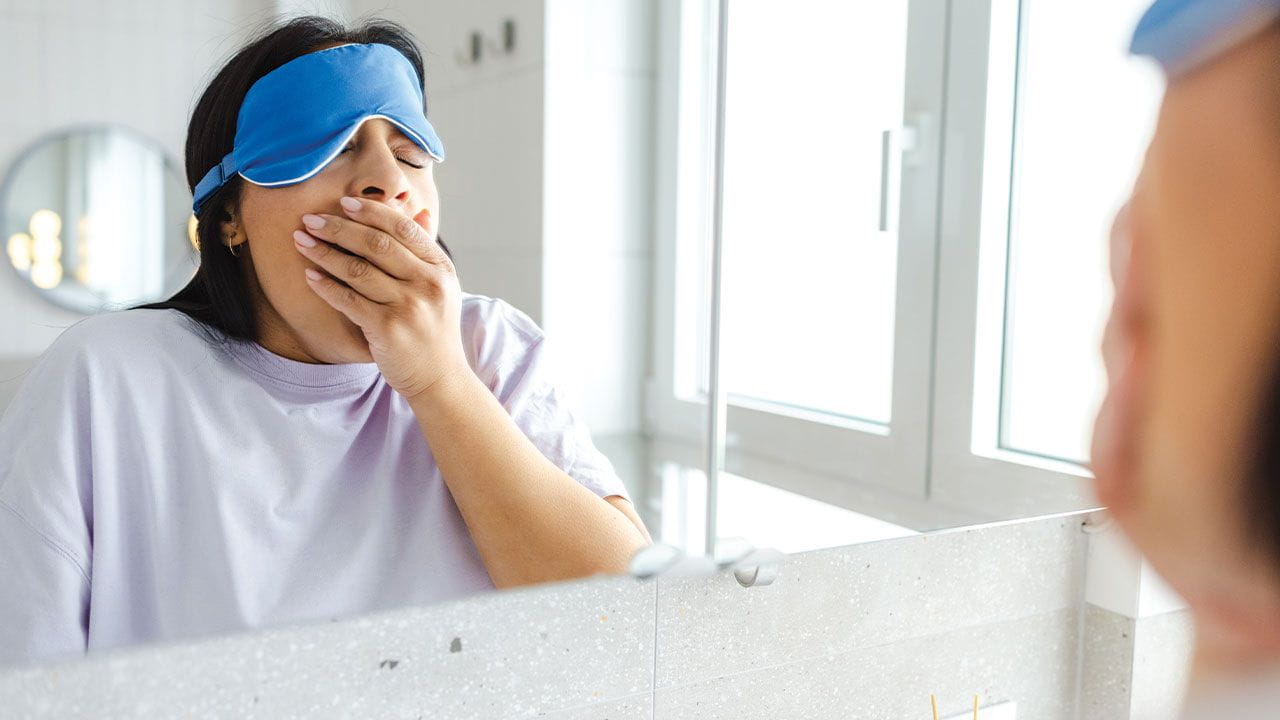

Tired after a full night's sleep? Discover what could be causing fatigue during the day and how you can combat it.
You went to bed on time, got a full night’s sleep and still woke up wanting to hit snooze. Sound familiar? The reality is that the number of hours you sleep is only part of the story. If you regularly start the day tired, the issue may not be how long you slept, but what happened before and during those hours. In this episode, we explore what could be standing between you and a better night’s sleep.
Expert: Dr. Nadir Mulla, primary care physician
Notable topics covered:
How circadian rhythm helps regulate the sleep-wake cycle
The effects of morning sunlight and evening light exposure
Melatonin: Why darkness is more important than a supplement
The potential benefits and drawbacks of sleep wearables
Caffeine blocks feelings of sleepiness — but may cause a crash later
“Decaf” isn’t the same as “caffeine free”
How alcohol interferes with sleep quality
Sleep stages and the roles of REM and deep sleep
How exercise, consistent sleep times and a bedtime routine may support better sleep
Using cognitive behavioral therapy to manage nighttime rumination
[Engagement Card]

Article Transcript
DR. NADIR MULLA: If you talk to any piano player or any instrument player of any sort, they'll be practicing a piece and they'll always be stuck or they'll always get paused on one specific portion. Next morning when they wake up, they don't have that hiccup anymore.
PAIGE ROMANOWSKI: Wow.
DR. MULLA: So your brain kind of knows what's rough around the edges and at sleep it finally hard codes and processes those things, and so you can get better without necessarily practicing harder.
ZACH: I'm Zach and this is on health with Houston Methodist. Now when it comes to sleep, I think we all have a general understanding that when you get your eight hours, you're going to wake up the next morning and you're going to feel renewed, refreshed, well-rested, right? But if you don't get those eight hours the next morning, you're going to wake up and you're going to be groggy. You're going to be a little tired, and you're going to understand why, because you didn't get your recommended eight hours, right? The question is, what happens when you get your eight hours of sleep, but you wake up and you're still tired, you don't feel refreshed. You don't feel renewed. What is an adequate amount of sleep? And that's what we're talking about today. Paige, talk to Doctor Nadir Mulla. He's a primary care physician here at Houston Methodist. And let's get into their conversation about adequate sleep.
PAIGE: Thanks so much for joining me on the podcast today, Dr. Mulla.
DR. MULLA: Thanks so much for having me. It's good to be back.
PAIGE: It's great to have you back on. Today we're gonna be talking a little bit more about sleep and why we might still feel tired after getting eight hours of sleep. Recently the CDC said that around 55% of Americans wake up feeling well rested but that means approximately 45% do not. If somebody is getting those full seven, eight hours of sleep a night but still waking up not feeling well rested, what might cause that?
DR. MULLA: First thing, everybody's heard of a circadian rhythm, correct? 24-hours and most people's understanding it's kind of our biological clock, biological ticker. And it's not just humans that have this but everything across the entire animal kingdom has it. Even going as far as to bacteria, single-celled organisms, they experience a day phase and a night phase. So let's talk about circadian rhythm first. What's your understanding of a circadian rhythm?
PAIGE: Well, based off of what my wearable says, it has something to do with when you should be exposed to light, specifically natural light.
DR. MULLA: Fantastic. Yes, I love wearables. That's also a pretty interesting subject. If we have time later, let's get into that. But yes, you hit one of the major points. Light is actually a huge factor and it's actually the most major factor in terms of controlling our circadian rhythm, which is our 24-hour clock. And the reason for that is we have this small spot inside of our brain called the SCN. That stands for suprachiasmatic nucleus, kind of a mouthful, but it's really tightly linked to photoreceptors in the back of our eyes and that's where light gets processed. And so when you first wake up in the morning, you should get some natural sunlight and that starts off and is a major controller of initiating what your body perceives as daytime. And going over a little bit more, the lack of light in the evening, which actually is the biggest problem for modern society ever since the invention of the light bulb and the iPad, that kind of is the harbinger of some of most people's sleep problems. I'm sure you've heard of melatonin also.
PAIGE: Yes.
DR. MULLA: Yeah. What is your understanding of melatonin?
PAIGE: So this might be kind of a hot take, but I am not a melatonin advocate. I have heard, correct me if I'm wrong, that it can actually mess with how your sleep happens, like your sleep cycles. And so as a not so great sleeper myself, I'm very hesitant to try that.
DR. MULLA: Very good. Very good. Yes. And people do have mixed responses with melatonin. And even within melatonin that you buy from the pharmacy, it may say that it's a certain milligram amount, but when you test it, it may not necessarily be so.
PAIGE: Sure.
DR. MULLA: And I agree with you. I would push people more so towards getting natural melatonin as opposed to taking it from a pill. And a lot of that does have to do with the light response.
PAIGE: Where is that natural melatonin available?
DR. MULLA: Great question. It comes from darkness.
PAIGE: Oh, wow.
DR. MULLA: Yeah. So there's a really cool experiment, the iPad experiment, where what they did was they compared people who were reading off of their iPad as opposed to reading off of just a regular light bulb on printed page. And they did that for like two hours before they slept. And they found that the folks that had the iPad produced 23% less melatonin than the folks just reading off of a page. And the thing is you need to get to a certain threshold to get to start that cycle of sleeping. And so when you have that prolonged exposure, it can push the circadian rhythm a little bit later. So you don't really start getting sleepy until about an hour or two later after having some kind of light stimulus, whether it's bright light from your room, whether it's from your iPad, whether it's from any other number of things, your alarm clock. And it takes very little amount of light to actually stimulate that. And so sometimes people really get caught up in terms of putting night mode on their iPhone when their room lighting is actually really bright. And so in terms of how much bang for your buck you're getting versus dimming your room lights as opposed to being on your phone however you go to sleep can be very different. When it comes to light, you know, we often talk about blue light. And yeah, compared to like LED bulbs versus regular incandescent bulbs, there is more blue light which affects your photoreceptors a little bit more. And so that can stimulate or actually not stimulate you getting as much melatonin. So what is a practical takeaway from the circadian rhythm standpoint? It's going to be first getting bright, super bright light first thing in the morning within the first 30 minutes of waking up. That can be a really powerful punch to your circadian rhythm to say, "Okay, my day has started today." And your body feels as, "Okay, my day has started today." And it can organize your hormonal patterns from cortisol, testosterone, all sorts of things to be in a proper rhythm so that way your body stays in proper rhythm and you can have perfect functioning.
PAIGE: And what about daylight savings time?
DR. MULLA: Great point. I'm so glad you brought that up. So daylight savings time is a gigantic experiment that happens throughout most industrialized nations. And what's really interesting, they did a study in Michigan where they looked at the rates of heart attacks between what's normal, what happens that night that you lose an hour versus that night that you gain an hour. I wanna ask you what your guess is.
PAIGE: I'm gonna guess that when you are losing the hour that it messes with your circadian rhythm more versus when you're gaining an hour of sleep.
DR. MULLA: Yes, absolutely. So it's really tough. There was 20% more heart attacks when you lost an hour of sleep and there was 20% less heart attacks when we gained that one hour of sleep.
PAIGE: And so what is that connection between sleep and cardiovascular health?
DR. MULLA: Great point. So sleep affects all areas of our life from our emotions to our cardiac health. And it has a lot to do with your blood pressure and how much the cycling or how strong or relaxed your heart and your blood vessels can be in that time. So it's pretty complicated, but I think overall having good sleep and eight hours of good quality sleep is going to lead to much better health, especially in regards to cardiovascular health, but in so many other different areas. And while we're on the subject of the circadian rhythm, I do think the light was really important. But the other thing that's really important is temperature. And so temperature has a huge play in terms of how we sleep and how deep we sleep and how we go through the different cycles. And so, you know, in the daytime, your core temperature, meaning inside your body, not necessarily your skin temperature, is a little bit higher. And at night it shifts a couple of degrees cooler. And what's really interesting about that is they've done experiments where they put suits on people's bodies that have water that go through the suit. So it's like almost like a wet suit. You're not actually being wet. So basically the point of that is that it can change the temperature on top of your skin surface. And what they've noted is that people can sleep much quicker. So in young healthy adults, it was like 18% faster and older adults, it was 23% faster, and especially older adults with insomnia is about 28% faster.
PAIGE: So room temperature does play a big role in your quality of sleep.
DR. MULLA: Enormous, enormous. So what do you think is an ideal temperature to sleep at night?
PAIGE: Well, I grew up in the north, so I tend to like cooler temperatures better. My ideal temperature would be a brisk 68 degrees.
DR. MULLA: Very good. They say 65.
PAIGE: Oh, wow. Okay.
DR. MULLA: Yeah. So pretty, pretty darn cold.
PAIGE: Yeah.
DR. MULLA: I think that might be a lot for people to tolerate in the beginning.
PAIGE: Yeah.
DR. MULLA: But the science is pretty, pretty solid. And the reason I keep harboring on the point of core temperature versus skin temperature, especially your hands and your feet, a lot of us will go through this pattern throughout the night and especially while we're falling asleep where we'll take off the blanket off our leg or our arm for a second. And that's actually really interesting because your extremities, your hands, your feet, your face even, they can dissipate a lot of heat. So that's your body trying to get rid of that extra heat from the core. So your blood vessels, they'll travel to your feet. They'll get exposed to the ambient temperature and they'll release a lot of their heat. And what's even more interesting is there's actually like a paradoxical effect. So when your hand and feet are cold subjectively, your blood vessels are actually quite constricted. So what you do is you put on socks, you put it underneath the bed, and that'll open up the blood vessels. And so even though they're warmer, they're able to release heat better. So that's why sometimes we'll tell folks to take a warm bath in the evening. What will happen is you'll get a lot of vasodilation or blood vessels relaxing. And what that does is you might feel warm, but your body's releasing a lot of heat. And that can actually help put people to sleep way faster.
PAIGE: Wow.
DR. MULLA: Yeah.
PAIGE: That's really interesting the science behind all of that.
DR. MULLA: Yeah.
And you know, when we see folks in the office, we used to prescribe a lot of different medications that might help people go to sleep, what we call sleep latency, meaning the time it takes between when you actually go to bed and how you fall asleep. And some of those medications, what they'll do is they'll just make a huge sedative effect. Notice I said sedative and not necessarily sleep effect. So the sedative effect, your whole brain system is slowed and your actual quality of sleep as measured by an EEG, which is the way you can measure brain waves, not as robust, the amount of nighttime awakenings that are subconscious, meaning your body has a little bit of an arousal, goes back to sleep, that can go up too. So I think a lot of these non-pharmacological methods, meaning different behaviors and lifestyle choices that we can do are actually way more effective most of the time than any one medication or any number of medications that we can use in the office.
PAIGE: Sure.
DR. MULLA: Sometimes it's a little bit hard for to hear, you know?
PAIGE: Yeah, yeah. And in the rise of the wearables, some people have noted that it can actually be a little bit more anxiety inducing, knowing that something is monitoring your sleep. In your opinion, do you think that it is a placebo effect? If the wearable says, I slept poorly, so now I feel more tired. Do you see a lot of that or do you think that it's fairly accurate and we're just becoming more aware now that we have the data at our disposal?
DR. MULLA: Great question. I'm not sponsored by any one of these companies. And so I will say that it really depends on the type of person that you are. I'll often talk to patients and I'll say, how much will this information make you more anxious versus how much do you think this will actually help you? And I think, you know, the kind of person that you are, you know, some people, they love the data and they can use that to improve their behavior to a level where it actually brings them positive benefit in their life. And so for some people it becomes a game, you know?
PAIGE: I'm that person.
DR. MULLA: Yeah. I wore a Ultrahuman ring for a bit and I used to love seeing my sleep score in the morning and seeing what my heart rate variability was overnight, what my different stages of sleep were. And to some degree they are accurate, but they're not 100% accurate. But yes, it does definitely gamify it for you. I especially liked that one piece where, I don't know if yours does this, but it'll tell you, "Hey, go to sleep at this time..."
PAIGE: Yes.
DR. MULLA: Or, "Stop drinking caffeine at this time."
PAIGE: And it's interesting too, kind of in line with the circadian rhythm, it'll tell you when you should start drinking caffeine. And it's not right away when you wake up, it's like an hour and a half after.
DR. MULLA: Yeah.
PAIGE: Does caffeine intake immediately when you wake up impact your sleep the next night? Or how does that work together?
DR. MULLA: Fantastic question. I'm really glad you brought that up as well. So again, it comes back to it depends. [Laughing] Caffeine, everybody processes a little bit differently depending on their liver and the enzymes that they have that's largely genetically driven. Some folks, they can drink tea 9, 10 p.m. and they can go to sleep just fine.
PAIGE: Wow.
DR. MULLA: They can process it quickly. Most people, it's about four to six hours that they have a half-life. So what that means is that after four to six hours, half of what you drink or half of the caffeine that you consumed is still present in your system. And so, do we know how caffeine works?
PAIGE: Probably not on a scientific level. I just know that it usually wakes me up.
DR. MULLA: Yeah, yeah. Great point. So a lot of folks feel like it makes them wake up more. What actually it does is it makes you feel less sleepy.
PAIGE: Okay. And what's that difference?
DR. MULLA: If you think of like melatonin, going back to melatonin, it's like a musical conductor that says, "Okay, start." But the actual wiring of sleeping is processed by something different, and that is sleep pressure. And they're are two very different processes that actually don't interact with each other.
PAIGE: Oh, wow.
DR. MULLA: And what you want to do, ideally, is get them to line up with your lifestyle. Mother Nature kind of did this on purpose, you know, just in case there was some crazy reason that you needed to stay up later. If you've pulled an all-nighter before, you can imagine that first part of the night, you're sleepy. Then you get to a point where you're really sleepy, but then you get to a point where you're actually a little bit more awake and alert again. And then it comes back down pretty quickly. And what you're seeing is you have the circadian rhythm, which is going through the normal 24-hour cycle with the sleep pressure. And so for every hour that you're awake, your brain produces adenosine. That's a compound that'll get higher and higher in concentration as you're awake. So when you're pulling that all-nighter, your adenosine goes up and up and up. And then when it gets to the morning hours again, your circadian rhythm comes back and says that I should be awake at this time, but you also have high adenosine. So it's not like you feel great, but you are a little bit more alert.
PAIGE: Right.
DR. MULLA: And so the way that, coming back to caffeine, caffeine works by blocking the sites that adenosine attaches to. So it competes with it. So, you know, adenosine is still existing in your system and it's still building up, but the caffeine goes into that spot where adenosine should be and says, "Okay, there's actually not adenosine here." And so sometimes people can have a caffeine crash where -- Yeah, have you experienced that?
PAIGE: I have. [Laughing]
DR. MULLA: Yeah. So after your body finishes processing that caffeine, all of a sudden all that adenosine comes back in full force and you crash pretty hard.
PAIGE: Yeah. Or if you get really used to consuming a lot of caffeine, you get a headache the next morning if you are not consuming caffeine that way.
DR. MULLA: Yeah. Yeah. Caffeine is pretty powerful. I mean, humans have used it for a long time. I use it daily.
PAIGE: Same.
DR. MULLA: Sometimes I have to be careful of getting increased amounts or too much, you know, because I could drink it all day.
PAIGE: Yeah.
DR. MULLA: But I will say one other thing. What's your take on decaf?
PAIGE: Decaf? I am not a fan. There is no point in drinking it.
DR. MULLA: And why is there no point?
PAIGE: Because I want the caffeine.
DR. MULLA: Exactly. And so what people misunderstand sometimes is that decaf doesn't actually mean no caffeine.
PAIGE: Really?
DR. MULLA: It can still actually have 15 to 30% of the caffeine as compared to a regular coffee. So if you're drinking decaf late into the night in the evening thinking you're actually not creating any issues with your sleep and your sleep pressure, it actually can. So that is one thing that I wanted to mention because I think it's little known.
PAIGE: That's a crazy myth.
DR. MULLA: Yeah. Yeah. Yeah. Sometimes my friends, I remember going back when I was thinking about this, my friends would be like, "Man, I had decaf, but I still wasn't able to sleep last night." Now I know why.
PAIGE: Yes. And I'm certain that caffeine mixing with other things in your body, like the rise of the espresso martini in popularity, what is that like on somebody's sleep aside from the caffeine effect?
DR. MULLA: Oh, great question. Yes. Alcohol is another one big factor that can impair sleep latency as well as sleep quality. Alcohol, what it does, it again, it's a sedative. It's not necessarily something that helps with sleep. So it just decreases the activation of that front side of your brain, that prefrontal cortex. And so it makes you a little bit less inhibited. Some people say, "It actually activates me. I'm more fun. I'm more social. I dance a little bit easier." And so that's exactly how it works. It calms down a lot of that cognitive functioning in that front part of the brain and lets the other areas of your brain activate a little bit more. Because the front part of your brain kind of acts as like a break. And your emotional reactivity areas of the brain, like the amygdala and your brainstem, they get a little bit more active. And so you'll get a little bit less of a particular sleep called REM sleep. Have you heard of REM sleep before?
PAIGE: I have. And it stands for rapid eye movement?
DR. MULLA: Yes, that's correct. So when you go to sleep, there's different stages of sleep. You have REM sleep and then NREM sleep, which stands for non-rapid eye movement. And that was very cleverly named.
PAIGE: Yes. [Chuckling]
DR. MULLA: So REM sleep, if you attach electrodes to your head to map out the activity of how much electrical activation is going on, it actually doesn't look any different than the awake brain.
PAIGE: Wow.
DR. MULLA: There's lots of different impulses going on many times a second. And you really can't tell the difference unless you attach electrodes to the muscles as well. And then with the muscles, you'll notice that they're completely inactive. When you're in REM sleep, you can have really vivid dreams. The other big thing about REM sleep, that's where a lot of your emotional processing and social processing occurs.
PAIGE: Can you break down what, like, the gold standard of a sleep cycle should look like? And maybe how often we should be in REM?
DR. MULLA: Great question. So there are four cycles, the REM and the NREM. There's NREM 1, 2, and 3. NREM 1 is one that most people are pretty familiar with. It's when you're falling asleep, you might have some vivid imagery. That's where people feel like they're falling and they suddenly jolt up when they're falling asleep. Stage 2 and stage 3 of sleep look a lot different compared to the REM sleep and the awake brain. So if you imagine like a football stadium right before a game, people are talking, there's a lot of chatter everywhere in all different parts, some louder than others. That's very reminiscent of an awake brain with all the different neurons firing and whatnot. The deep stages of sleep, it's when they all get into unison. If you imagine when one side of the stadium does a wave and then it goes all throughout or they all do the same chant, that's very similar to how your brain responds in stage 2 and stage 3. And we call that deep, slow wave sleep. And what's really interesting about that is that there are moments where we'll have brief impulses of electricity. We call those spindles. And what's really interesting about spindles is that we can measure them. And when we have people do memory tests and we measure their spindles, we can, without them actually doing the test after they wake up, we can predict how much they'll actually remember.
PAIGE: Wow.
DR. MULLA: Those spindles are really highly associated with learning things. If you talk to any piano player or any instrument player of any sort, they'll be practicing a piece for a long time in the day and they'll always be stuck or they'll always get paused on one specific portion. And overnight, that area of that brain that was active when they were playing, it'll also have a little bit of a spindle. Next morning when they wake up, they don't have that hiccup anymore.
PAIGE: Wow.
DR. MULLA: So your brain kind of knows what's rough around the edges. And at sleep, it finally hard codes and processes those things. And so you can get better without necessarily practicing harder.
PAIGE: Wow.
DR. MULLA: Yeah, yeah.
PAIGE: So it is true that sleep really does impact every part of your life.
DR. MULLA: Yes.
PAIGE: And what do you typically advise these patients who are coming to you in their 20s, 30s, 40s, struggling to sleep, aside from something to help them try to fall asleep?
DR. MULLA: So for our folks that are in their 20s and 30s, they can do a lot of different things. They can control their light. That's huge. Get early sunlight. Dim your rooms. Dim your evening activities as much as you can from phone to otherwise. Controlling temperature. Understanding that we need to reduce our core temperature. So reducing your room temperature as much as you can tolerate. You might get into arguments with your roommates about that. I know I do with my wife every night. You can exercise. Exercise also shows a big bi-directional pattern. Not just in terms of sleep latency, meaning how quickly you fall asleep, but sleep quality in terms of going through all the different stages and their appropriate lengths of time. You can also avoid alcohol, caffeine earlier in the day. And when we talked about temperature, the other thing was that you can do those warm and cool baths. And lastly, I think for most people, but especially in the 20 or 30 year olds, sometimes there's a little component of anxiety. We have pretty much a 24/7 world. And throughout the day, we're just so active and so distracted by doing all sorts of different things that in the night when it's time to wind down, that's actually the time where mentally and psychologically we're winding up. We're thinking about what we didn't accomplish that day, what we need to do for tomorrow. We're thinking about different social interactions that maybe didn't go as well as we ever wanted to, or what this person might be thinking. The term for this is called rumination.
PAIGE: Rumination.
DR. MULLA: One thing that you can do for all sorts of these things is cognitive behavioral therapy insomnia, CBTI for short.
PAIGE: Sure.
DR. MULLA: Really now the first-line treatment for most insomnias. We used to use a lot of sleep hygiene. Sleep hygiene is great. We touched on a lot of that here. But CBTI, one of the things that you can do with CBTI is schedule your rumination. So you'll say between 7 to 7:30, I'm gonna address all the things that bother me and we'll have a plan for them. But after 7:30, I'm not allowed to think about any of that stuff.
PAIGE: And how does one train their brain to just cut off at that 7:30 mark?
DR. MULLA: It's not gonna happen immediately, but it is something that you'll end up finding to be a little bit more useful. Because you can worry yourself constantly. But what's interesting is when you've put that rumination into that slot, you'll create your plan, you'll create what you need to do, and then you'll end up carrying those things out as opposed to like, "Okay, I said I was gonna fix that thing in the garage tomorrow. You know what, maybe I'll do it again the next day or the following day." But when you actually schedule it out, you end up accomplishing a lot of those tasks that do result in anxiety a little bit sooner. So yes, it's a difficult technique. But if you can practice it, it's like any other skill, you'll get better at it. So schedule those ruminations. And then have like a real good wind down period, whatever it is that you want to do. The bath I think is fantastic. Teas that are not caffeinated whatsoever. If you want to read something that's not on a LED screen. Create your wind down routine. And even that can become part of one of the signals that tells your brain it's time to sleep. Even brushing your teeth at night and doing that ritual. That'll tell your brain over time. Your brain will actually learn that this is a part of, "Okay, it's time to wind down." And it'll help you carry through and actually end up falling asleep. The brain is really good at patterns. So if you can sleep at the same time and wake up at the same time every day, including the weekends, which is easier and harder at different stages of your life, it's probably one of the best things that you can do.
PAIGE: Yeah. That consistency is key.
DR. MULLA: Exactly.
PAIGE: Awesome. Well, thank you so much, Dr. Mulla for joining us on the podcast today. It was great to hear all about our sleep cycles, REM, and what we can do to practice better sleep hygiene.
DR. MULLA: Thank you so much. I had a lot of fun.
ZACH: All right. That's going to do it for us this time on on health with Houston Methodist. Be sure to share, like and subscribe wherever you get your podcasts. We drop episodes Tuesday mornings. So until next time. Stay tuned and stay healthy.