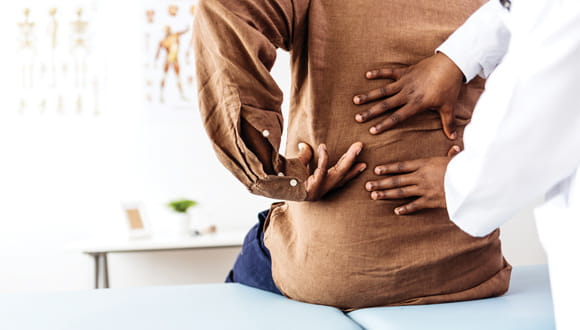
Both cause back pain and, often, radiating leg pain, and they can't be told apart without imaging.
Back pain affects nearly everyone at some point in their lives. Most of the time, it’s not caused by a structural problem in the spine, and the pain resolves on its own. But when back pain travels down the leg or comes with numbness or weakness, it's time to consider whether a more serious underlying issue may be at play.
Two spine conditions that often get confused are spondylolisthesis and a herniated disc. While both cause back pain and, often, radiating leg pain, they're two distinct issues.
"Spondylolisthesis is the slippage of one vertebra over another, while a herniated disc occurs when the cushion material between vertebrae pushes back into the spinal canal and presses on a nerve," explains Dr. Mark Prasarn, a spinal surgeon at Houston Methodist. "Because symptoms overlap significantly, a correct diagnosis requires X-ray and/or MRI."
Adding to the confusion, both conditions are often lumped together under vague, misleading labels like “slipped disc” and “sciatica.” Neither is a precise medical term physicians use to describe a specific diagnosis.
Distinguishing between spondylolisthesis and a herniated disc matters, though, because treatment paths differ, which means understanding what makes them different is the first step toward getting the right care.
Spondylolisthesis happens when a vertebra shifts out of position
Spondylolisthesis occurs when one vertebra slips forward over the one below it. It most commonly happens in the lower lumbar spine, at the top of the pelvis.
There are six underlying causes of spondylolisthesis:
Degenerative: The most common cause; this is when normal wear and tear leads to joints loosening and the vertebra to slip.
Isthmic: A stress fracture develops at the back of the vertebra, making it unstable enough to slip.
Congenital: Present at birth, this is when bones don't form properly and create vulnerability to slippage.
Traumatic: A significant injury destabilizes the spine, allowing a vertebra to shift.
Pathologic: An underlying condition (osteoporosis, Paget's disease, a tumor, infection) compromises the bone.
Iatrogenic: A previous spine surgery inadvertently destabilizes the segment.
Regardless of the cause, when a vertebra shifts out of position, the instability can lead to back pain. “And if slippage leads to narrowing of the spinal canal, it can pinch the surrounding nerves and send pain, numbness or weakness into the legs, which is called radicular pain,” Dr. Prasarn adds.
A herniated disc is a different structural problem with overlapping symptoms
Unlike spondylolisthesis, a herniated disc doesn’t involve the bones of the spine. Instead, it involves the cushiony discs that sit between each vertebra.
When a disc herniates, its inner material pushes backward into the spinal canal and can press against a nerve(s). This irritates the nerve, leading to pain, numbness, tingling or weakness, which — because spinal nerves run to specific parts of the body — travels (radiates) down the associated limb.
Like spondylolisthesis, herniated discs occur most commonly in the lumbar spine, which is why these sensations often travel down the leg.
Diagnosing these conditions requires imaging, not just a description of symptoms
Diagnosing either condition usually starts with imaging. For back pain without leg symptoms, a plain X-ray is often a sufficient first step since it's low-radiation, inexpensive and can be done in the office.
"Most of the time a person has simple low back pain, and we can rule out more concerning causes with an X-ray," says Dr. Prasarn. "Additionally, spondylolisthesis is visible on X-ray, so if that's the issue, we can often make that diagnosis immediately.”
[Related Content]
An MRI becomes necessary when leg symptoms are present, such as radiating pain, numbness or weakness.
It’s also used when neurologic symptoms appear, including:
Sensory changes like numbness or pins-and-needles
Weakness, such as foot drop
Balance problems related to impaired proprioception
Changes in bowel or bladder function
For most people, treatment starts conservatively
For both herniated discs and spondylolisthesis, physical therapy is the standard starting point, provided the patient doesn't have significant neurologic deficits.
A herniated disc can actually resolve without surgery, Dr. Prasarn notes. "The body can even resorb the herniated material over time, especially with conservative management," he adds. "Physical therapy reduces pain, improves function and buys time for that natural process to occur.” He adds that people who do not improve, or who have worsening neurologic deficits, are the ones who may consider surgical intervention.
Spondylolisthesis doesn't self-resolve the way a disc herniation can, but symptoms can still improve. "Even if that portion of the spine remains unstable, I've seen improvement with just physical therapy," Dr. Prasarn says. "If you strengthen the muscles around the spine and your core, you can stabilize that injured segment and the pain can get better without fixing the structural issue with surgery."
Reassessment around six to eight weeks is the standard guideline for gauging treatment. If symptoms are improving, conservative management continues. If they're not, surgical options may be considered.
When to consider surgery for spondylolisthesis
When surgery is needed, minimally invasive options can make recovery more manageable than you may expect.
[Engagement Card]
The clearest indication for surgery is a neurologic deficit that is getting worse. At that point, Dr. Prasarn says, surgery is almost always a must — the goal is to stop that progression before it causes permanent damage.
For patients with mild neurologic symptoms or radicular pain that hasn't responded to therapy, surgery is an option but not a requirement.
"If nonsurgical treatment fails, then it's really up to that person on whether they want to pursue surgery, so long as neurologic deficits haven’t arisen."
Dr. Mark Prasarn, spinal surgeon
For a younger, highly active patient with a herniated disc, Dr. Prasarn might take a more aggressive treatment approach, recommending surgery much sooner. “For instance, if a competitive athlete can no longer perform at a competitive level due to chronic pain or neurologic symptoms, it’s time to talk about surgically correcting the issue,” adds Dr. Prasarn.
For older patients with degenerative spondylolisthesis, the goal is often quality of life — restoring the ability to walk, stay active and maintain overall health. As Dr. Prasarn points out, a person who can't walk more than 20 feet without stopping isn't just in pain; that limitation has real consequences for their overall well-being.
Persistent back pain deserves a clear answer
If you have back pain that stays in your back, the first step is usually rest, basic care and, if the pain lingers, a visit to your primary care doctor.
But if the pain travels down your leg, comes with numbness or weakness and hasn't improved after a few weeks, it's time to see a spine specialist. Imaging will tell you what's actually happening, and from there, a clear plan can follow.
The most important thing you can do is not self-diagnose. Get the right imaging, work with a spine specialist and make decisions based on what's actually going on in your spine, not a best guess.
Frequently asked questions about spondylolisthesis and herniated disc
What is the difference between spondylolisthesis and a herniated disc?
Spondylolisthesis is the slippage of one vertebra over the vertebra below it, most commonly in the lower lumbar spine. A herniated disc, on the other hand, occurs when the soft cushion material between two vertebrae pushes backward into the spinal canal and presses on a nerve(s). They are two structurally different problems that can produce similar symptoms, including back pain and radiating leg pain.
Can I tell whether I have spondylolisthesis or a herniated disc based on my symptoms?
No. The symptoms of both conditions overlap so significantly that an accurate diagnosis requires imaging, such as X-rays or an MRI.
Is a herniated disc the same as a slipped disc?
"Slipped disc" is an imprecise, informal term that can refer to either a herniated disc or spondylolisthesis, which is part of why Dr. Prasarn discourages its use. A herniated disc is when disc material extrudes into the spinal canal; spondylolisthesis is when the vertebra itself shifts position. While one refers to changes in a disc and the other to a shifting vertebra, neither is defined by disc slippage.
What causes the leg pain associated with both conditions?
Both spondylolisthesis and herniated discs can lead to compression of spinal nerves, producing radiating pain, numbness or weakness that travels from the lower back through the buttocks and down the leg. Many patients call this sciatica, but doctors prefer the term "radicular pain" because it specifically identifies the spine as the source and distinguishes it from other causes of leg pain, such as piriformis syndrome.
Can spondylolisthesis or a herniated disc heal without surgery?
A herniated disc can resolve on its own in some patients — the body may resorb the herniated material over time, especially with conservative management like physical therapy. Spondylolisthesis does not reverse itself, but strengthening the core and surrounding muscles through physical therapy can stabilize the affected segment and significantly reduce symptoms. Fewer than half of spondylolisthesis patients ultimately require surgery.
When does back pain from spondylolisthesis or a herniated disc require surgery?
Surgery is required when neurologic deficits, such as numbness, weakness or impaired bowel and bladder function, are present and worsening. In all other cases, at least six weeks of physical therapy must be attempted first, and surgery becomes an option only if conservative treatment fails. The decision is largely patient-driven unless neurologic progression makes surgery medically necessary.