
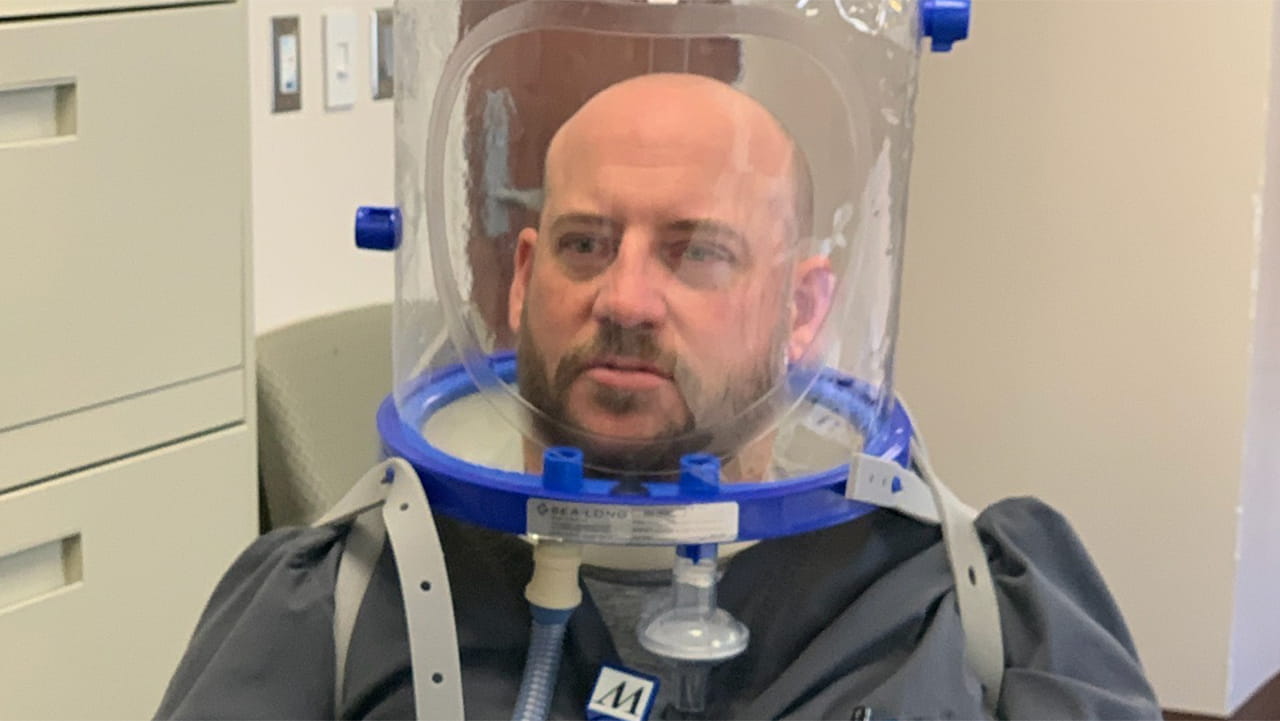

Innovative helmet may help prevent intubation for COVID-19 patients. The Sea-Long helmet is the only one in the U.S. that meets Food and Drug Administration requirements.
Only the most severe COVID-19 patients require a stay in the ICU, often when they display respiratory symptoms. Their care may begin with nasal cannula oxygen, but quickly progress to intubation, when a tube is inserted through the nose or mouth to help patients breathe—and requiring a ventilator. In addition to putting health care providers at risk when they perform the intubation procedure, many individuals require reintubation after the breathing tube is removed.
With these concerns in mind, Faisal Masud, MD, medical director, Center of Critical Care, and professor of clinical anesthesiology, Departments of Anesthesiology & Critical Care and Cardiovascular Sciences, DeBakey Heart & Vascular Center, began seeking clinical alternatives to ventilators for COVID-19 patients. One innovation was brought to his attention by Houston Methodist Chief Academic Officer, Dirk Sostman, MD, who learned about the potential device on March 31 and immediately acquired three.
Called simply “the helmet,” the device is made of lightweight, transparent plastic that resembles a spacesuit hood. Produced by Sea-Long Medical Systems in Waxahachie, Texas, it is the only one in the U.S. that meets Food and Drug Administration requirements and has been validated in a clinical study for acute respiratory syndrome.
Houston Methodist’s respiratory therapy team began testing the three helmets as soon they arrived. They confirmed the helmets met specific requirements: a secure seal, an easily attached viral filter and the ability to provide 60 liters of oxygenation. In addition to being more comfortable for patients, the helmet also allows easy access for giving inhaled medicines.
Led by Masud, the health care staff began using the helmets for ICU patients displaying symptoms from low oxygenation levels due to COVID-19. They hoped to see rapid improvement and, ideally, avoid intubation.
The helmet also is used for the special group of COVID-19 patients who are taken off ventilators—during the critical first 48 hours when aiming to avoid re-intubation.