
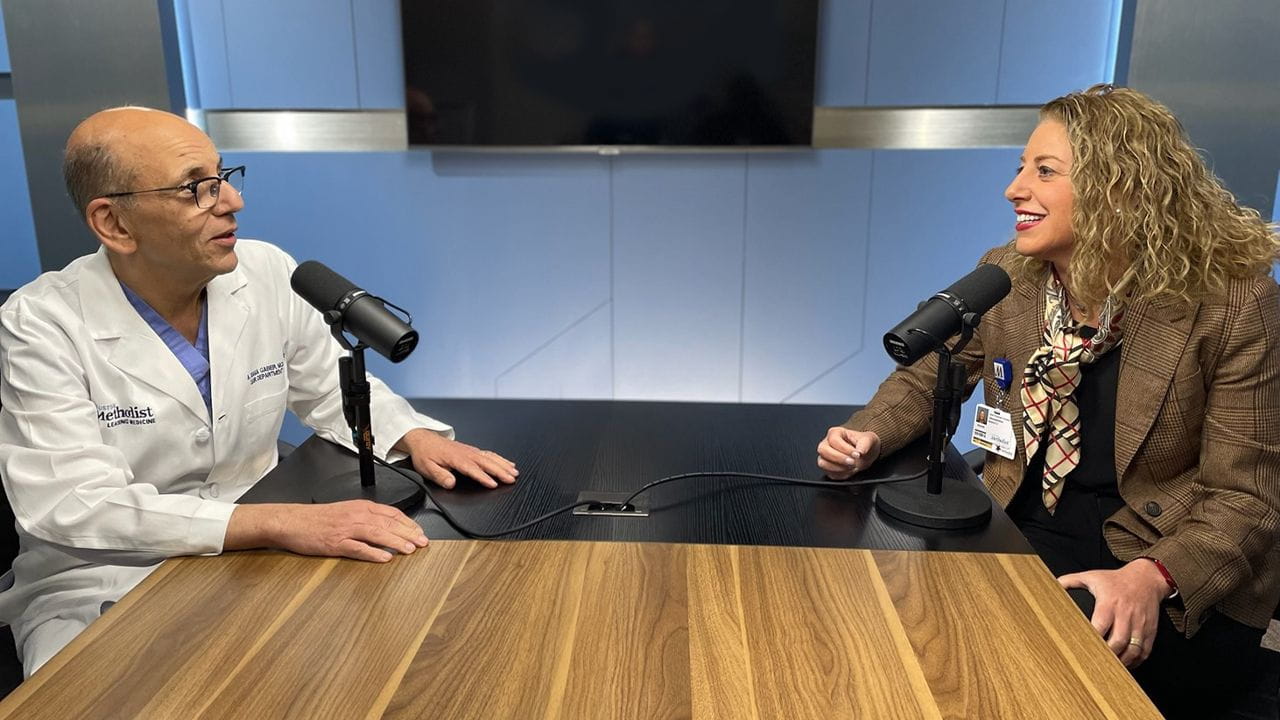

How Houston Methodist’s Department of Surgery maintains its high standards and innovative drive by focusing on safety, quality management and programmatic development.
On this episode of Quality Time, Dr. A. Osama Gaber shares how Houston Methodist’s Department of Surgery maintains its high standards and innovative drive by focusing on safety, quality management and programmatic development. By pairing talented faculty with strong institutional quality frameworks, the department continuously improves patient safety and results.
He also shares how out of the devastating loss of his daughter came Nora’s Gift Foundation and Nora’s Home — a hospitality home in the Texas Medical Center that provides affordable, supportive housing for transplant patients and their families. Built with support from Houston Methodist, Nora’s Home includes 32 rooms and community spaces and has served thousands of families over the past 13 years.
Expert: Dr. A. Osama Gaber, John F. Jr. and Carolyn Bookout Presidential Distinguished Chair in Surgery, chair of the Department of Surgery at Houston Methodist, and the Founding Director of the J.C. Walter Jr. Transplant Center
Notable topics covered:
-
The evolution of transplantation and robotic surgery
-
Houston Methodist’s performance on national quality metrics
-
Programmatic growth and curriculum development
-
Nora’s Home
Related links:
-
Dr. A. Osama Gaber (Faculty Profile, LinkedIn)
Article Transcript
DR. SHLOMIT SCHAAL: Welcome to Quality Time, a Houston Methodist leading medicine podcast. I'm your host Dr. Shlomit Schaal, a Clinician Scientist and a Retina Specialist, and I serve as they Chief Physician Executive of Houston Methodist. Join us each month as my guests and I discuss the many ways that quality impacts care delivery. I'm pleased to welcome Dr. Osama Gaber, Chair of the Department of Surgery at Houston Methodist Hospital. He's the John F., Jr. and Carolyn Bookout Presidential Distinguished Chair and the Founding Director of the J.C. Walter Junior Transplant Center. Dr. Gaber is a professor of Surgery at Weill Cornell Medical College and he's the Co-director of the Underwood Center for Gastrointestinal Diseases and Gastrointestinal Surgery. He's a senior member of the Houston Methodist Research Institute. He also founded the Nora's Gift Foundation to build Nora's Home in the Texas Medical Center, a hospitality home established to provide transplant patients and their families with affordable, temporary housing where they can find encouragement and support within a family environment. Welcome, Dr. Gaber.
DR. OSAMA GABER: Thank you, Dr. Schaal, really appreciate being here.
DR. SCHAAL: Tell us a little bit about yourself.
DR. GABER: I think you've really made a great introduction of me. I'm a transplant surgeon by profession. I am a father of five children, including Nora that we lost in an accident sometime maybe 15, 20 years ago. And I have four grandkids, and I am passionate about research, quality, and really advancing and building systems of care for patients in our community.
DR. SCHAAL: Tell us a little bit about Nora's Foundation.
DR. GABER: Lillian and I lost Nora when she was 7 years of age. We were vacationing in Italy and had a car accident. And really was an amazingly difficult time in our lives. But, you know, our patients really rallied behind us and helped us get through it, and they actually supported the idea of creating some sort of a monument to keep Nora's name alive. That's one of the things that if you're a parent and you lose child that you're always worried about. You're worried about that child being completely forgotten. And that foundation was a way to keep Nora's memory alive. And now, with the help of Methodist, which gave us an amazing gift in terms of the piece of land that we have built Nora's Home on for a nominal lease. We were able to build a home with 32 rooms and beautiful community spaces. And we've served 11 years now into building of the home. We have almost four or five thousand families that stayed in Nora's Home, all of them transplant people. And it's really been one of the most gratifying things in my career and my life. Both Lillian and I really love to see that and love to see the people who are staying there.
DR. SCHAAL: Wonderful. What a wonderful way to contribute to the memory and really make sure that actually it's really helping many families here at Houston Methodist that come to a transplant. And tell us a little bit about transplant. Not everybody knows what that entails.
DR. GABER: So, when we started -- transplantation at Methodist, it really goes back to the 1960s when Dr. DeBakey really started the first experiments in transplantation. There were a lot of firsts done in the late 60s, early 70s in transplantation here at Methodist Hospital. But Dr. DeBakey was really one of those multi-talented surgeons and his advances in cardiovascular surgery were just so impressive. The transplant center then went through a period of what I would call stabilization for several years until Methodist created this new academic sort of hospital. And when we -- I came here it was clear to me that this is one of the best hospitals in the nation but also that the transplant program was too small for the capabilities of this hospital doing somewhere around 100 transplants or so. And we built an infrastructure that recognized the uniformity of transplantation across organs. So we have a transplant center in which we do heart, lung, liver, kidney, pancreas. All the transplants. And really, with the support of the hospital and the excellence of all the staff around. This past year, we did almost 650 transplants and we're on a trajectory to easily get to 700 or 750 in the next couple of years. I think that this has been one of the major things that really transformed our hospital both clinically wise but also we have close to 8.5 million dollars in research and we published about 165 papers. We're very keen on making transplantation -- It's a gift of life for those who need it, and just structuring a program that recognizes that and services patients up to giving them a place to stay and taking care of them emotionally has been, sort of, the way by which we've enhanced transplantation. I also have to say that Nora's Home also services all the transplant hospitals in the Medical Center, which also has been growing. So, it's been a great opportunity to be part of the transplantation effort at Methodist.
DR. SCHAAL: Wonderful. And you're the Chair of the Department of Surgery. What does that department include?
DR. GABER: So, we have a very vibrant department. Of course, the transplant program is a major part of the department. We share -- the department shares with cardiovascular department the transplant program. Of course, actually we have seven other departments involved in transplantation, but for surgery we have several, really, very thriving divisions. This includes transplantation, surgical oncology, metabolic and bariatric surgery, colon and colorectal surgery, acute care, or what we call acute care surgery which is part of emergency medicine and emergency surgery. Critical surgical care. I'm sure I forgot something but this is -- [Laughing]
DR. SCHAAL: So, many subspecialties of surgery and yet you are responsible for the results in all of these subdivisions of the department. How are you maintaining high quality in the department of surgery at Houston Methodist?
DR. GABER: I think it's really -- It seems hard but it isn't because of the faculty that we have. So, in every one of these endeavors that I talk to you about we have people that are very keen and very interested in quality and outcomes. And I think just from my part all I have to do is provide the supervision and the resources, but they really are very innovative. They come up with amazing projects and quality assessments and outcomes management ideas. And of course the hospital helps a lot by having a very organized quality structure that helps us achieve our goals.
DR. SCHAAL: You recently told me that there is an incredible improvement in lowering morality rate after surgery. Tell us a little bit about that.
DR. GABER: That's one of the things that I'm most proud of. If you look at -- The hospital measures quality through the Vizient database, but also we have other databases that we use to monitor quality. In the Vizient database, which is used in the U.S. News & World Report ranked hospitals, we have the lowest in hospital mortality after surgery. Being number one in the country is really an amazing achievement for us. We also are in the top ten in the readmissions and in length of stay. We have gotten the NSQIP award for quality which was the American College of Surgeons quality program. We have excellent results in the STS and bariatrics database. We achieve sort of all those standards and parameters in there. I think that our emphasis on quality has really paid off by us becoming a very safe place and a very advanced place in terms of safety for our patients coming through for surgical care.
DR. SCHAAL: So, one of the advancements in surgery is robotic surgery. Tell us a little but about that and how you invest in that here at Houston Methodist.
DR. GABER: Yes. I saw robotic surgery as really a tremendous advance over the non-invasive sort of laparoscopic surgeries that we have. The idea of non-invasive surgery started probably in the middle 80s or so. And, you know, you can do most surgical procedures, particularly in the abdomen, without having to make big incisions or cuts into people. The robot adds another dimension in that it improves the visualization, gives 3D imaging, and actually really uses regular hand motion because the cameras are looking with your hands. So now there are many operations that were quite difficult to be done robotically before that can be achieved robotically. And I saw that it was one of the major things I emphasized when I started taking care of the department is, "Are we gonna make a robotic transformation in the department?" So, we went from about maybe 30% of the faculty doing robotic procedures to now about 70% of the faculty. In fact, the numbers would have been better if older people, like myself, would learn robotics. But all of the faculty are now robotic trained. We have so much emphasis on safety and robotics. So, we have training courses, we offer certification, we bring experts from all over the country to help us with robotics. And as a result, we've expanded our robotics surgery very extensively over the past few years. The beneficiaries of that are the patients.
DR. SCHAAL: So, the robots are expensive, right? And I'm sure there are listeners out there that are wondering, "Is it worth the cost? Is it that much better to do surgery with a robot rather than, you know, minimally invasive laparoscopic surgery?" What are your thoughts?
DR. GABER: So, when you compare both things in terms of dollars and cents, right, it seems to be that the differences are minute, right? They're not that big. But in terms of the patient acceptance, in terms of the expansion of the repertoire of surgery. So, I'll give you an example. If you wanna take a Whipple pancreatectomy and there were surgeons that could do that laparoscopically, was extremely difficult. I mean, we were doing that when I was -- when I first started coming here but it was difficult, it was complex, it took a lot of hours. Now, with robotics, we have surgeons that now would routinely can do that, right? And do it much faster and with very little blood loss and so forth. So, I think the comparison is unfair if you just do it in terms of the expense. It's the patient outcomes and it is really the expansion of the repertoire. So all of our thoracic surgery, which I failed to mention, is one of the biggest divisions that I have, all of our robotics surgeries now, about 85% of them are done -- All of our thoracic surgery now about 85% of them are done robotically. And I cannot explain to you, of course you would know that being a physician, that the difference between having your chest cut open and between having an operation without having an open chest, the average length of stay is like 2 point some days instead of weeks and recovery is much faster. And actually, because of the imaging, this is what is not factored into the cost question. We are now able to see smaller lesions that before it was just wasn't worth it to open a patient, explore for them to see if they're cancerous or not. Now they're able to find them, mark them from the outside, do them robotically, cure cancers of the lung. Completely cure them. You take a Stage 1 cancer, very small cancer, one centimeter, and you take it out and you achieve a cure. So, robotics have been a major advance for us.
DR. SCHAAL: So, how prevalent is roboting in this nation? Is that the mainstream right now or?
DR. GABER: It's up and coming. I think a lot of people are seeing the advantages of it. The learning curves are different and the procedures that are being done are different. For example, we just did our first robotic, completely robotic, living donor liver transplant. So we were able to take a liver out of donor, completely robotically and transplant it into a recipient.
DR. SCHAAL: Wow.
DR. GABER: We also did our first completely robotic kidney transplant. So now you can have a kidney transplant without being cut open.
DR. SCHAAL: Wow
DR. GABER: So, it's very advanced. A lot of people are starting to do this, but our emphasis hasn't been on being first but on being safest.
DR. SCHAAL: Mm-hmm.
DR. GABER: And I think that that's been something that's very important for us is, "How can we make this transformation?" You take a whole bunch of faculty, a whole group of people that are now training to do robotics and you transition them to do that without affecting these excellent quality outcomes that we have. This has been our challenge, and we up to now, have executed successfully on that.
DR. SCHAAL: So, you're talking about training the physicians and the surgeons of the future?
DR. GABER: The operating room staff, the anesthesiologists, the residents, everybody being trained. You touched on the training of the physicians of the future, which are our residents, and we have a very robust surgical curriculum for them that's robotically-based and we train them very intently on that. And we have a graduated program for them to gain expertise and efficiency. And the idea is if you graduate from our program you will be robotically trained and you'll be able to do that from the get-go.
DR. SCHAAL: And is there an emphasis on quality and quality metric in that residency program, that training program? Are the residents learning, you know, all these metrics that we are so familiar with? Are they learning it during residency?
DR. GABER: Actually, I don't know if you were at the most recent board meeting, but I brought my residents with me to the board meeting.
DR. SCHAAL: I know, I was there. She was sitting next to me.
DR. GABER: Oh, that's correct. That's correct, you were sitting… Yeah, and she -- I think that the -- We emphasize the training of the residents on quality. They need to understand the metrics that we have because a lot of the residents walk out of training and start jobs and they don't understand what quality management is. To be honest with you, even though I think we're ahead of a lot of people, we're not where I would like to be. I think that the residents should be part and parcel of the whole quality effort of the department's action or strategic plan. And we are working -- We have an educational retreat coming up and one of the emphasis that we're gonna have is what every resident is gonna be responsible for in terms of quality? So, for example, what we did over the last couple of years, we created an initiative called "Fresh Note." So, if you know the idea that when we do medical notes, particularly the computerized notes, there is a lot of basic medical information that gets copied from one note to the next.
DR. SCHAAL: Right.
DR. GABER: Now that doesn't change, but creating a fresh note on a daily basis to identify what the areas of concern, what the management plans are, is a huge communication tool within the hospital. And because we have a very large service of acute care surgery that is almost all -- residents are the primary caregivers in that service, we wanted to make sure that every note that we have is really fresh and really -- And the residents have been very responsive to that. It takes time because, of course, it takes time to do that. But when -- them understanding the value of that for the continuum of care in the hospital, they really have been doing quite well on that.
DR. SCHAAL: So you've been in surgery, in the surgery field for quite a while, what can you tell me, share with me as the biggest forward step that you've seen in your lifetime?
DR. GABER: Oh, my God. There has been so -- I mean, I think our generation has really seen tremendous changes in surgical care. And I think the introduction of laparoscopy and robotics has been amazing. I think the advances in transplantation have been, just, unheard of. I think that when you talk about cancer care the chance of cure and prolonging survival of cancer patients that we see now. There are a lot of diseases I studied in medical school that were terminal and now I see people, you know, living five, seven, ten, fifteen years after a cancer diagnosis that was not possible just because of the biomarkers, the genetics, the introduction of the new treatments and so forth. I think now we're also on the cusp of a whole new revolution into CRISPR technology and gene editing and introducing that into the clinical practice. There is, I mean, I just think the medical practice, the informatics part, the ability to use artificial intelligence to determine, you know, patient outcomes and how to triage patients in care is just starting but I think that's gonna be the next revolution. It's been mind-boggling and I'm just so happy that throughout my career I've been able to be part of that.
DR. SCHAAL: And you're the Chair of Surgery, it's not only here at Houston Methodist Hospital it's really all across our system. So, how do make sure that the same quality, high quality of care and low mortality is everywhere in the system?
DR. GABER: Well, I mean, you touched on a very important part. Our patients walk into a Methodist hospital, they don't see a difference. I mean, we see a difference because of where we're stationed. They don't see that, it's all Methodist to them. And they expect the same quality, the same patient experience, the same outcomes and so forth. So, I think this needs work, right? It doesn't happen arbitrarily, it needs work. It needs work from the surgeons and it needs work from the management and administration of these hospitals, and we're blessed by having a system that's, like, fully coordinated with each other. I think you recruit the correct people, and I can tell you that out of all our system hospital, close to 30-50% depending which hospital you look at, we've recruited our residents to work in there.
DR. SCHAAL: Uh-huh.
DR. GABER: This is a guaranteed quality of a person that understands quality as with a Methodist stamp on it, right? So, we have these people there. We recruit excellent surgeons that want to be in the Houston area that will work in these hospitals. We give them the support and the resources, I think that's very important. We give them the technology, like robotics, across all of our hospital system. And you know, the chairman maintains supervision of what happens and makes sure that everything is happening correctly. I have to say that I'm very proud. I mean, some of our system hospitals have national recognition for the quality that they have in surgical care, and I have to tell you that I couldn't have been more happy with that.
DR. SCHAAL: So, you said "excellent surgeon," and I am wondering if this definition of excellent surgeon has changed over the years. What does it mean to be an excellent surgeon?
DR. GABER: It has changed dramatically. So, when I was growing up, an excellent surgeon, somebody who did excellent surgery. But now, an excellent surgeon is somebody who does excellent surgery, is a great communicator, is a team player, is a patient advocate, is a quality champion. I mean, I think an excellent surgeon now is much more of a complete sort of physician than that definition has ever meant. Now, I think also in a hospital like Methodist, an excellent surgeon should understand the science, should be on the cutting edge of the technology, should be an innovator. I mean, I know it's a tall order but it's amazing that we have, you know, 85 surgeons in the department that would all qualify for that label. So, we -- It takes us a long time to pick our candidates, but it pays off in terms of our safety and our patient outcomes.
DR. SCHAAL: It's interesting that you mentioned being a team player as one of the qualities of a really excellent surgeon. And once you invited me to one of your faculty meetings and you told your faculty, I heard that, I sat there, and you said, "I don't want a department of surgeons, I want a department of surgery." What did you mean by that?
DR. GABER: So, I think that if you don't instill team process and programmatic growth into a department, then the surgeons tend to gravitate into doing well themselves. And I think in order to lead transformational health care, you know, changes, you need to have programmatic visions and that's part of our strategic plan, actually, is that we are gonna emphasize programmatic development. I can have five really great surgeons that can do transplants but that doesn't guarantee -- I mean, and I've seen that in a lot of other programs. You have excellent people, they can't get along, and the programs never grow, and the patient don't get the benefit of that excellence. So, I think if you recruit excellent people that are team players and you create a department surgery, a department of people working together to achieve patient quality, that is not just an additional, it's a multiplier. It's a, you know, it multiplies the value of your surgeons to the patients. And if you come on a Saturday or Sunday to the operating room, right, and you're look at the transplant program, like, 70, 80% working that program are there. It's not because they're on call, it's not because somebody told them to be there, it's because they all wanna help each other because they wanna make sure that the patient outcome is best. And I think that's the spirit that our department has.
DR. SCHAAL: And another thing that I was impressed is seeing so many women surgeons in your department. How does that -- First of all how does that happen and then how does it affect quality?
DR. GABER: Well, I think that it happened by design. As you know our prior chairman, Dr. Barbara Bass, was one of the top women surgeon in the country. And I have a daughter that's in medical school and I understand that I would love for her to get the same opportunities like everybody in surgery. So, it happens by design because you realize that the -- If you look at the past 15 years, there has been a growth in the number of women surgeons. And I think women surgeons bring that team mentality, the dedication to the patient, that care about outcomes, you know, to a team. They actually help very much glue teams together and -- It's a personal bias, I don't have statistics to show that, but I truly believe in that. And I look for excellent women surgeons because I think they are really a real gift to this goal of building departments. And I've been very much rewarded. If you look at our quality outcomes, for example, right? With 40% of our faculty being women that's, you know, an amazing tribute to their contribution.
DR. SCHAAL: Wonderful. And we're gonna end this conversation with a question that I ask all my guests, it is, what does quality mean to you?
DR. GABER: Really, I look at it from the patient's perspective, right? I mean, I know the numbers and I know the databases and so forth, but I have one of my best friends going through treatment, actually. He's from, you know, another state but he flies out to Methodist to get his care because I believe in that quality. That is what quality means to me, is when I bring my best friend to be cared for where I believe there is quality. That is quality, and it means that it's patient experience that is unrivaled. It's safety in the operating room, it's safety for -- It's great transition between inpatient and outpatient care. It's responsive physicians. It's state of the art treatment. To me that's all, these are all elements of quality and I'm just so happy that I work in an environment like this.
DR. SCHAAL: Wonderful. Dr. Gaber, it's been so inspiring to talk to you and learn from you. Thank you very much.
DR. GABER: Oh it's my pleasure, thank you so much.
DR. SCHAAL: And thank you for listening. So that you never miss an episode, subscribe to Quality Time. New episodes will download to your podcast device. I appreciate your support. Thank you, and until next time, I am always listening.