
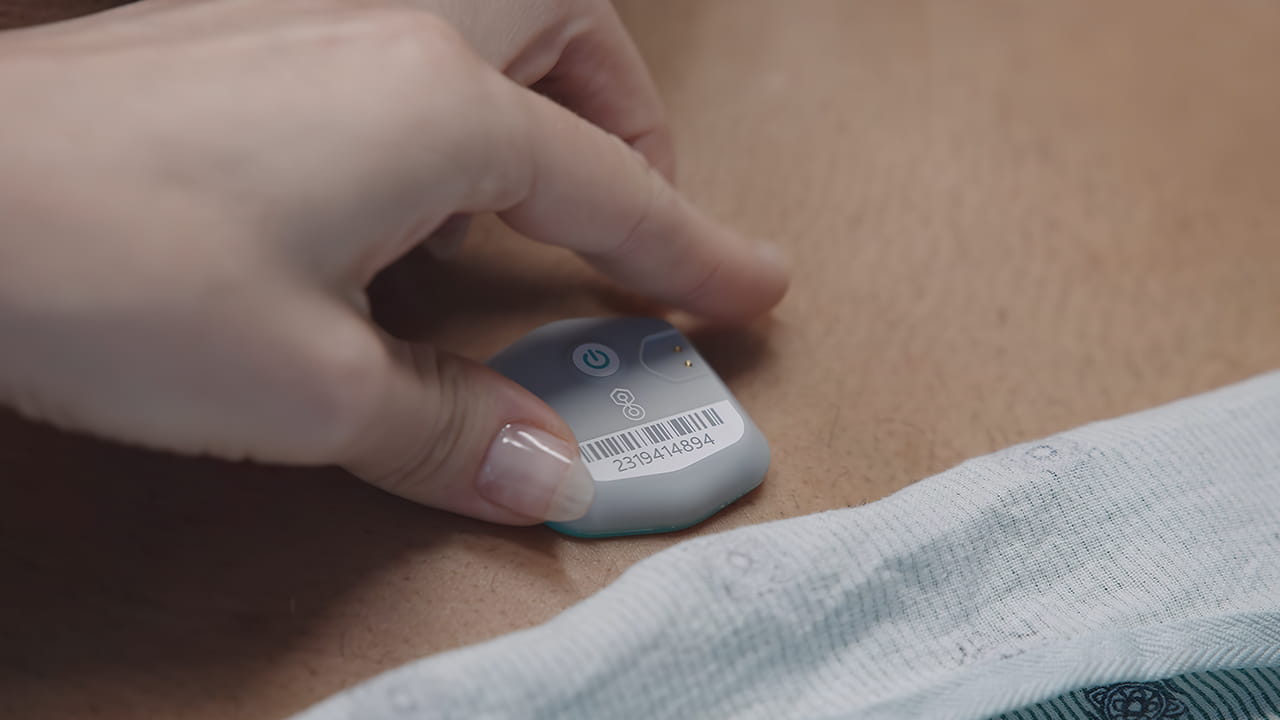

Houston Methodist Cypress is leading the hospital system in using innovative, wearable technology to monitor patient care.
When Houston Methodist began designing its new Cypress hospital in 2021, leaders were asking a forward-looking question: which digital health technologies would be mature enough by 2025 to meaningfully change patient care? Among the answers, one tool emerged as transformative — continuous, wearable patient monitoring powered by a biosensor.
Rather than treating continuous monitoring as an add-on, Houston Methodist set out to build a clinical and technical environment where technologies could operate at full scale and deliver measurable clinical impact.
From intermittent vitals to continuous insight
In 2022, Houston Methodist partnered with BioIntelliSense to deploy the BioButton, a small wearable biosensor that continuously captures vital signs every minute and sends hourly summaries directly into the electronic health record (EHR). The shift marked a fundamental change from traditional four-hour spot checks to uninterrupted physiological monitoring.
That change has driven meaningful improvements in both patient outcomes and clinician workflows. In general care units, continuous monitoring has been associated with a 27% reduction in the risk of patient mortality and earlier detection of clinical deterioration. A 2025 study of 1,120 patients showed that minute-by-minute data enabled clinicians to identify subtle physiological changes hours sooner than conventional methods.
“For a patient who’s sick enough to be in a hospital, a lot can happen in four hours,” says Dr. Sarah Pletcher, Houston Methodist’s chief digital health officer. Continuous monitoring fills in those blind spots while allowing patients to rest more comfortably, particularly overnight.
Reducing bedside burden
Beyond its clinical value, proactive patient monitoring has also changed the day-to-day experience of nursing care. Traditionally, bedside nurses may spend up to three hours per shift transporting vitals equipment from room to room. Automating much of that process through wearable monitoring frees clinicians to focus on direct patient care and helps ease workforce strain.
This operational benefit becomes especially significant at scale. Data from biosensors is monitored centrally, with a single clinician able to oversee up to 500 patients across the system. Continuous streams of data support earlier interventions without increasing staffing demands, reinforcing the business case for systemwide deployment.
A hospital designed to support continuous monitoring
The Cypress hospital was designed specifically to support these multiparameter wearable innovations. Rather than retrofitting aging infrastructure, Houston Methodist embedded reliability, security and scalability into the building itself, creating standardized, technology-rich patient rooms across the facility.
Each room operates on an available, segmented network capable of supporting dense device environments, Internet of Things and virtual care workflows. This digital foundation ensures that continuous data from wearable biosensors can move seamlessly into clinical systems and command centers without interruption.
Because every room is equipped identically, clinicians experience consistent monitoring across units — an important factor in driving adoption and trust in continuous monitoring technologies.
Continuous monitoring as part of a virtual care ecosystem
At Cypress, wearable device data feeds into a broader virtual care infrastructure that includes virtual nursing, telesitting and centralized monitoring teams. Overnight, ICU beds across the Houston Methodist system are monitored virtually, and biosensor data adds another layer of proactive surveillance outside of critical care units.
This ecosystem allows Houston Methodist to move from reactive response to anticipatory care, identifying deterioration earlier and coordinating interventions faster — sometimes before a bedside clinician would otherwise notice a problem.
Looking ahead
Houston Methodist leaders see continuous monitoring as a cornerstone of how inpatient care will evolve. The Cypress hospital now serves as a proving ground where continuous monitoring can be tested, refined and scaled across the system’s eight-hospital network.
With its flexible, innovation-ready design and proven clinical impact, continuous monitoring is helping Houston Methodist redefine how hospitals detect risk, support clinicians and improve outcomes — not just today, but well into the future.