

A clear understanding of TED’s mechanisms, clinical features and treatment options is essential for timely recognition and treatment.
Video Highlights
-
Thyroid eye disease (TED) most commonly affects patients with Graves’ disease, but thyroid status does not exclude risk. Up to 25–50% of patients with Graves’ disease may develop TED, and 5–10% of cases occur in patients who are hypothyroid or euthyroid. Smoking is a major modifiable risk factor and is associated with increased disease severity and resistance to treatment.
-
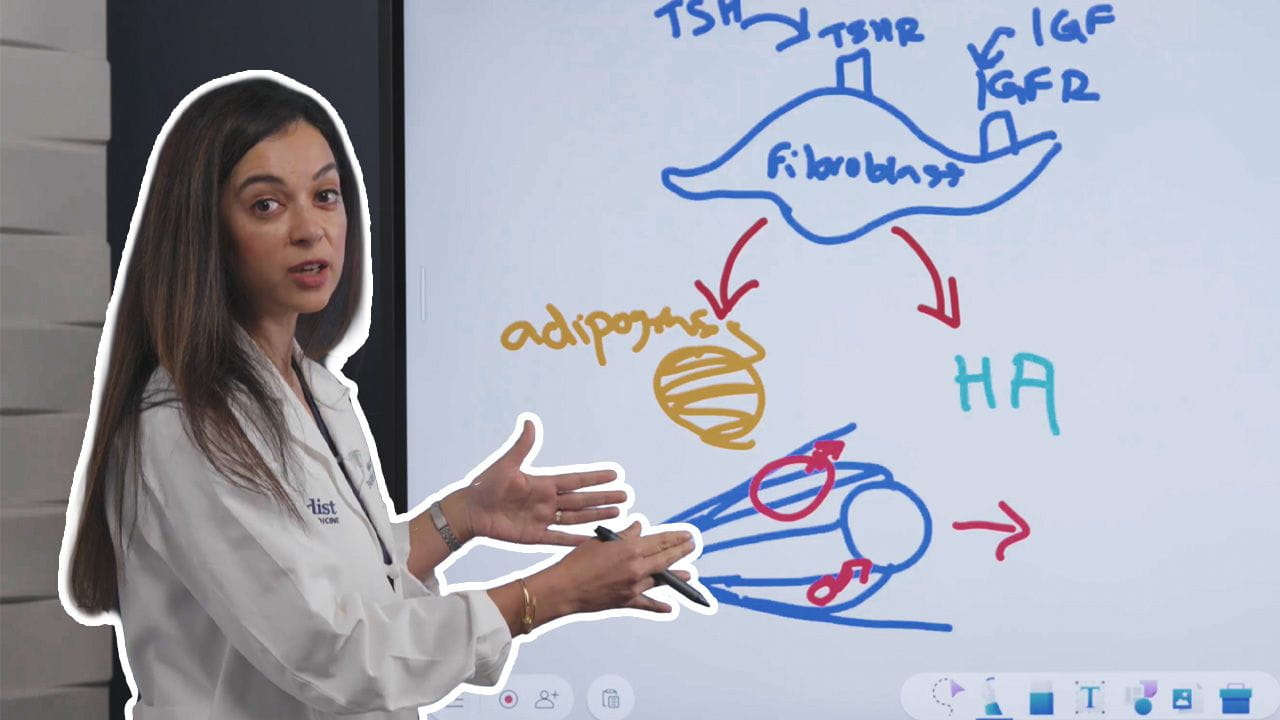
Orbital inflammation is driven by antibody activation of fibroblasts within a closed bony space. Circulating TSH and insulin‑like growth factor antibodies bind to receptors on orbital fibroblasts, triggering adipogenesis and increased glycosaminoglycan (hyaluronic acid) production. Expansion of fat and extraocular muscles within the confined orbit results in proptosis and other downstream inflammatory manifestations.
-
Eyelid retraction and proptosis are the most common clinical signs. Lid retraction occurs in up to 90% of patients and may be superior, inferior or lateral in distribution, sometimes presenting as contralateral ptosis due to Hering’s law. Proptosis is the second most common finding and can be unilateral or bilateral, reflecting forward displacement of the globe.
-
Pain, diplopia and ocular surface disease reflect extraocular muscle involvement. Patients frequently report orbital pain that worsens with eye movement, along with dry eye, tearing and keratopathy related to exposure.
-
Diplopia occurs due to enlargement of extraocular muscles — most commonly the inferior rectus — typically sparing the tendon and helping differentiate TED from other orbital inflammatory conditions.
-
Optic neuropathy is rare, but it's vision‑threatening and requires early recognition and urgent treatment. Seen in approximately 6–9% of patients, this complication may result from compressive or stretch mechanisms at the orbital apex.
Thyroid eye disease (TED) is a complex condition that most often occurs in patients with Graves’ disease but can also present in hypothyroid or euthyroid states. The disease is driven by antibody‑mediated inflammation within the orbit, leading to characteristic changes in eyelids, extraocular muscles and orbital fat. While many patients present with visible orbital signs, symptoms can range from ocular surface discomfort to vision‑threatening optic neuropathy. A clear understanding of TED’s mechanisms, clinical features and treatment options is essential for timely recognition and treatment.
Article Transcript
00:00–00:30 Hi. My name is Amina Malik, and I'm the director of oculoplastic surgery here at Houston Methodist Hospital. And I'm going to be discussing with you all thyroid eye disease. What we'll go over briefly is the epidemiology, pathophysiology, risk factors, clinical signs and symptoms and treatment. So let's get started discussing the epidemiology. So who gets this disease? So patients who typically are affected are going to have Graves' disease. Up to 25 to 50% of patients with Graves' disease can develop this condition. Patients who are hypothyroid or euthyroid can still get the condition,
00:30–01:00 but it's less commonly seen. In 5 to 10% of the time patients can be hypo or euthyroid. Now. While Graves' disease patients are the ones who most commonly get affected with the eye disease, what additional risk factors do patients have? Well, female gender, like most autoimmune conditions, are going to be more likely affected as they have an overall incidence
01:00–01:30 of 16 per 100,000. Males can also get this disease, but it's at a lower incidence of about 2.9 per 100,000. Other risk factors for this condition are going to include smoking. This is a major risk factor for the condition, as they have to 7 to 8 times more likely to get the disease, and if they have the disease, it's more likely to be severe and more refractory to treatment. Now let's talk about the pathophysiology.
01:30–02:00 So what's causing this condition? Oftentimes it can be confusing for patients. My thyroid is here. My eye is here. Where is the connection or what's causing this? So let's go back and think about what's happening on a cellular level. So we have orbital fibroblasts in the orbit. And on these orbital fibroblasts, we have receptors. We have the TSH receptor
02:00–02:30 as well as the insulin-like growth factor receptor. And in autoimmune thyroid conditions, we have these circulating antibodies. The TSH antibody as well as the insulin-like growth factor. And both of these can bind to these receptors on the orbital fibroblasts. Now when this binding happens, then what? Well I'm going to change our color here. And what we can see happens is that binding leads to two things.
02:30–03:00 We're going to get increased orbital fat or adipogenesis. So we get increased fat production. Adipogenesis. And we're going to get increased hyaluronic acid synthesis. Glycosaminoglycans. So this is just going to be increased HA. And so when we get that increased HA, and the increased orbital fat, well what's happening to the eye?
03:00–03:30 So if we go back to think about our eye we know that it lives in a closed bony socket. We have the extraocular muscles surrounding it. And it's living in this pear-shaped orbit. Okay. And so when we get the enlargement of both the fat as well as the intraocular muscles, you get increase in the size, increase in the size. What's going to happen to the eye? It has nowhere to go but forward.
03:30–04:00 And so it's this binding that's happening to these receptors on the orbital fibroblast that's leading to this downstream inflammatory reaction that will then correlate with the clinical signs and symptoms that we see in thyroid disease. So what are the most common clinical signs and symptoms that these patients present with? Well, lid retraction is the most common sign. 90% of patients with thyroid eye disease will have this. And so normally we know that the eyelid should rest so that it's covering the superior 1 to 2mm of the colored part of the eye or the iris.
04:00–04:30 However, in thyroid eye disease, we often will see the sclera both above and below the colored part of the eye. So you can have superior lid retraction and inferior lid retraction where we can see the sclera here. Now sometimes it can be more subtle where patients only have lateral lid retraction, as in this patient we can see the superior sclera laterally. And so that lateral flare is also, you know very classically seen in thyroid eye disease. It's also important to realize that some patients can actually present with ptosis or a droopy eyelid due to Hering's law from a contralateral eyelid retraction.
04:30–05:00 So in this patient again we can see the superior scleral show here laterally that lateral lid flare, which is again a classic sign in thyroid eye disease. And what's happening on the right side because of Hering's law, each eye we know gets equal innervation from the brain. In Hering's law, we know that the left eye eye is getting the signal from the brain
05:00–05:30 to relax while the right eye gets that same signal to relax. And that's why this patient has ptosis here. So although she presented with a droopy eyelid, an eyelid lift really was not the treatment, but rather a workup for thyroid eye disease, which is indeed what she had. So eyelid retraction is the most common sign. 90% of patients with thyroid eye disease will present with this. Now, proptosis is the second most common clinical sign we're going to see in patients with thyroid eye disease.
05:30–06:00 And it's important to realize that thyroid disease is the most common cause of unilateral or bilateral disease. So it can affect one or both eyes. When we think about the pathophysiology, when we have all of that expansion happening behind the eye, the increased size of the extraocular muscles, the increased fat. There's nowhere for the eye to go but forward. So we get the axial proptosis or exophthalmos. In addition we can see eyelid edema which we can see here. The eyelids are swollen. We also can see erythema of the eyelids. If we go back to our classical signs of inflammation, you know, redness and swelling. We can also have pain or pressure
06:00–06:30 if we think about the orbit being congested and enlarged. Patients will often complain of this dull, achy, throbbing sensation behind the eyes. And this can often worsen with movement. And that is again because of the increased size of the extraocular muscles when they move their eye, in any direction. That can be, painful. So we have pain that can be worse with eye movement.
06:30–07:00 We also can have conjunctival injection where the eyes are red, as we can see here. We can also have caruncular swelling or caruncular edema. So here we can see the conjunctival injection. The caruncle is here in the medial, part of the conjunctiva. That can often be swollen. We can also have chemosis, which is the, conjunctival swelling. And we also see here just all of her eyelid swelling and erythema. So she has all of the classical signs of thyroid eye disease, and this patient
07:00–07:30 was an active smoker, making her disease more severe. So we'll just write chemosis here as well. To again, go over some of the more common signs that we're going to be seeing in thyroid eye disease. Now, when it comes to symptoms, again, these patients will complain of pain often. They often will have watery eyes. They can have dry eyes, due to, the overproduction of tears from the lacrimal gland. Or sometimes the tearing can also be reflex tearing because they have exposure.
07:30–08:00 Keratopathy from the eyes being abnormally widely open or proptotic that can lead to surface increased surface area for the tears to evaporate from and dry from. So they often will have the burning sensation as well, which can lead to reflex tearing. Now, in addition, patients can often present with double vision or diplopia. And this happens again because of enlargement of the extraocular muscles.
08:00–08:30 Now, the most commonly involved muscles, there's a mnemonic for this called, I'm slow (IMSLO). And so the inferior rectus muscle is the most commonly involved muscle. So we can see here it's significantly enlarged compared to the right side. And that you can see the ocular misalignment corresponding with the enlarged muscle. The medial rectus is going to be the second most involved muscle, followed by the superior rectus.
08:30–09:00 Followed by the lateral rectus. And lastly followed by the oblique muscles. The superior and inferior oblique muscles. Now important to remember is in these patients the extraocular muscle involvement usually spares the tendon. So it's the muscle belly that's enlarged. But the tendon is not, which is an important differentiating factor from, condition that can be in the differential diagnosis for thyroid eye disease, which is going to be orbital, idiopathic orbital inflammation.
09:00–09:30 So in those cases, oftentimes the tendon will also be involved. Now in addition to lid retraction, proptosis, double vision, what other signs can we see on exam? The most important, but thankfully most rare sign in thyroid eye disease is going to be the dysthyroid optic neuropathy.
09:30–10:00 And why is this important? Because this condition can cause patients to go blind. And that can be permanent if left untreated. Now, this can be seen anywhere in 6 to 9% of patients. It is more commonly again seen in patients who smoke. And so what is happening in these patients is the optic nerve can become swollen, which can lead to vision loss. And what's causing this optic neuropathy.
10:00–10:30 So when we go back and think about the eye living in the closed bony socket, the orbit, when we have the expansion of them, extraocular muscles that can cause compression on the optic nerve, which can lead to the swelling and the vision loss. So this can either be one of two types—compressive optic neuropathy where again, pressure from the enlarged fat and extraocular muscles can push the optic nerve at the apex, causing vision loss. Or we can have what's called stretch optic neuropathy, where the eye becomes
10:30–11:00 so proptotic that it puts the optic nerve on stretch, it becomes taut. So you can see in this case that globe is fully beyond the orbit. And you can see the shape of the eye can somewhat change to become a little bit more guitar pick instead of a normal round shape. So both of these conditions—compressive or stretch optic neuropathy—are emergencies where patients need to be treated urgently with either surgery and or medication, to, to prevent permanent vision loss. And patients can check for this at home.
11:00–11:30 Also, you know, red desaturation is one of the earliest signs of optic neuropathy. So they can take a red lipstick or a marker and just check one at eye at a time. And if it starts to become more rust colored or dull, that can be an indication that they could be developing this condition, which again needs to be treated emergently. So now that we've gone over the most common clinical signs and symptoms of this condition, you know, what can we do for these patients? What are our treatment options?
11:30–12:00 So starting with lifestyle changes, there are things that we can advise our patients to do. So of course, avoiding smoking. That is going to be bad. So primary or secondhand smoke can release further glycosamino- glycans from those orbital fibroblasts, leading to increased congestion. So that is the single most important modifiable risk factor that these patients can do. Also low salt diet, that can also help decrease swelling.
12:00–12:30 Sleeping with their head elevated can also help. Avoiding stress of any time. We know that can worsen any autoimmune condition, including thyroid eye disease. And then in some studies, selenium supplementation has been shown to prevent worsening of thyroid eye disease. Now, these studies did take place in selenium-deficient populations. But patients can try taking selenium 100 micrograms twice a day for six months,
12:30–13:00 or they can eat a fistful of Brazil nuts, which are also high in selenium to try to decrease the disease progression. So we have some lifestyle things. In addition, there are medical treatment options that we can discuss. Now, prior to 2020, steroids were the mainstay of medical therapy for thyroid eye disease. And in the EUGOGO trials, IV steroids were shown to be more effective and have less side effects than oral steroids.
13:00–13:30 And so in the EUGOGO trial, the typical dose is 500mg IV weekly for six weeks, followed by 250mg weekly IV for six weeks. So steroids can be considered. In addition, there are some other immunologics that can be used, including rituximab, which we know is a CD20 inhibitor, as well as tocilizumab, which is a IL-6 inhibitor.
13:30–14:00 These are off label indications for thyroid eye disease but have shown to be efficacious in various trials. Now, orbital radiation can also be used as a useful modality to decrease the inflammation that these patients are experiencing in thyroid eye disease. And then in 2020, we had our first FDA approved medication, teprotumumab.
14:00–14:30 This is a insulin-like growth factor receptor inhibitor. It's a monoclonal antibody that is also given IV, and it's given every three weeks for a total of eight infusions. So it's over a six month therapy. And this was evaluated in two, large, randomized, double blinded clinical trials. And it was shown to be effective in decreasing proptosis as well as their clinical activity score.
14:30–15:00 So I'll show some clinical examples of patients who were treated with teprotumumab and saw marked improvement. We can see here this patient has the eyelid swelling as well as the erythema, the conjunctival injection, as well as proptosis. And after her eight infusions of teprotumumab, she had a marked reduction in the proptosis, swelling and injection.
15:00–15:30 Similarly, this is a patient who had significant thyroid eye disease. We can see her eyelid swelling and erythema, the injection. She also had severe pain. This is after eight infusions of teprotumumab where she's experienced a really nice improvement. Now, there are several side effects that this medication can have, so it's very important to discuss those with your patients. In particular, patients who are diabetic, it can make the blood sugar grow up.
15:30–16:00 If patients have preexistent hearing loss can also worsen this and cause hearing loss. And in patients who have underlying inflammatory bowel disease, this this medication can worsen it. So it's important to be selective and have those conversations with your patients to see, you know, who is an ideal candidate for which potential medical therapy. Now, in addition to medications, surgery is also a very useful modality for the treatment of thyroid eye disease. And so what are we doing during surgery?
16:00–16:30 Well, orbital decompression is performed to allow space for the congested orbital tissues to decompress posteriorly behind the eye. So when we think of the orbit, we have the roof, we have the floor, we have the medial wall, and the lateral wall. So we have four walls of the orbit. And so when we talk about orbital decompression, there are different types that we can perform.
16:30–17:00 We can do bony decompression where we're removing most commonly the lateral orbital floor or the medial wall. And we can combine that or just do a fat decompression so we can have bone and fat. Or we can just do orbital fat, because when we go back to think again about the pathophysiology, we know that there's increased fat behind the eye, so removing some of that fat also gives space for the eye to decompress posteriorly.
17:00–17:30 So in this gentleman, we can see, he presented he presented with the proptosis, the lid retraction, the injection, many of those common signs we discussed this is post surgical decompression. He had lateral orbital wall, orbital floor and medial wall, as well as fat and had a really nice improvement. Similarly, this patient presented with the proptosis as well as eyelid retraction. And this is after undergoing medial wall floor, orbital fat decompression followed by eyelid retraction repair to restore her symmetry.
17:30–18:00 Here's another example, again, of a patient who presented with eyelid retraction. She did have a little bit of proptosis, but that was really not bothering her. She didn't have a lot of pain. She didn't have exposure. Her main symptom was the eyelid retraction. So we always treat patients individually. It's a very heterogenous disease as we've seen. So she underwent simple in-office eyelid retraction repair
18:00–18:30 which really allowed her to return to a more normal position, and really improving her outcome as well. So we've discussed this important condition called thyroid eye disease or TED, which is very important to keep in your differential for any patients who are presenting with lid retraction, proptosis, double vision, eye pain, redness, swelling around the eyes, and rarely, but importantly, vision loss. This condition can significantly affect our patients quality of life as well as their vision.
18:30–19:00 And importantly, we do have a variety of treatment options now that we're able to offer our patients to improve their life. So thank you for your attention.