

How health systems can unify virtual care, command-center operations, data and workflow redesign to deliver the right care in the right place at the right time.
For healthcare leaders, one of the most important strategic questions is no longer whether digital tools belong in care delivery, but how to orchestrate them effectively across the patient journey. The concept of tech-enabled care delivery offers one answer: an operating model that brings together people, processes, technology platforms and clinical workflows to help patients move through the system more safely, efficiently and seamlessly.
Rather than a single application or standalone system, this concept is best understood as an enterprise orchestration strategy. It combines centralized visibility, virtualized capabilities, intelligent monitoring and coordinated decision-making, enabling teams to respond to patient needs in real time across inpatient, outpatient, emergency and virtual settings.
From metaphor to operating model
Tech-coordinated care delivery resonates because it captures the complexity of modern healthcare. As Dr. Sarah Pletcher, Vice President and Digital Health Officer, puts it, it is about getting “the right care in the right place at the right time with the right level of support.” As in air traffic control, the goal is not simply to operate a single piece of software. It is to coordinate many moving parts — clinicians, support teams, protocols, data flows, beds, diagnostics, consultations and transitions of care — so that patients move through the system more effectively.
In practice, this model often relies on centralized command-center functions that aggregate data from multiple sources into shared clinical and operational views. This allows teams to monitor patient status, avoid bottlenecks, coordinate handoffs and allocate resources more effectively than traditional siloed workflows permit.
Coordinating the entire patient journey
The real value of tech-enabledcare delivery emerges when organizations stop viewing virtual care, inpatient throughput, and remote monitoring as separate initiatives.
“A patient may begin with a virtual urgent care visit, be directed to the emergency department, receive a virtual specialist consultation, complete admission workflows with remote support and then continue under enhanced monitoring as care teams determine the most appropriate placement and next steps,” says Dr. Pletcher.
When these capabilities are aligned on coordinated platforms, the system can function as a connected continuum rather than a set of disconnected encounters.
That same logic applies across settings. In inpatient care, better orchestration can support bed management, discharge planning, pharmacy coordination and escalation pathways. In outpatient care, it can improve the sequencing of follow-up diagnostics, imaging, labs and specialist referrals.
The unifying principle is coordination, which reduces friction for both patients and care teams and improves the system’s ability to act on timely information.
Implementation requires more than technology
One of the clearest lessons from this approach is that implementation cannot be treated as a simple technology rollout. Because this is a coordinated model rather than a single tool, adoption depends on extensive change management.
“Implementation requires more than technology. Every workflow change must be localized to the clinical context, whether that means emergency department operations, inpatient nursing practice, remote consultation processes or discharge support."
Dr. Sarah Pletcher, Digital Health Officer
That, in turn, requires broad stakeholder alignment. Clinicians and operational teams need to understand how redesigned workflows will help them deliver better care. Patients need clear explanations of what new technologies mean for their experience. Information technology teams must support infrastructure and integration. Executive leaders must champion the strategic rationale and commit resources to sustain transformation. In short, successful orchestration depends as much on culture and governance as it does on platforms and devices.
Patient experience depends on trust and clarity
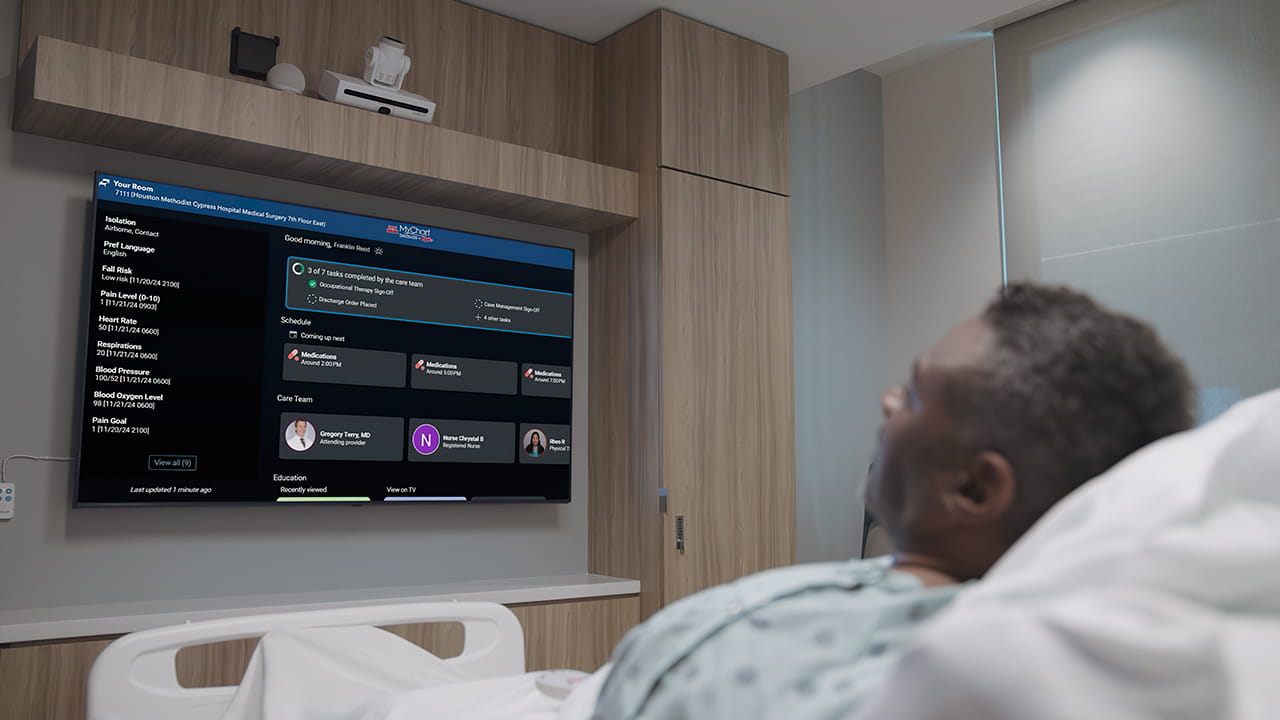
For patients, the benefits of this model can be both practical and immediate. Virtual access improves convenience, expands availability and reduces the disruption associated with travel, missed work or delayed appointments. Inside the hospital, technology-enabled care can feel less intrusive when patients understand its purpose: continuous support, earlier recognition of change and more coordinated response from the care team.
That makes communication essential.
Patients are more likely to embrace remote monitoring and virtual support when organizations clearly explain the “why” behind the tools — what is being measured, how the information is used and how the technology helps clinicians keep them safe, says Dr. Pletcher. Transparency can turn unfamiliar technology into “a visible extension of care” rather than a source of uncertainty, she notes.
Continuous data changes affect the response timeline
A major advantage of coordinated, technology-enabled care is the shift from periodic observation to continuous awareness. When remote monitoring tools collect data at a much higher frequency than traditional spot checks, organizations can identify concerning trends earlier. Algorithms and alerting workflows can then help teams intervene sooner, often when smaller corrective actions are still possible.
This is where the concept becomes especially relevant. Its promise is not only convenience or modernization, but a different operational posture: one that uses better data flow, centralized oversight and coordinated escalation to reduce delays, detect deterioration sooner and support more timely clinical decision-making.
A continuing evolution, not a one-time build
Ultimately, tech-enabled care delivery is best viewed as a strategic capability for modern health systems: a way to centralize visibility, connect virtual and physical operations and coordinate care across increasingly complex environments, says Dr. Pletcher. As organizations continue to evolve their command centers, monitoring tools, digital workflows and support models, the opportunity is not to build “one perfect system,” but to create a more intelligent, responsive and integrated approach to care delivery.