
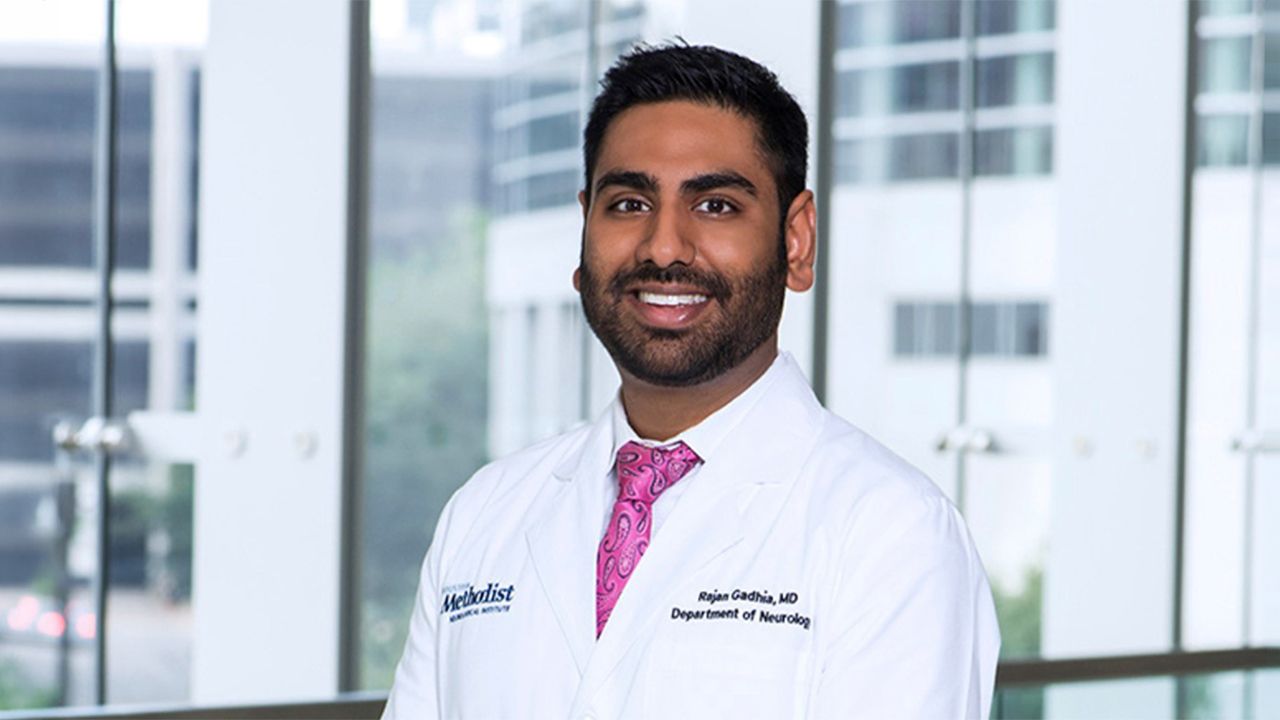

From Houston Methodist resident to trained vascular neurologist and fellowship program director, Dr. Rajan Gadhia shares his unique path to leadership.
When Dr. Rajan Gadhia arrived at Houston Methodist as a visiting medical student, he was still deciding where he wanted to complete his neurology residency. It did not take long for Houston Methodist to distinguish itself.
What struck him was not simply the clinical experience, but the investment faculty made in teaching — even for a student who did not yet belong to the program. During an away rotation, Dr. Gadhia participated in morning report with legendary department chair Dr. Stanley Appel; worked alongside veteran faculty leaders; and saw firsthand the attention physician instructors devoted to trainees.
“I was blown away by the level of priority residents were given in terms of teaching and learning,” Dr. Gadhia recalled. “I realized then and there that this was the place for me.”
Barely a decade later, Dr. Gadhia is helping provide the same opportunities to the next generation of trainees, serving as a vascular neurologist, faculty member and program director of the Houston Methodist Vascular Neurology Fellowship.
His path from trainee to teacher illustrates what can happen when an academic medical center gives young physicians not only rigorous training, but also the opportunity to help shape the programs where they work.
Finding his path in Houston
A Houston native who grew up in Sugar Land, Dr. Gadhia became interested in medicine as a teenager, eventually attending Texas Tech University and its medical school through a highly selective combined undergraduate-medical program.
He gravitated toward neurology early, fascinated by how much remained to be understood about the brain. During his clinical training, exposure to interventional neurology initially drew him toward procedural stroke care. But as a Houston Methodist resident, he realized he wanted something different: the ability to care for patients across the entire course of a stroke.
Vascular neurology offered that continuity.
“I enjoyed the fact that I could see patients all the way through the spectrum, from their arrival by ambulance through emergency care, the ICU, rehabilitation and eventually outpatient follow-up.”
By his second year of residency, Dr. Gadhia knew vascular neurology was where he belonged. There was just one complication: Houston Methodist did not yet have a vascular neurology fellowship.
Instead of simply looking elsewhere, Dr. Gadhia was invited to help build one.
Senior faculty enlisted the young resident to help prepare the application for an Accreditation Council for Graduate Medical Education-accredited fellowship. As Dr. Gadhia researched other programs, he also identified something he believed Houston Methodist's developing program needed: robust training in telestroke.
At the time, Houston Methodist did not have a systemwide telestroke service. Dr. Gadhia saw the technology as an important way to reduce geographic disparities in access to time-sensitive stroke expertise.
That realization helped determine his next step.
Leaving to bring something back
Dr. Gadhia's Houston Methodist mentors had enough confidence in him to offer him a faculty position even without additional fellowship training. He declined.
“I thought it was important to gain an outside perspective before trying to create a robust program here,” he said.
When Dr. Appel asked where the strongest place to learn telestroke would be, Dr. Gadhia pointed to Massachusetts General Hospital and Harvard Medical School, home to one of the field's pioneering telestroke networks.
The answer from his mentor was straightforward: “Alright, you have your answer. Go for it.”
Dr. Gadhia garnered a coveted spot at Harvard for his vascular neurology fellowship, but his departure from Houston Methodist was never intended to be permanent. Before he left, he had already signed a contract to return as a faculty member.
That made his fellowship more than another credential. Dr. Gadhia approached the year as an opportunity to figure out what he wanted to bring home. He studied telestroke technology and infrastructure, but also examined how programs functioned from the perspectives of patients and physicians, identifying pain points Houston Methodist could address when it built its own service.
The timing proved fortuitous. Houston Methodist Hospital The Woodlands was preparing to open just days before Dr. Gadhia finished his fellowship, creating an opportunity to use virtual neurology to extend specialized stroke expertise to the new campus.
The resulting telestroke program eventually expanded across Houston Methodist. By 2019, it was available at every hospital in the system, with some locations even receiving around-the-clock coverage.
Building the program he once envisioned
Meanwhile, the fellowship Dr. Gadhia had helped design as a resident had become a reality. Soon after he returned from Boston, he took over leadership of the vascular neurology fellowship program.
Dr. Gadhia believes his career trajectory reflects something unusual about Houston Methodist's academic culture: meaningful responsibility can begin well before someone has a faculty title.
“It’s unheard of, really, to have a resident be empowered enough to put together programs, even be part of the process of designing fellowships.”
Rajan Gadhia, MD
He credits faculty support with allowing him to contribute as a trainee, seek additional expertise elsewhere and then return with opportunities to lead early in his career.
Today, that experience shapes how he approaches education.
His philosophy begins with a deceptively simple principle: Fellows are there to learn. The program deliberately provides progressive responsibility rather than expecting fellows to function immediately as independent physicians filling a service need.
On telestroke calls, for example, new fellows initially observe faculty conducting assessments. They gradually take the lead while faculty remain present, eventually reaching the point where the attending physician can largely become a “fly on the wall.”
Dr. Gadhia also emphasizes exposure to the broader responsibilities of vascular neurology. Fellows participate in the clinical care of complex stroke patients, but they also learn about quality management, stroke center administration, research and the process of bringing new sites into a telestroke network.
The goal is not merely to graduate capable stroke neurologists. It is to prepare physicians who can build and lead programs of their own.
Completing the circle
The fellowship now trains two vascular neurology fellows each year, with plans for eventual growth. In recent years, Houston Methodist has recruited graduates of the fellowship back into the system — extending the cycle of training, retention and leadership that shaped his own career.
For Dr. Gadhia, academic excellence is ultimately not the product of any single physician or training program. It requires an institution willing to coordinate education, clinical care, research and leadership development.
“Fellowship programs don't happen in silos,” he said. “They happen with coordination, oversight, support and synergy. Luckily, we have all of that and more here.”