
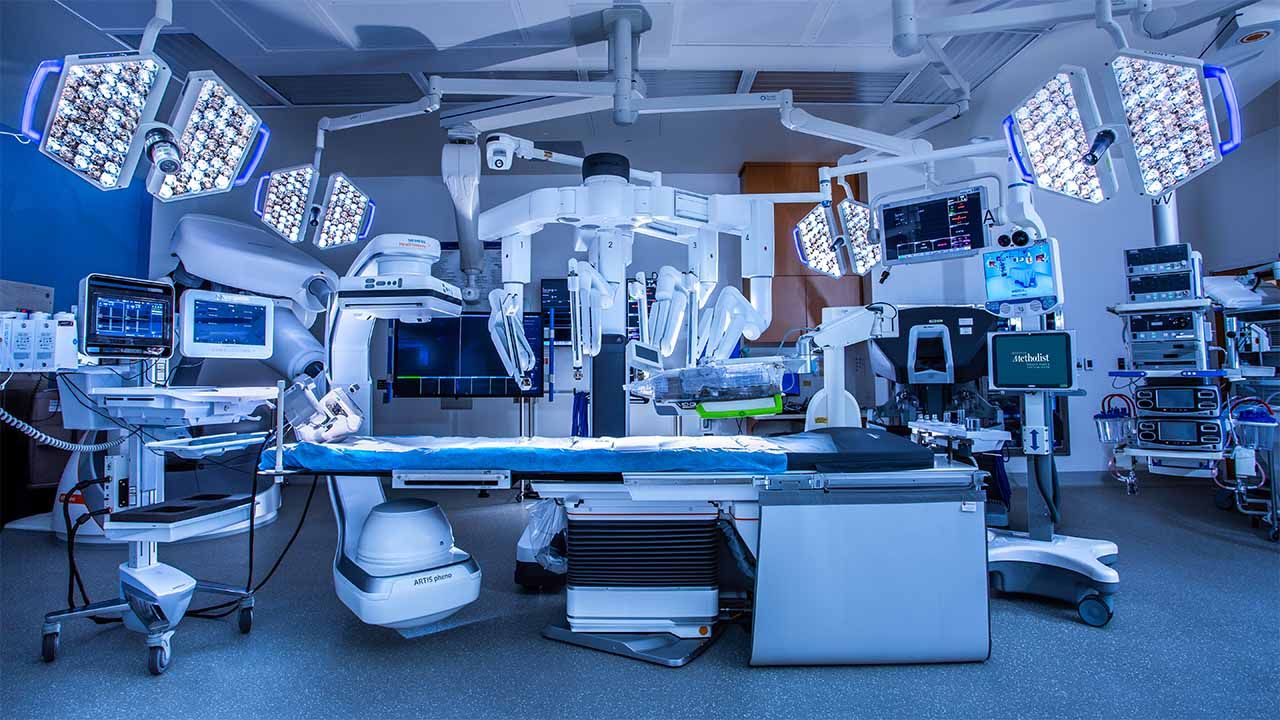

The Bookout Center for Innovation in Surgery is advancing Houston Methodist’s legacy of innovation through cutting-edge research, robotics, AI, spatial computing and global partnerships designed to transform the future of surgical care.
What began as a bold idea in a two-page proposal is rapidly becoming a centerpiece of innovation at Houston Methodist.
The Bookout Center builds on the Methodist Institute for Technology, Innovation & Education (MITIE)'s more than 20-year legacy, expanding its mission beyond surgical education and training to include research, technology development, engineering and global collaboration. The center officially launched in 2024 with philanthropic support from the Bookout family and now brings together experts in medicine, engineering and emerging technologies to accelerate the future of surgical care.
“We’re building on a strong foundation,” says Dr. Stuart Corr, Director of Innovation Engineering at The Bookout Center, who helped shape the center's vision. “MITIE created a world-class reputation in surgical education. The Bookout Center expands those capabilities and positions Houston Methodist to lead in the next generation of surgical innovation.”
A major milestone in the center’s growth has been recruiting new faculty leaders whose expertise spans robotics, artificial intelligence and spatial computing. Among them are Dr. Farshid Beigi, a specialist in surgical robotics and embodied surgical intelligence, and Dr. Robert LiKamWa, a professor whose work focuses on immersive technologies and spatial computing. Drs. Beigi and LiKamWa share appointments at Houston Methodist and Rice University.
Together, they are helping shape a vision that extends far beyond traditional research.
The Bookout Center’s work is organized around four pillars: research, innovation, translation and partnerships. Rather than focusing solely on scientific discovery, the center aims to move promising technologies into real-world clinical settings to improve patient care and surgical outcomes. Industry collaboration is also central to the strategy, creating opportunities to test, validate and scale innovations with partners across the U.S. and around the world.
One area generating excitement is spatial computing, which combines advanced imaging, virtual reality and immersive visualization technologies. Researchers are exploring ways to capture surgical procedures in three dimensions, allowing learners and clinicians to revisit operations from multiple perspectives, review complex cases and create new training experiences. These technologies could eventually support medical education, patient communication and care team collaboration on an unprecedented scale.
At the same time, robotics and artificial intelligence initiatives are focused on developing technologies that make surgery more intelligent, connected and efficient. The concept of “embodied surgical intelligence” brings together people, devices, sensors and software into a coordinated system designed to support better surgical decision-making and performance.
For Houston Methodist, the vision extends beyond new tools and technologies. Leaders describe the Bookout Center as a place where clinicians, engineers, scientists, educators and industry partners can work side by side to solve meaningful challenges in surgery.
Ultimately, the goal is to establish the center as a global destination for surgical innovation, attracting exceptional talent, industry partnerships and groundbreaking ideas.
“This is a new chapter for Houston Methodist,” Dr. Corr says. “We want to be the place where bold ideas are tested, validated and transformed into capabilities that advance medicine around the world.”