
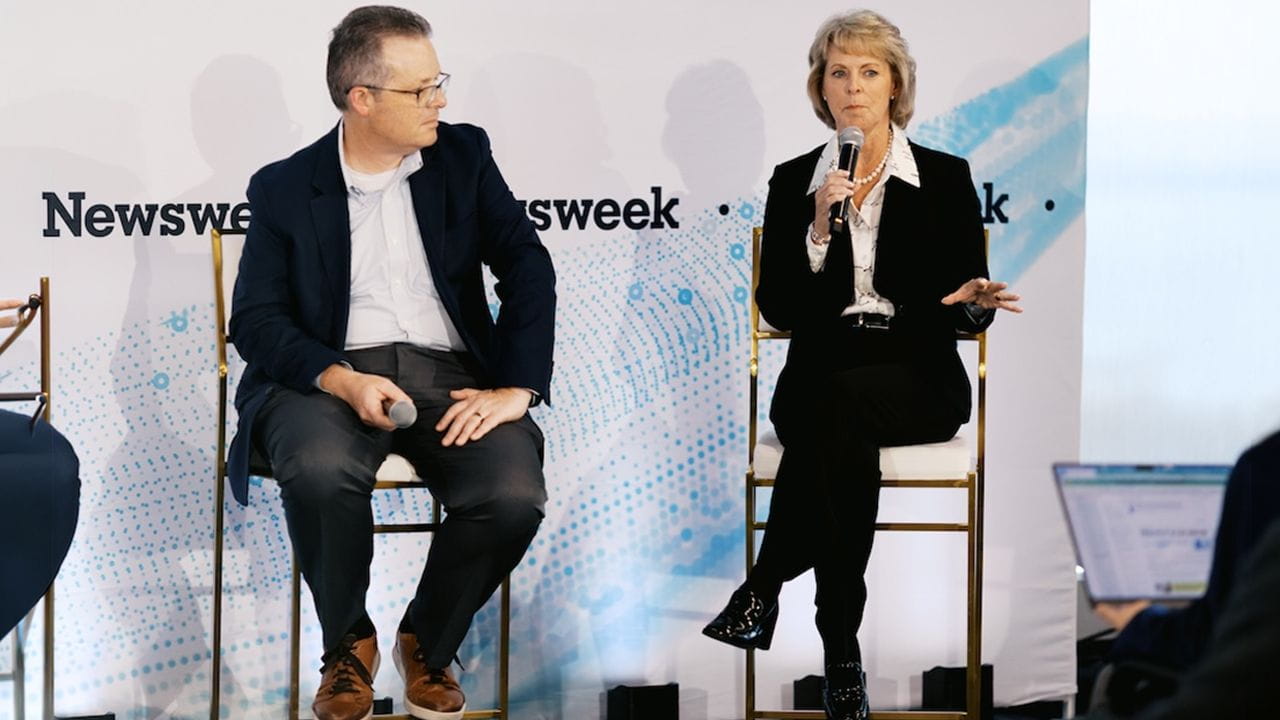

At the Newsweek summit, Houston Methodist leaders shared how healthcare organizations are moving beyond AI experimentation to focus on governance, workforce adoption, operational value and scalable implementation.
While much of the national conversation around artificial intelligence in healthcare remains focused on governance, adoption and early use cases, one theme emerged clearly from this year's Newsweek summit: Healthcare organizations are moving from asking whether to use AI to determining how to implement it responsibly and at scale.
Michelle Stansbury, associate chief innovation officer and vice president of IT applications at Houston Methodist, joined a panel discussion on healthcare innovation and AI, alongside executives from leading health systems, to discuss how organizations are approaching AI transformation. The discussions reinforced several trends Houston Methodist has already identified as critical to success.
Responsible AI remains the industry's top priority
Across panel discussions and conversations with healthcare leaders, governance emerged as a central theme. Organizations are focused on deploying AI technologies with appropriate oversight, clear accountability and safeguards to protect patients and operations.
"Everyone is asking, ‘How are we responsibly using AI in our environments, and how do we ensure the right guardrails are in place?’" says Stansbury.
As AI capabilities evolve, healthcare leaders are closely watching how new models are evaluated and introduced into clinical and operational workflows. Stansbury emphasized that governance must be an ongoing process, with continuous review of new tools and updates rather than a one-time approval.
Equally important is maintaining human oversight. Whether supporting clinicians, coders or operational teams, AI is being positioned as a tool that augments expertise rather than replaces it.
Agentic AI adoption is beginning on the business side
While AI remains a major focus across healthcare, discussions about agentic AI revealed a more cautious approach.
Many organizations are prioritizing business and operational applications before expanding autonomous technologies into clinical settings. Areas such as human resources, finance, supply chain management, scheduling, registration and prior authorizations are viewed as lower-risk opportunities where AI agents can deliver measurable value today.
"I think there's so much opportunity on the business side of the house first. When you start to get into the clinical side, organizations are being much more thoughtful about identifying the right use cases."
Michelle Stansbury, associate chief innovation officer and vice president of IT applications
This perspective closely aligns with Houston Methodist's strategy, which focuses on solving operational challenges while carefully evaluating future clinical applications.
AI is accelerating research and discovery
One area generating significant enthusiasm across industries is AI's potential to accelerate research.
Organizations that once spent months evaluating large datasets now use AI to uncover insights in a fraction of the time. While clinical studies and validation remain essential, AI helps researchers move faster through the early stages of discovery and analysis.
The result is faster access to information and greater efficiency in pinpointing promising areas for further investigation.
Why scaling matters
Beyond individual technologies, the summit highlighted a challenge many healthcare organizations still face — moving innovations beyond pilot programs.
According to Stansbury, successful innovation requires strong alignment among operational leaders, IT teams and executive leadership. At Houston Methodist, innovation initiatives are built around solving specific problems and are developed in close partnership with the teams responsible for implementation.
"Operations and IT are at the table together," she says. "We're trying to determine how to make these solutions happen and how to do so as quickly as possible."
That collaborative approach helps accelerate adoption while ensuring technologies address real clinical, operational or workforce needs.
Educating the workforce for the next phase of AI
As AI capabilities mature, many healthcare organizations are turning their attention to workforce education.
Leaders at the summit discussed the importance of helping employees understand where AI can create value, how to use it responsibly, and how teams can identify meaningful use cases within their own areas.
For Houston Methodist, that means continuing to engage business leaders across functions such as finance, HR and supply chain while building organizational readiness for the next generation of AI-enabled tools.
Looking ahead
The summit underscored that healthcare's AI journey is entering a new phase. Conversations are shifting from experimentation to governance, workforce adoption, operational transformation and scalable implementation.
For Houston Methodist, those discussions reinforced an ongoing strategy of deploying technologies that solve meaningful problems, maintaining strong governance and partnering closely with operational leaders to ensure innovations deliver measurable value for patients, clinicians and the organization as a whole.
Rather than chasing technology for technology's sake, the focus remains on using AI to improve care delivery, enhance workforce efficiency and support the future of healthcare.