
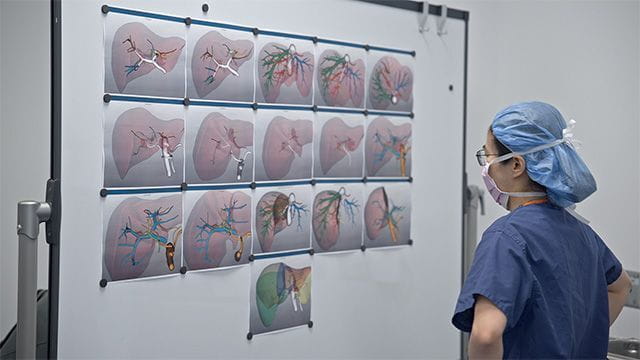

Robotic split liver surgery may reduce pain, shorten hospital stays and support faster recovery for living donors.
Article Highlights
- Houston Methodist’s robotic split liver surgery program uses minimally invasive techniques to reduce pain, shorten hospital stays and accelerate recovery for living liver donors.
- The program combines the expertise of Dr. Yee Lee Cheah and Dr. Caroline Simon to optimize donor graft preparation and recipient matching.
- Extensive robotic workflow development and staff training enabled the team to successfully transition complex liver transplant procedures to a robotic platform.
- Houston Methodist has completed more than a dozen robotic donor-recipient liver transplant pairs, a milestone achieved by only a handful of centers nationwide.
- Liver transplant survival rates remain above national averages despite a high-acuity case mix, supporting the program’s ability to expand access while maintaining strong outcomes.
Houston Methodist has launched a robotic split liver surgery program that's expanding transplant options for patients while improving recovery and outcomes for living donors. The innovative program, led by Dr. Yee Lee Cheah and Dr. Caroline Simon, combines decades of surgical expertise with cutting-edge robotic technology to perform complex procedures through smaller incisions and with greater precision.
"Living donors are a very special group of people because they are giving half their liver, taking on risks and sacrificing a lot to save someone's life," said Dr. Cheah, director of the Robotic Living Donor Liver Transplant Program. "It's our responsibility to reduce their discomfort and risk wherever possible — and robotic surgery allows us to do that."
By minimizing the number and size of incisions, robotic split liver surgery offers living donors a shorter hospital stay, less pain and a faster recovery. These advantages are critical in encouraging more individuals to consider becoming living donors — a key factor in expanding the liver transplant donor pool at a time when demand continues to rise.
“Our results show that patients truly benefit from this approach. We're not just matching organs — we're improving lives.”
Dr. Caroline Simon
Dr. Cheah and Dr. Simon, both recruited to Houston Methodist to advance the transplant and hepatobiliary programs, bring a long-standing partnership to the operating room. The pair has worked together for more than a decade, with Dr. Cheah performing donor surgeries and Dr. Simon handling recipient transplants.
"That close working relationship allows for seamless communication," said Dr. Simon. "I know exactly the types of liver grafts Dr. Cheah will prepare, and I can match those to recipients with precision. That makes all the difference for outcomes."
Before launching the program, the team spent months building the necessary infrastructure, including converting liver and pancreas resections to robotic techniques to train staff and refine their workflow. The Houston Methodist team has now completed more than a dozen robotic donor-recipient liver transplant pairs, a milestone reached by only a handful of institutions nationwide.
With survival rates exceeding both 90% at one year and 70% at five years, the hospital's liver transplant outcomes remain above national averages, despite taking on some of the most complex cases.
"More and more people are coming in and asking if we can do this robotically," Dr. Cheah added. "And I hope that trend continues, because you can't have living donation without a donor."